Studying Study of a Sicilian Peasant
Sophia Jaffer learns the art of portraiture from John Singer Sargent’s portrait in the Fitzwilliam Museum
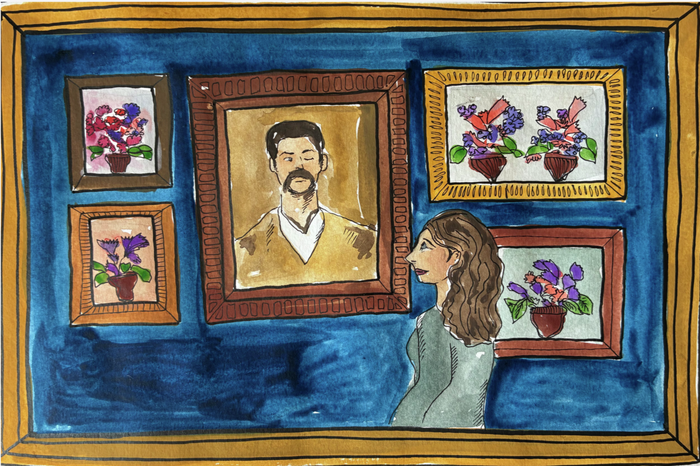
Tucked away in the upper gallery of the Fitzwilliam is an inconspicuous little portrait titled Study of a Sicilian Peasant by John Singer Sargent. Painted in 1907, it is a break from the artist’s usual preoccupation with society’s elite – described by Sargent himself as “rather a study than a picture”.
What does it mean for a piece of art to capture you? I visited the Fitzwilliam the second time I set foot in Cambridge, wiling away some spare hours before a house viewing. I did not expect to acquire a favourite painting during this foray. But it is hard to predict when a piece of art will reach out and grip your heart in its fist.
“The entire nature of the portrait, the meaning and soul, spirals out from these oft-considered “windows to the soul” like layers of a spider’s web”
So, what makes a good portrait? Is it technical skill? Likeness? Essence? Study of a Sicilian Peasant possesses Sargent’s usual technical proficiency, although it is hard to measure likeness when its subject is an individual lost to history. Perhaps it is the subject’s anonymity that makes the portrait so captivating. When I first saw it, I was struck with its inherent beauty and softness, the dignity and respect dedicated to an ‘ordinary’ peasant amongst the privileged and elite of society. The sitter’s shirt dissolves into rough brushstrokes, the background is minimal, but in the deep shadows of his face, there is a palpable emotion and vividness to his features. The light in his eyes gives a quality of ‘aliveness’ a sense of movement and liminality that allows the viewer to imagine the bracket of the scene. This is a man who has walked up to the painting, and who, when it is over, will walk away again.
I paint portraits myself. This quality is one that I think many artists chase, and few attain. To paint a person is a particular type of intimacy. There are the artistic rules that one must always follow: anatomy, tonal mapping, light and shadow. But you can follow these rules dogmatically and still fail to capture a person at all. Perhaps that is why I am always so averse to painting my friends or family. What if I fail to capture their likeness? Even worse, what if the painting offends them? The last significant portrait I painted was a self-portrait, a little rough around the edges, the same unpolished quality we can see in Sargent’s Study. I always start at the eyes, even though it’s usually advisable to layer colour and depth evenly across the face. The entire nature of the portrait, the meaning and soul, spirals out from these oft-considered “windows to the soul” like layers of a spider’s web.
“Sargent succeeds in the difficult task of capturing essence, ‘aliveness’, emotion and meaning through the eyes”
It seems that Sargent has the same idea. His peasant is looking out of frame, dashes of light reflecting across the irises and under the waterline, struck with an undefinable emotion. Is that duty? Pride? Yearning? We must remember that there is a dialogue here. We are seeing Sargent as much as we are seeing the peasant. All art is an interpretation. In the case of Study of a Sicilian Peasant, we may draw connections between the tenderness of the portrayal and speculations around Sargent’s sexuality. Or, we consider the act of portraiture as a simple exchange of humanity. Certainly, what makes this artwork so compelling for me is how immediately its humanity jumps out at you. Sargent succeeds in the difficult task of capturing essence, ‘aliveness’, emotion and meaning through the eyes.
I am not a champion of hyperrealism. I think the technical skill is admirable, the discipline enviable, but all my favourite paintings are ones that see the world in a way the lens of a camera cannot. Sargent gets the perfect balance of light and shadow, the depth is rich and realistic, there is a definite sense of space and movement. The fact that it is “rather a study than a picture,” created more for practice or artistic learning, lends it the charm and fluidity that brings it to life.
Do I have one-size-fits-all advice for painting good portraits? Certainly not. I could say start on the eyes, make sure to capture the way the sun battles with the pupils. I could say paint with an agenda, pin down a purpose and a vision. I could say “know your subject,” “see more than their nose and cheeks and hair and look deeper,” “consider their personality,” “sketch out their soul”. It is a well-known fact that good writers are good readers. I can only offer the same advice: that to paint good portraits you must feel the same emotions as you do when you view good portraits. Sargent’s Study of a Sicilian Peasant taught me that to make good art, you need to love good art.
 Comment / Top of the slops: the competitiveness of college dining4 June 2026
 Comment / The Cambridge drift1 June 2026
 News / Cambridge psychologist warns against blanket social media ban for under-16s1 June 2026
 News / University support staff strikes end after month of action2 June 2026
 Music / We need to talk about Kendrick2 June 2026
 Lifestyle / ‘Using me for sets’: navigating the politics of the room ballot5 June 2026
 Arts / Studying Study of a Sicilian Peasant5 June 2026
- Comment / Top of the slops: the competitiveness of college dining4 June 2026
 Interviews / Bible Scholar Mattie Mae Motl: “God is a woman”4 June 2026
 Features / One big happy (college) family?4 June 2026