
Commercial Feature
How to Choose the Best Bale Stacker for Your Farm
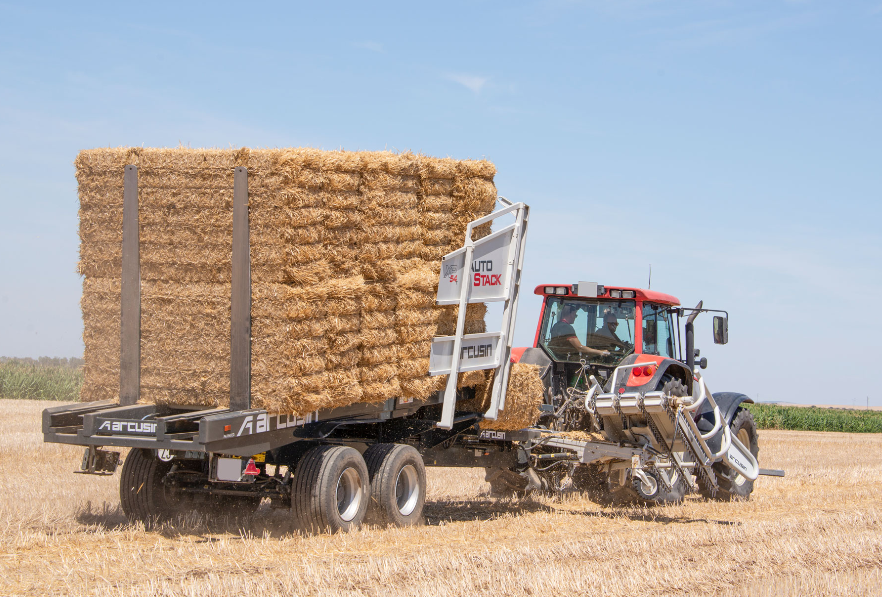
The right bale stacker can save you hours every harvest day. The wrong one can slow the whole operation down. Here is everything you need to know before you buy.
What Is a Bale Stacker, and Do You Actually Need One?
Harvest windows are short. Every minute a bale sits in the field unattended is a minute of risk: weather, moisture, and wasted labour.
A bale stacker is a piece of farm equipment that collects individual bales directly from the field, building large transport-ready or storage-ready stacks, often eight to twelve bales high, and moves them out of the field in a single efficient pass. The core benefit is simple: instead of making dozens of individual pick-up runs with a loader, one operator can clear an entire field systematically, cutting your field clearance time by a significant margin.
For small operations baling fewer than 500 bales a week, manual handling may still be viable. But for anyone running at commercial scale, delivering hay commercially, or managing large fields with tight weather windows, a bale stacker is no longer a luxury. It is a productivity multiplier.
The technology has matured considerably over the past decade. Modern stackers offer hydraulic suspension systems, compatibility with different bale sizes, independent wheel control, and in-cab digital monitoring, features that were unheard of on previous generations of equipment.
Types of Bale Stackers: Understanding the Difference
High-Capacity Field Stackers (e.g., AutoStack FSX)
These machines are designed for contractors and large commercial operations that need to move large volumes of bales over long distances from the field. They feature extensible platforms (up to 16 bales), stack heights of up to 8 bales high, and independent hydraulic suspension on each wheel to maximise stability and reduce the risk of overturn. They require approximately 140 hp and are built for high-throughput use.
Mid-Range Field Stackers (e.g., AutoStack XP)
Designed for large-scale farmers who unload at the edge of the field rather than transporting bales long distances, these machines are specifically built for irrigated, muddy, and soft ground conditions, where they minimise terrain damage. They typically carry 12 bales to a height of 6 bales high, require around 120 hp, and use a tandem suspension with self-steering rear axle for manoeuvrability.
Key Features to Evaluate Before You Buy
Working Speed and Throughput: Can it keep pace with your balers? Bottlenecks here defeat the entire purpose.
Bale Size Compatibility: Some stackers are engineered for a specific bale tie pattern or length. Compatibility across all square bale sizes is a key differentiator.
Terrain Performance: Rolling, soft, or irrigated ground punishes poorly designed stackers. Look for wide-stance frames, low centre of gravity, and lateral stability systems.
Stack Height: Higher stacks mean fewer passes and faster field clearance, but they also demand greater machine stability.
Loading Capacity: Extensible platform designs allow for two loading configurations on the same machine, adding operational flexibility.
Required Tractor HP: Match your existing tractor fleet to the machine’s power requirements before purchase.
Operator Safety: Independent hydraulic suspension, stability systems, and clear sightlines from the cab all reduce risk during the stacking cycle.
Bale Stacker Brand Comparison
The table below summarises the most widely discussed options in the current UK market.
| Brand / Model | Best For | Bale Capacity | Stack Height | Terrain | HP Required |
| Arcusin AutoStack FSX (Editor’s Pick) | Contractors, large commercial ops | 14–16 bales | 8 high | All terrain, independent wheel suspension | 140 hp |
| Arcusin AutoStack XP | Large farms, soft/muddy fields | 12 bales | 6 high | Soft/irrigated fields, tandem suspension | 120 hp |
| Prostack / conventional alternatives | Smaller scale, simpler setup | Varies | Varies | Flat preferred | Varies |
Arcusin AutoStack: A Closer Look
About Arcusin 50 Years of Bale Handling Innovation
Arcusin is a Spanish agricultural machinery manufacturer founded in 1976 by the Cusiné family in Catalunya. What began with the family trading mules has evolved into one of the most recognised names in specialist bale handling equipment globally. The company’s product range spans bale stackers, accumulators, bundlers, and handlers, all engineered with the same focus: reducing manual labour and maximising in-field logistics for forage farmers.
Now celebrating its 50th anniversary under the leadership of third-generation CEO Blanca Cusiné, Arcusin continues to invest heavily in R&D and exhibits at Agritechnica alongside names like Krone and Pöttinger.
Arcusin in the UK: UK and Ireland buyers are served by Arcusin UK Ltd, the official UK and Ireland importer and distributor for Arcusin machinery, based in Oxton, Nottinghamshire. With over a decade of experience representing the brand in these markets, Arcusin UK offers machine sales (new and used), full service backup, and spare parts supply for all Arcusin machines. More information is available at Arcusin.
AutoStack FSX — Technical Highlights
Recommended for contractors and large commercial operations that need to move large volumes of bales at distance. Key specifications:
- Extensible platform with two loading capacities: 14 bales (6.3 m) or 16 bales (7.2 m)
- Stack height: 8 bales high (standard 90×120 / 3×4 bales)
- Independent hydraulic suspension on each wheel, maximising stability and reducing overturn risk
- Optional steer axle
- Required power: 140 hp
AutoStack XP — Technical Highlights
Designed specifically for soft, muddy, and irrigated fields where terrain protection matters. Ideal when unloading at the field edge rather than transporting over long distances. Key specifications:
- Single loading capacity: 12 bales (5.4 m)
- Stack height: 6 bales high (standard 90×120 / 3×4 bales)
- Tandem suspension with self-steering rear axle
- Required power: 120 hp
“A well-chosen bale stacker does not just reduce labour hours. It reshapes the entire harvest logistics workflow. Fewer passes, more predictable loading points, and faster truck turnaround all compound into measurable improvements in overall profitability per tonne of hay.”
Your Pre-Purchase Checklist
Before committing to any stacker, run through these questions for your specific operation:
- What bale type do you primarily produce? Check compatibility with your bale dimensions before anything else.
- How far do bales need to travel from field to storage? Long distances favour the FSX; field-edge unloading suits the XP.
- What is your terrain like? Soft or muddy ground points squarely toward the AutoStack XP. Mixed or firm terrain suits the FSX.
- What tractor HP is available? The FSX requires 140 hp; the XP works from 120 hp.
- How much volume do you handle per season? Contractors and high-volume operations will recoup the FSX investment fastest.
- Do you sell hay directly to buyers? Clean, consistent bale stacks matter for truck loading efficiency and buyer presentation.
- What after-sales support is available locally? Arcusin UK Ltd in Nottinghamshire provides full service backup and parts for the entire UK and Ireland. Verify dealer proximity before purchase; this matters as much as any spec sheet.
Frequently Asked Questions
What is the difference between a bale stacker and a bale accumulator? A bale accumulator collects and groups bales in the field as they exit the baler, depositing organised clusters for later collection. A bale stacker goes further, picking up those groups and building a large, transport-ready or storage-ready stack, often eight to twelve bales high. They serve sequential roles in the harvest chain: accumulate first, stack second. Some operations use only a stacker and skip the intermediate accumulation step entirely, clearing the field in a single pass.
How much labour cost can a bale stacker save? One-operator use is the defining advantage. A well-specified bale stacker allows a single operator to clear a field that would otherwise require two to three people working with a loader and trailers. For large commercial operations, this translates directly into reduced headcount during harvest and faster field turnaround.
Which AutoStack model is right for my farm? The FSX is built for volume and distance: contractors and large commercial operations moving bales across significant distances from the field. The XP is built for terrain sensitivity: large farms where fields are soft, irrigated, or muddy, and where unloading happens at the field edge. Both are available through Arcusin UK Ltd.
What size tractor do I need? The AutoStack FSX requires approximately 140 hp. The AutoStack XP works from approximately 120 hp. If your fleet skews below these figures, discuss options with your dealer before purchase.
Is Arcusin well supported in the UK? Yes. Arcusin UK Ltd, based in Oxton, Nottinghamshire, is the sole official UK and Ireland importer and distributor for Arcusin machinery. They stock new and used machines, provide full service backup, and supply spare parts for the entire Arcusin range. You can reach them at arcusin.com or by phone on 07790 989024.
Can a bale stacker handle bales of different sizes? The AutoStack range is designed to handle all standard large square bale sizes. Confirm specific bale dimensions with your dealer to ensure compatibility before purchase.
Final Recommendations
There is no single ‘best’ bale stacker, only the best stacker for your operation.
If you are a contractor or large commercial operation moving significant volumes of bales over distance, the Arcusin AutoStack FSX is the standout choice. Its extensible platform, 8-high stacking capacity, and independent hydraulic suspension on each wheel make it the most capable large-square-bale stacker available in the UK market today.
If your fields are soft, irrigated, or prone to waterlogging, and you unload at the field edge, the Arcusin AutoStack XP is purpose-built for your conditions. Its tandem suspension and terrain-friendly design minimise ground damage without compromising throughput.
Whatever you choose, prioritise your dealer relationship almost as much as the machine itself. In the UK and Ireland, Arcusin UK Ltd in Nottinghamshire is your direct point of contact for sales, service, and parts. The best stacker with poor local support will cost you more in downtime than a slightly less optimal machine with an excellent dealer who can get a part to your farm within 24 hours.
 News / Simon Goldhill resigns following sexual misconduct investigation16 June 2026
 Comment / Exercise, academia, and the Cambridge addiction to both17 June 2026
 Theatre / ‘Mental illness doesn’t exist in a vacuum’ says Obsessive, Compulsive, Divine 18 June 2026
 News / Ted Yip elected Union President after contested race 19 June 2026
 Lifestyle / You can’t always get what you want 18 June 2026
 Fashion / The trials and tribulations of sewing your own wardrobe19 June 2026
 Science / Science can tell us right from wrong19 June 2026
- News / Ted Yip elected Union President after contested race 19 June 2026
- Lifestyle / You can’t always get what you want 18 June 2026
- Theatre / ‘Mental illness doesn’t exist in a vacuum’ says Obsessive, Compulsive, Divine 18 June 2026
