University support staff strikes end after month of action
The SU voted to support the strike action, stating that ‘staff working conditions are student learning conditions’
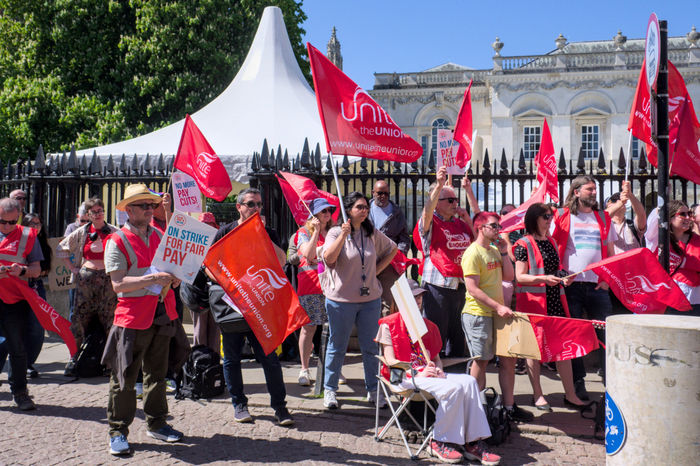
More than a month of strike action by University support staff has come to an end, following an escalation of industrial action throughout May.
The strikes, allegedly involving more than 500 university staff, were held in support of the introduction of a ‘Cambridge weighting’ pay supplement to help offset the city’s high cost of living.
Most recently, staff engaged in strike action throughout mid- to late May, which the Unite union warned would “cause significantly more disruption” than previous strikes.
The industrial action came in response to the University and Colleges Employers’ Association’s offer of a below inflation pay rise of 1.4%, as well as concerns over the University’s “wage spine,” which has compressed salaries at lower pay grades.
The workers – including library, museum, estates management, finance, student services, and IT staff – had previously participated in strike action on 21, 22, and 30 April and 1 May. The action resulted in the full or partial closures of the Fitzwilliam Museum, Whipple Museum, Scott Polar Museum, Zoology Museum, Haddon Library, and the Architecture and Art History Library. Finalist judging for the Fitzwilliam Museum, which was shortlisted for Museum of the Year in April, was also postponed due to the latest round of strike action.
Unite has claimed that below inflation levels of pay have led to some staff members commuting for miles to get to work and using food banks. The union has also emphasised that the University of Oxford introduced a pay supplement of £1,500 in 2024, which was increased by 15% in 2025.
A motion calling for Cambridge’s Students’ Union (SU) to support the Easter Unite strikes, proposed by the Cambridge Marxist Society, was passed at a Student Council meeting on 18 May. The Council also agreed to circulate information about union-organised picket lines and future rallies in support of striking workers via the university-wide email, in an effort to “drum up even higher student turnout”.
The Council said it believes students should support the striking workers, “as it is only with the support of these workers that the University can function day-to-day”.
It added: “When students are being squeezed by the cost of living, departments aren’t receiving the funding possible and being threatened with closure, and workers cry out for more money to support their ability to work in Cambridge, the question must be asked as to where the money is going in the University.”
The Council also noted: “If Unite and other unions could point to the student body of Cambridge being on their side, it would be a large boon for the unions at the negotiating table.”
On 21 May, the SU released a statement on its website in support of strike action, claiming that “staff working conditions are student learning conditions,” and describing it as “unsustainable and unfair” that staff are finding it increasingly difficult to live in Cambridge.
The statement continued: “The Student Council at the SU has consistently voted to support strikes, fair pay, and safe working conditions, reaffirming this position most recently on 18th May. And this goes both ways. When the Vet School was threatened, Unite representatives worked tirelessly alongside students to save it, including organising the rallies and providing the all-important megaphones. We must continue to stand alongside Unite through their campaigns, and we’d encourage all students to support Unite at their pickets.”
The SU added: “We strongly believe students should avoid crossing picket lines wherever possible, including by choosing to work in alternative libraries and study spaces during this week.” However, it clarified this did not include students attending exams or accessing student support services.
It also warned that all morning exams scheduled between 26 to 29 May at New Museums and Downing sites were “highly likely” to be picketed, affecting a total of 24 exams.
A University spokesperson told Varsity: “We understand the challenges around cost of living, and have introduced several measures in response, including a supplement of 2.5% of basic pay for employees on lower pay grades, raising the minimum starting salary for research assistants and increasing paid family leave.
“While we regret the industrial action is taking place, we remain committed to open and constructive dialogue with Unite around pay and other issues.”
Staff at Addenbrooke’s Hospital, the primary teaching hospital for the University’s medical students, also held a rally on Wednesday (27/05), calling for an NHS high cost area supplement (HCAS).
Like University service staff, staff at Addenbrooke’s receive no pay supplement for working in Cambridge, despite NHS workers in London and Oxford benefiting from pay weighting.
A CUH spokesperson said: “We recognise the cost of living in Cambridge is a significant concern and as a Trust we are working with staff to help support them. This includes measures such as subsidised car parking, free public transport options to the hospital site, financial wellbeing advice and support, as well as a scheme that allows staff to access part of their monthly earnings early to help ease the pressure.”
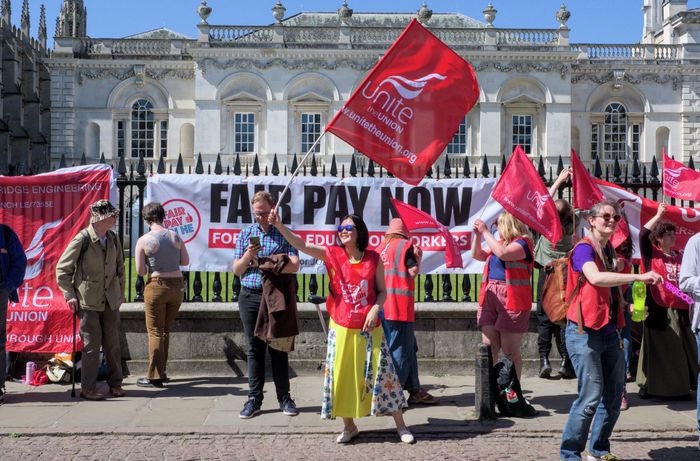
Unite has launched a petition demanding HCAS for workers in Cambridge, which has received over 2,300 signatures. An additional petition calling on the University to introduce a weighted pay supplement has received over 900 responses to date.
Chris Hardwick, Unite’s regional officer, said: “Cambridge University bears full responsibility for the disruption facing students and members of the public. It can clearly afford to provide Cambridge weighting and ease the intense cost of living strain affecting its staff but is refusing to do so out of sheer greed.
“This dispute will keep escalating until the university follows Oxford’s lead and introduces additional support for its dedicated and hardworking employees.”
 News / Simon Goldhill resigns following sexual misconduct investigation16 June 2026
 News / News in Brief: Pokémon, planting, and the plague21 June 2026
 News / Join Varsity’s editorial team this Michaelmas22 June 2026
 Lifestyle / Not a pub, not a club: Cambridge nightlife’s best third spaces22 June 2026
 Comment / How do we find exambiguity?22 June 2026
 Music / Liverpool vs Manchester: the musical derby23 June 2026
- Lifestyle / Not a pub, not a club: Cambridge nightlife’s best third spaces22 June 2026
 Fashion / Academic prestige or aesthetic appeal?22 June 2026
 Sport / Martina Abels Marti leads Newbroke to Cuppers victory against SJK amidst transgender ruling controversy22 June 2026
- Comment / How do we find exambiguity?22 June 2026