The Cambridge drift
Jasper Finlay Burnside comments on the logistical nightmare of walking in Cambridge, and what it reflects about the wider institution

In Cambridge, they say you are always looking for one of three things: a book, a job, or a significant other. Personally, I’d settle for finding someone who is looking up. Each foray into the city centre feels like a veritable execution of my sanity. We are surrounded by some of the finest minds in the world, yet the student body seems collectively incapable of walking in a straight line. Instead, we have the ‘Cambridge drift’: a catastrophic zig-zag executed with the reliable grace of a confused pigeon. Too many of us live in a digital world of one, oblivious to the human barricades we form on King’s Parade. It is time to restore the social contract and return to a functional pedestrian society.
Consider for a moment King’s Parade, a stretch of cobblestone that should be a jewel of our civic crown, but has instead been relegated to a logistical nightmare. Here, the collision between the urban planning of centuries past and contemporary spatial ignorance of the highest order occurs. The town’s capillaries were designed with horse-drawn carts in mind, yet today they are overwhelmed by pedestrians who believe they are on an infinite, frictionless plane. To attempt to go from one side of town to the other at any time besides midnight is to engage in a physical activity that requires such complete agility and strategic thought as to make Sun Tzu appear simplistic.
“When someone deigns to zig and zag across a crowded street, they make a quiet but plodding philosophical statement”
To understand this drift, we must first stratify its primary practitioners. First, there are the digital solipsists. These representatives operate within a highly insulated world of their own imagination, shielded off from reality by their noise-cancelling headphones and the seductive illumination of a phone screen. They float more than walk down the streets, wholly oblivious to the fact that their sudden, completely unannounced decision to stop and check a notification has caused a five-person pile-up behind them. They are a pausing hazard, operating under the assumption that the rest of the world would simply stop around them.
Second, we must confront the thoughtful saunterer. They so often think lofty thoughts, burdened by the weight of the intellectual tradition which is supposedly meant to be passed down to us. They wander the pavement veering from one side to the other, eyes fixed on some invisible point or wisdom in the middle distance, presumably pondering Kantian ethics while ignoring that the true categorical imperative is to observe basic walking etiquette.
“It is a micro-tyranny of the ego that is enacted upon the cobbles”
Finally and most infamously, the tourist phalanx. Operating in a tightly knit, impenetrable wall five abreast, they move with all the speed and gentleness of a glacier and the unpredictability of a flock of starlings at the height of their migration. They halt dead in their tracks, without warning or signal, to photograph a completely normal brick formation, turning a thoroughfare into an instant, immovable human blockade.
The drift is the manifestation of a broader, and considerably more insidious cultural languor, the retreat into an atomised, splintered, hyper-individualistic narcissism. When someone deigns to zig and zag across a crowded street, they make a quiet but plodding philosophical statement. They declare, at their immediate whim, their right to wander aimlessly or drift toward a shop window without looking behind them; this supposed right supersedes the community’s collective ability to get where they are going. It is a micro-tyranny of the ego that is enacted upon the cobbles. We have become an assembly of people occupying the same geographic space, joined in our utter lack of civic consciousness.
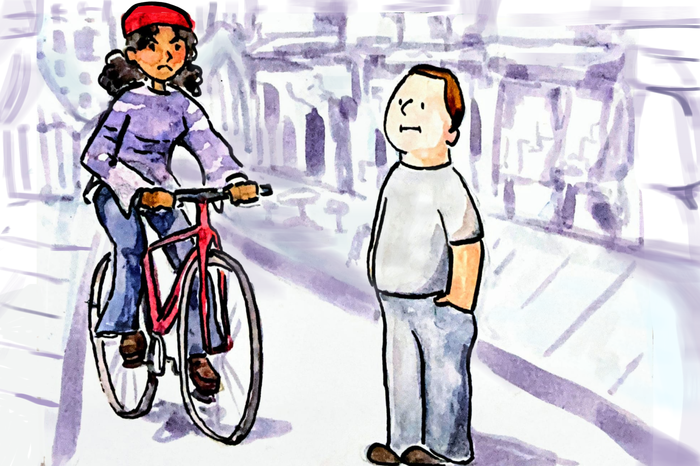
We must demand a restoration of the pedestrian society. If we are to truly claim the title of the world’s finest minds, let us demonstrate it not just in our collection of Nobel prizes and our endeavour for humanity, but in our basic motor functions. It requires no great leap of intellect to check one’s periphery before changing direction; it requires no profound sagacity to walk two-abreast rather than blocking the whole street. Let us together banish the aimless drift and return to the straight line. If you need to contemplate the mysteries of the universe, do it over a desk or some hallowed college ground. But before you take your first steps on our streets, look ahead. The future of our collective sanity depends on it, and more importantly, I have better things to do than spend my afternoons dodging drunken pigeons on the street.
 News / Simon Goldhill resigns following sexual misconduct investigation16 June 2026
 News / News in Brief: Pokémon, planting, and the plague21 June 2026
 News / Join Varsity’s editorial team this Michaelmas22 June 2026
 Lifestyle / Not a pub, not a club: Cambridge nightlife’s best third spaces22 June 2026
 Comment / How do we find exambiguity?22 June 2026
 Music / Liverpool vs Manchester: the musical derby23 June 2026
- Lifestyle / Not a pub, not a club: Cambridge nightlife’s best third spaces22 June 2026
 Fashion / Academic prestige or aesthetic appeal?22 June 2026
 Sport / Martina Abels Marti leads Newbroke to Cuppers victory against SJK amidst transgender ruling controversy22 June 2026
- Comment / How do we find exambiguity?22 June 2026