Send in the clown costumes
Daisy Simpson takes a look at the styling of Twelfth Night‘s clown, Feste, and what this can teach us about costume design choices
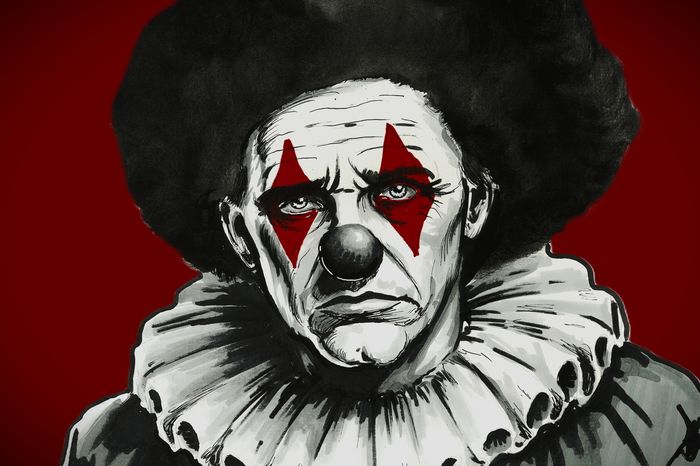
Prasanna Puwanarajah’s adaptation of Twelfth Night, which I enjoyed at the Barbican Theatre three months ago, had a tremendous deal to recommend it; skilfully interpolated music, perfectly pitched comedic performances, and set design that managed to be eye-catching without being gimmicky. But one styling choice in particular grabbed my attention, and that was the presentation of Feste as a melancholy echo of a traditional harlequin or clown.
“Comedy and tragedy are yin and yang; and painting Feste as ‘the sad clown’ rather than the happily frolicking one was a brilliant way to show this”
Michael Grady-Hall’s look, at first glance, appeared to be fairly conventional. He wore a suitably rumpled brown jacket over a white shirt and blue trousers, simultaneously conveying ordinariness and the slightly off-kilter kookiness of a professional jokester. But take a closer look at production stills; his face is lightly dusted with white paint, as though he’s wandered into a French-period-piece bakery at the wrong moment, and his hair has a distinctly Eraserhead-esque, electrocuted quality.
This was not a production featuring particularly outlandish or unrealistic design elements, so this decision stood out to me. It heightened his performance’s pensive, hallucinatory inflection by giving him the feel of an old-fashioned Pierrot, innocently displaying grimaces and not-so-blank stares for the whole world to see. Although other elements of the production also possessed visually intriguing details, I kept being drawn back to this one, mostly because of its vintage quality and its sense of having been carried over from another time and place.
“Costume choices in Cambridge student productions can be somewhat hit and miss”
There were certainly reminiscent or nostalgic elements to Grady-Hall’s Pierrot look; as the Museum of the American Arts & Crafts Movement reminds us, the character or archetype originated with Commedia dell’Arte’s Pedrolino in the 1700s, and was recognisable due to his “powdered face,” “neck ruff” and “mischief”. But here, the powder was applied in intermittent patches as though Feste had participated in a rugby scrum before arriving at the Court of Duke Orsino. The neck decoration idea was redefined by the reintroduction of Feste in a honeybee-like enclosure of ruffles later on; and his mischief was concealed behind a layer of contemplative ennui. This version of Twelfth Night retained the historical Pierrot elements, while also incorporating some entertaining touches for the sake of the distinctly modern angst pervading the whole production. Comedy and tragedy are yin and yang; and painting Feste as the ‘sad clown’ rather than the happily frolicking one was a brilliant way to show this.
Costume choices in Cambridge student productions can be somewhat hit and miss, ranging from the meticulously period-specific to the contemporary-and-haphazardly-pulled-together. Often, designers seem to feel as though they are required to fall into one of two camps, historical accuracy versus hipstery eclecticism – and this one physical depiction of Feste convinced me that such a binary opposition is arbitrary.
 Comment / The Cambridge drift1 June 2026
 Comment / Top of the slops: the competitiveness of college dining4 June 2026
 News / Cambridge psychologist warns against blanket social media ban for under-16s1 June 2026
 News / University support staff strikes end after month of action2 June 2026
 Music / We need to talk about Kendrick2 June 2026
- Comment / Top of the slops: the competitiveness of college dining4 June 2026
 Interviews / Bible Scholar Mattie Mae Motl: “God is a woman”4 June 2026
 Features / One big happy (college) family?4 June 2026
 Theatre / Bold beginnings in the Corpus Playroom 3 June 2026
- Music / We need to talk about Kendrick2 June 2026