Getting an education from procastination
Lucy Farmer suggests some of the most important things you learn in Cambridge don’t happen in the library
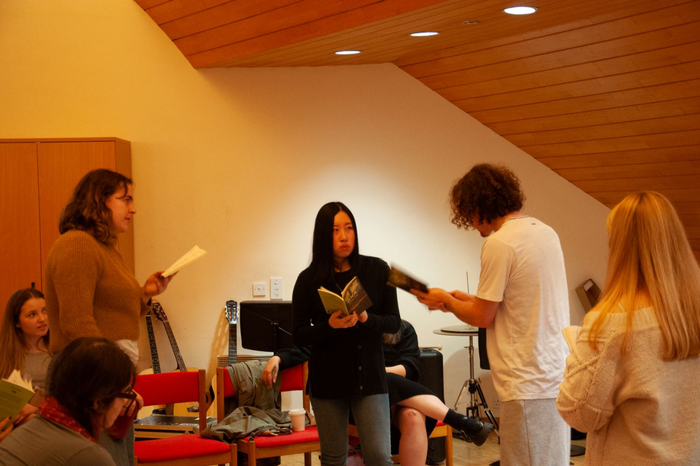
Every individual involved with theatre at Cambridge will be well versed in the commitment, and the critical lack of degree work, that is required to put your all into a performance. From acting to design to production, being part of a show can be one of the most rewarding yet exhausting experiences. Especially with the essay deadlines looming and exam season pending, it can be easy to forget just how joyful and beneficial dabbling in student theatre can be.
Contrary to what your supervisor may think, Cambridge (and any) student theatre offers the essential co-curricular skills that employers look for, even if not related to the showbiz industry. It provides a clear track record of responsibility and commitment paralleling the demands of project management in the corporate world or roles requiring a stark sense of leadership – practically any ambitious job. Handling budgets and marketing a show as a producer, coordinating a large and varied team as a director, harnessing a sense of teamwork and collaboration as an actor all demonstrate highly employable skills. It can sometimes feel like a full-time job taking part in theatre, so why not reap the rewards? It certainly is when considering the rich experience and lessons it provides you with.
“Theatre doesn’t have to involve sacrificing academics, it can work optimally alongside a degree”
The connections and sense of community within Cambridge theatre are abundant, especially when considering alumni such as Sir Ian McKellen, Emma Thompson, and Hugh Laurie. You may find yourself sharing a stage with an actor that has done screen/professional theatre work or chatting to a director who has staged some incredible productions. I experienced this firsthand when I was able to bond with Clementine Rice, an incredible director who has set up her own production company and is in the process of staging an Off-Broadway show. I was even able to interview Clementine about her student to professional theatre journey and have developed a great friendship with her. Simply by having a chat or bonding with someone, surprising professional connections can be made; and, equally as important, lifelong friendships can be forged that may just be the key to your first graduate job.
Still, it seems futile becoming involved with student theatre in the hope that it may enrich your future career if it involves falling behind in your degree because of it. However, theatre doesn’t have to involve sacrificing academics, it can work optimally alongside a degree. Direction, acting and design exercise key critical and intellectual muscles, encouraging engagement with texts and the construction of arguments through semiotics such as performance skills, staging and set design. The ability to justify these creative decisions mirror the analytical processes involved in essay writing and even lab work. Theatre’s ability to bring together academic disciplines makes it so crucial and unique to student life. Learning to communicate across intellectual boundaries certainly has been personally beneficial, as I have found myself chatting with a Nat-Sci about the universe or a historian about the rise of communism in between rehearsals. These culturally and intellectually engaging conversations are plentiful within and outside the rehearsal room, expanding knowledge in all its forms.
“The transferable, degree-enhancing skills of student theatre is surely worth sacrificing just a little time in the library for”
While CVs and experience all look great on paper, what employers often find makes an applicant successful are their people skills and personality. This can’t be taught by a textbook or acquired no matter how many Shakespeare plays you read (sadly for us first-year Englings). Theatre provides the optimal education in the profession of how to work well with other people, a cornerstone of the workplace. Productions are high pressure environments which, unlike exam season, require you to manage this stress whilst simultaneously cooperating with others to produce a cohesive final product. No matter how frustrated you may become in rehearsal (we all know the feeling of wanting to pull your hair out when hearing the words “can we run that one more time?”), theatre demands resilience. Learning to lead teams, communicate and become (somewhat) knowledgeable across different departments, whilst sustaining morale, is the role of all individuals participating in a production. When learning that an actor is ill or a light has blown right before opening night, creative problem solving and adaptation is necessary in theatre. Calm improvisation in the face of adversity is a skill valued by employers even more so than ‘perfection’ (or whatever that looks like).
Ultimately, the simple capacity to manage the Cambridge workload, alongside becoming involved with its rich student theatre scene and all its employable benefits, teaches a lesson that will stick with you much more than a date from the French revolution or an equation. The transferable, degree-enhancing skills of student theatre is surely worth sacrificing just a little time in the library for. By all means (and for the sake of your degree), don’t completely ditch the books for the stage. But consider the enriching opportunities and self-development that Cambridge Student theatre can offer. Not simply extra-curricular but co-curricular, student theatre provides the potential to enrich your degree and future career, all by simply having a peek at CamDram.
 Comment / Top of the slops: the competitiveness of college dining4 June 2026
 Interviews / What’s the story behind Pages coffee house?8 June 2026
 News / News in Brief: Cambridge crowns, council confirmations, and competitive cricket8 June 2026
 Comment / The Cambridge drift1 June 2026
 News / Cambridge researchers produce ‘world-first’ AI vaccine6 June 2026
 Arts / Don’t rush me – I’m reading!9 June 2026
 Lifestyle / Don’t Cry at Me, Argentina – a next-year abroad story8 June 2026
- News / News in Brief: Cambridge crowns, council confirmations, and competitive cricket8 June 2026
 Science / Failure is the foundation of science8 June 2026
 Fashion / The hidden gems of formal fashion8 June 2026