Faith, doubt, and sanctity in Hamlet in the Chapel
Set in the stunning King’s College Chapel, this production promises to be a haunting exploration of religion
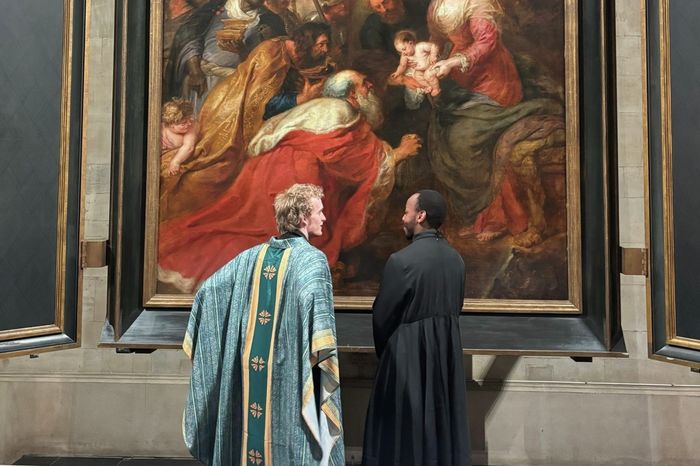
For several weeks, King’s College has been buzzing with anticipation and excitement. The time has finally come: tonight, Hamlet will be brought to King’s College Chapel in what is set to be a feat of extraordinary scale.
This is a Hamlet unlike any before it; a Shakespearean tragedy reimagined as a harrowing exploration of religious impiety and a criticism of organised religion. I’ve been deeply interested in this idea ever since I first encountered the show whilst perusing CamDram. It promises to be a complex, ground-breaking production: “Hamlet is reimagined […] as a priest in training, suspended between faith and doubt […] this production invites performers into a universe where sanctity and sin are indistinguishable.” As a King’s student excited by the closeness of such an amazing project, I was eager to speak with director Evie du Bois and producer Iris Tadie to uncover more about what inspired their creative vision.
It is clear that Evie has put her heart into this production; throughout the interview she spoke with a contagious enthusiasm. I started by asking her the question that has been on my mind ever since I first read about Hamlet: what inspired the religious perspective?
Evie described the realisation she had whilst working on Psalm 51 for a coursework piece; for her, religion and Hamlet are inseparable: “For context, David has sent a woman’s husband away so that he can commit adultery with her, but her husband dies. The Psalm is David confessing to a priest. I read it, and somehow it weirdly made sense. When I hear Claudius confessing, Hamlet overthinking, Polonius’ exaggerated wordplay or Laertes’ transparency, I see so many elements reflected in that Psalm.”
“Evie described how she wanted ‘The chapel to shape the play, not the play to shape the Chapel’”
Our conversation followed Hamlet’s first ever rehearsal in the Chapel itself. This was another factor of the production I was intrigued to know about: why King’s Chapel? Iris has prior experience with theatre performance in chapel spaces: “In my first year I was cast in The Duchess of Malfi in Corpus Chapel, and it led me to think: why not do something in King’s Chapel? I didn’t realise that it was something you could do until last year’s performance of Macbeth.”
Evie described how she wanted “the chapel to shape the play, not the play to shape the chapel,” an intention which is clearly foregrounded in the production’s design choices. “The production will be lit by candlelight, we want it to feel like a congregation,” she continued. Evie works as subdeacon in King’s Chapel and adores ecclesiastical vestments: “We wanted to use actual religious dress to ensure that this aspect is sanctified. We have an amazing costumer, who has sourced us some incredible decommissioned clerical dress. We’ve tried to keep the dress accurate to represent religious hierarchies.” Additionally, we can expect an entirely original score by Rich Mandal and choral music from King’s Voices and King’s College Choir.
Concerning the use of the chapel space, Chaplain Jonathan Kimber has expressed his enthusiasm: “I’m very much looking forward to this production, and to the energy unleashed by having such a classic play in such an iconic building. I have huge respect for the vision of Iris and Evie, and the way their conception integrates the place and the drama. Reading about it in a proposal is one thing – and a very exciting thing. Experiencing it in situ will be quite the encounter. I can’t imagine that anyone privileged to get a ticket will ever forget the experience.”
“Evie and Iris hope that the audience are left with a ‘haunting’ lasting impact”
What excited me during our conversation was not only how grand this production sounds, but also Evie and Iris’ ambition as to what it might mean for the future of the chapel. Religious services such as daily Evensong can be intimidating for those who have never experienced these events prior to university, which can cause feelings of uncertainty or even avoidance of Cambridge’s religious spaces. Evie and Iris hope that Hamlet will prove that the chapel is more than this, that it can be a creative space and a student space. They envision a yearly Lent tradition of Shakespeare in the chapel: “We want people to think that King’s Shakespeare is the best and biggest Shakespeare to be a part of.”
As for their own production, Evie and Iris hope that the audience are left with a “haunting” lasting impact: that the audience perceive this version of Hamlet as a cautionary tale and an exploration of our relationship with ourselves, faith, life and death. Central to this vision is the cast, whom Evie highly commended for their abounding talent and effort in rehearsals.

This production of Hamlet promises its audiences nothing short of an exquisite spectacle. I, for one, am looking forward to it.
Hamlet in the Chapel is running from 18th to 20th March at King’s College Chapel
 Comment / The Cambridge drift1 June 2026
 Comment / Top of the slops: the competitiveness of college dining4 June 2026
 News / Cambridge psychologist warns against blanket social media ban for under-16s1 June 2026
 News / University support staff strikes end after month of action2 June 2026
 Music / We need to talk about Kendrick2 June 2026
- Comment / Top of the slops: the competitiveness of college dining4 June 2026
 Interviews / Bible Scholar Mattie Mae Motl: “God is a woman”4 June 2026
 Features / One big happy (college) family?4 June 2026
 Theatre / Bold beginnings in the Corpus Playroom 3 June 2026
- Music / We need to talk about Kendrick2 June 2026