Amnesty International holds Cage Campaign for the right to protest
Cambridge University Amnesty International says UK universities have become ‘places of fear and censorship’
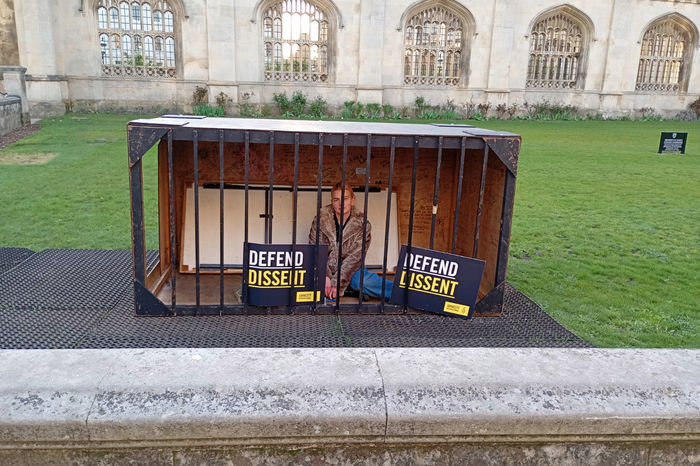
Cambridge University Amnesty International (CUAI) activists sat inside a cage on King’s Lawn from Friday (13/03) until Sunday (15/03) between 12pm and 5pm in support of the charity’s Defend Dissent campaign.
The demonstration also saw members collecting signatures to “protect the rights of student protest across UK campuses. Including, but not limited to, Palestinian rights protest”.
CUAI has held an annual Cage Campaign to highlight human rights issues for around 50 years.
The vice-chair of CUAI commented: “CUAI’s Cage Campaign has a long history of highlighting human rights violations around the world. Since we’re camped right on King’s Lawn, it garners quite a bit of attention each year from passers-by.”
She added: “This year, we’ve chosen to channel the attention we receive to highlight the Defend Dissent campaign, a nationally-networked and student-led movement fighting for the freedom to speak out and protest on UK university campuses without fear of disciplinary action or other forms of punishment. Student activists around the country, especially those organising for Palestine, have faced bans, surveillance, police involvement, and disciplinary action.”
Ciarán Rochford, a member of Amnesty, cited “several injunctions against non-violent peaceful protests by students,” as a limit imposed on the right to student protest in Cambridge.
CUAI’s campaign officer told Varsity that “technically” King’s Parade “is under injunction, so there couldn’t be a protest here which is ironic because we’re obviously here collecting signatures to be able to protest”.
She continued: “I’m involved in Cambridge for Palestine, so basically just everywhere we’ve been is now somewhere we couldn’t go legally […] we were at John’s or Magdalene for two days before they said ‘you have to go’; whereas it’s crazy to think there was an encampment here for three months, so it’s just crazy to see the bandwidth of the University.”
The campaign officer added: “You can’t be here with a […] Palestinian flag which is insane because […] you could have a flag of another culture but because it’s become political, you can’t have it.”
Amnesty UK’s Defend Dissent Charter calls on UK universities to adopt 10 pledges. These pledges include guaranteeing the freedom of expression and assembly and acting when they are threatened, ending the misuse of disciplinary actions and intrusive monitoring and data sharing, avoiding discrimination, confronting Islamophobia and antisemitism, being transparent and accountable, and establishing appropriate support services for at-risk students.
The chair of CUAI said the Cage Campaign was “our response to the crackdowns at universities for the last two years,” citing Amnesty’s promotion of the Defend Dissent Charter as a way “to make sure universities apply these principles Amnesty has come up with in order to comply with the way that students are able to access their freedom of expression on campus”.
She added: “Cambridge has […] repressed freedom of expression in order to ensure that there isn’t this threat of student dissent on campus. But that’s just more incentive for organisations like Amnesty UK to call out and respond to the university crackdowns.”
The Cage Campaign also encouraged members of the Regent House, the University’s governing body composed of around 7,000 academics and staff, to sign a Grace (formal proposal) in favour of arms divestment.
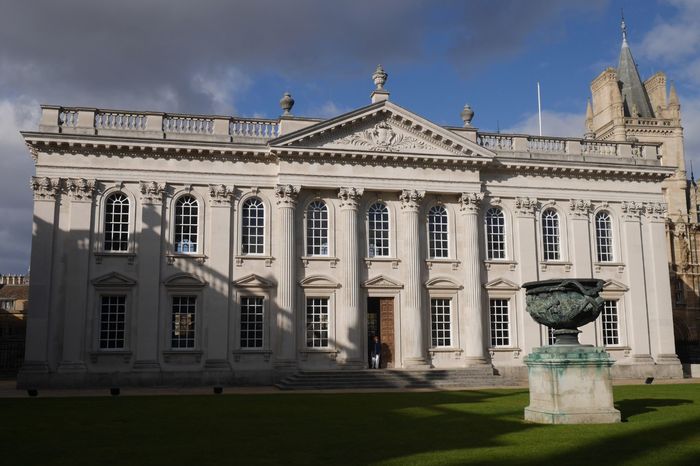
The Grace has now received the support of 155 members of the Regent House. The University Council (the University’s main executive body) has said it will consider the proposal “at the earliest opportunity”.
Georgia, a first year HSPS student who sat inside the cage in protest, commented: “The right to dissent impacts everybody […] and especially with the Grace on divestment, it’s really important that we get academics voting on divestment in order for it to actually go through.
“So it’s important that we’re here on Kings Parade, one of the most public places in Cambridge to get everybody involved in because it’s something everybody should be involved in.”
The University of Cambridge was contacted for comment.
 News / Venue cancels Cambridge talk by right-wing commentator Matt Goodwin after backlash28 May 2026
 News / Cambridge researchers warn of ‘underestimated brilliance’ if AI grades essays26 May 2026
 Interviews / Cambridge MP Daniel Zeichner on political realism and the ‘politics of grievance’29 May 2026
 Lifestyle / Blind Date: ‘I should’ve changed my socks’24 May 2026
 Comment / The no man’s land between triposes25 May 2026
 Film & TV / Project Hail Mary’s production design shows the power of human creativity30 May 2026
 Music / This music DOES contain hope30 May 2026
 Sport / Should we play more BUCS?30 May 2026
 Features / The language of optimisation and the architecture of merit30 May 2026
 Comment / We must support our strikers29 May 2026