The language of optimisation and the architecture of merit
Mimi Ronson explores how Cambridge’s culture of academic performance exposes hidden inequalities in ideas of merit and intelligence
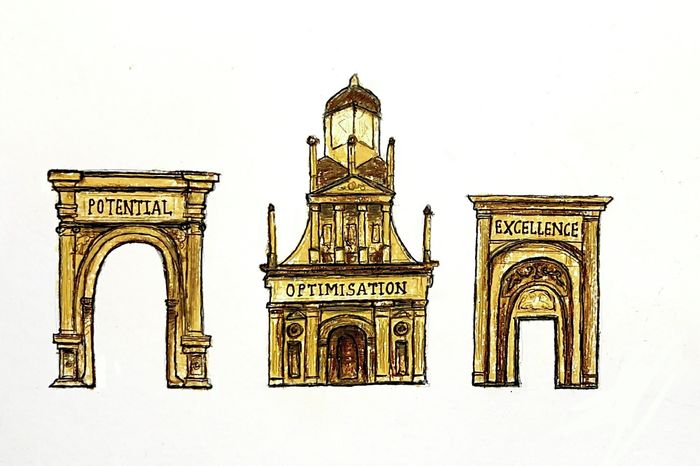
At the University of Cambridge, the doctrine of ‘optimisation’ has become an inescapable part of the academic vocabulary. It emerges as a set of assumptions within the vocabulary of elite academia, particularly around merit, intelligence, and potential. Whether we consider ourselves worthy to be here, or not, we are constantly measuring ourselves against a static bar. Value is assigned to students not just at the point of entry, nor just graduation, but is established and conditioned long before. This is a world of intellectual inequality; hidden social and political assumptions are baked into the way merit is measured. The choice of language reflects the everyday value judgements we make, not just of ourselves but of the environment that surrounds us.
Dr Ahmad Elabbar, Professor in the Philosophy of Science and Technology, is no stranger to measurement. He notes that ethics lie at the heart of the term ‘optimisation’, which has migrated from the scientific world into our daily vernacular as a “thick concept,” something both descriptive and evaluative. In his eyes, the judgments of success and excellence we apply to academia are never neutral; they are “half-technical and half-moral,” where ‘optimisation’ becomes synonymous with adhering to a specific institutional mould. A grade (the ‘technical’) is often mistaken for a measure of character (the ‘moral’). This ethical vernacular is defined primarily through its application: by using value-judgement even when assessing our own work, we reduce distinct human attitudes of curiosity and creativity into a single numerical scale, allowing the metric to define success before a student even begins.
“The choice of language reflects the everyday value judgements we make, not just of ourselves but of the environment that surrounds us”
Cambridge’s rigid term-time standard – exemplified by the gruelling eight-week term – is often better suited to a “certain kind of brain” than to a true measure of potential, reinforcing existing institutional hierarchies. Furthermore, the University environment can foster “epistemic injustice” by rewarding those whose backgrounds grant them a specific “eloquence” that the system finds compelling. For those who lack this institutional vernacular, their academic credibility can be lowered simply because of how they present their ideas. This constant signalling that worth is always open to question creates a unique “normative force,” making any academic setback feel catastrophic to a student’s sense of self-respect. Ultimately, Elabbar argues, this logic of improvement bleeds into a “marketplace of the self,” where students feel compelled to optimise everything from their degree results to being the soul of the party.
From the practitioner’s perspective, the management of these standards is equally not always easy. The Student Union’s Vice-President, Jessica Asiedu-Kwatchey, acknowledges how these “objective” assessments reproduce inequality. Conducting research into the University’s gender and ethnicity awarding gaps, she notes that the favouring of certain traditionally “Cambridge-representative” groups extends into final results, revealing a gap not as the product of a “talent issue” but as a systemic one. She has also assisted the relaunch of the SU’s Alternative Prospectus, something she views as a necessary combatant to the stereotypical ‘excellence’ of the Cambridge student and a representation of the lived realities of our academic world.
“In his eyes, the judgments of success and excellence we apply to academia are never neutral; they are ‘half-technical and half-moral’”
Asiedu-Kwatchey argues: “It’s about looking beyond the outdated image of Cambridge and allowing prospective students to really see themselves here.” She continues to note that: “It’s a challenge to the idea that there is one typical way to be a student,” a notion that appears to have its roots in the vocabulary of excellence and success that has forever been affiliated with the historic institution.
Asiedu-Kwatchey suggests that merit is often just a reflection of favoured teaching styles, and that these gaps are “not a talent issue” but are systematic. To dismantle these barriers, Asiedu-Kwatchey reclaims the University’s own technical vocabulary, changing “enhancement” from raising grades to improving student support. She rejects the traditional use of optimisation as a mere “end goal,” arguing instead that true academic standards should be measured by how well they provide students with the tools they need to “progress” in their lives and careers. By subverting these terms, she challenges the stereotypical ‘excellence’ of the historic institution and replaces the static bar of merit with a focus on genuine belonging and the lived realities of a diverse student body.
An anonymous student poll reveals that many students associate academic merit simply with a First; clearly, vocabulary is associated with the formal academic rubric of Cambridge, reinforcing how students struggle to separate it from numerical results. When asked what they felt academics themselves consider academic merit, one student responded, “a strong 2:i”. Nonetheless, another student feels as though “eloquent language” in a supervision setting sometimes restricts conversation to “unnecessary jargon,” and often “dilutes the actual substance” of scholarly debate. Another student affirms that failing to meet a specific metric of excellence is “nothing more than a description of an isolated measurement,” a clinical “tool of organising talent” that does not threaten their self-respect. Achievement is not just a term to be gate-kept by the world of academia: it can be inverted, reinterpreted and reclaimed by the individual.
“True academic standards should be measured by how well they provide students with the tools they need to ‘progress’ in their lives and careers”
The meaning applied to achievement in the Cambridge environment often misaligns with the very students who make up the academic cohort. Ellana Cowen is a neurodivergent second-year History student at St Edmund’s College, whose personal achievements often fall outside of the one-size-fits-all frame of improvement. She admits that: “It can feel like a lot to live up to the expectations of a perfect student when your brain is somewhere else.”
The University’s notion of excellence, often defined by a grade, “doesn’t often represent how much work you’ve put into something – especially as a neurodivergent student,” she says. Ellana, like Jessica, defines success and merit on her own terms, setting her “own expectations” on what achievement looks like: “As much as there is pressure from supervisors to maximise potential, I know what I can achieve whilst also not pushing myself to the limit.”

In a fast-paced academic environment that often mixes self-worth with a single numerical scale, Ellana’s resistance to being optimised highlights the friction between a rigid institutional mould and the actual lived reality of the student body. By setting boundaries on her own potential, she navigates an environment that often turns academic pressure into a threat to self-respect, choosing instead to find a sense of belonging that isn’t dictated by a singular definition of merit.
Across Cambridge, ideas of merit and excellence continue to shape who is recognised, rewarded and heard. Yet its inhabitants are increasingly questioning whether these standards truly reflect ability, or simply reinforce institutional expectations. As debates around accessibility and belonging continue, the language of optimisation itself is coming under scrutiny. What counts as ‘success’ at Cambridge may ultimately depend on who is allowed to define it.
 News / Simon Goldhill resigns following sexual misconduct investigation16 June 2026
 Comment / Exercise, academia, and the Cambridge addiction to both17 June 2026
 Theatre / A celebration of Queer Love in sacred spaces: Romeo and Juliet in Peterhouse Chapel16 June 2026
 Theatre / ‘Mental illness doesn’t exist in a vacuum’ says Obsessive, Compulsive, Divine 18 June 2026
 Music / ‘Returning again and again’ to the Bateman room16 June 2026
 News / Ted Yip elected Union President after contested race 19 June 2026
 Lifestyle / You can’t always get what you want 18 June 2026
- Theatre / ‘Mental illness doesn’t exist in a vacuum’ says Obsessive, Compulsive, Divine 18 June 2026
 News / Caius to begin antisemitism inquiry after Nazi symbol carved into bench18 June 2026
 Film & TV / Gen Z, FilmTok and the A24 problem17 June 2026