A trip to see what’s Happening
Rachel Jones gets involved with zine-making in Newnham
The serpentine arcs of the sculpture that hangs in the Iris bar weave their way between the hanging lights. They have dozens of drifting sheets of paper lodged upon their backs, and their metallic finish catches the soft glow of the hanging lamps. This is a piece of art in flux – a fitting backdrop for the second session of Happening, a termly, student-run zine that privileges the process and occasion of making art over any kind of perfected end product.
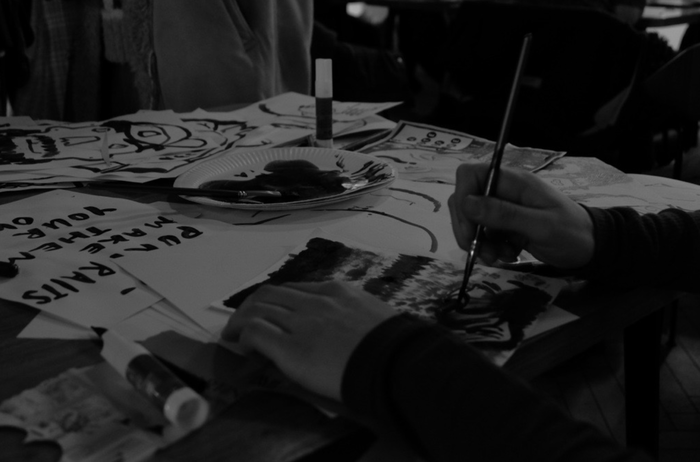
Intrigued by their eye-catching Instagram graphics and ballsy slogans (“Girls invented Happening not England” and “You can’t make art without making art,” to give just two), I go along to their session to see what all the noise is about. When I walk in, the bar feels to be brimming. The tables are strewn with art materials: the glossy colours of magazine pages cut bold poses, inks pool and swirl in paint pallets, blank sheets of paper wait expectantly. Soft indie dreampop blasts from a small speaker and foamy pink cocktails are balanced between notepads and paint water. And, everywhere, there are people making art. Self-portraits, poems, collages, pencil drawings and paintings. The creativity in the room is fizzing, infectious, and its range is unbounded.
“Everything that is made here tonight will make it into the zine”
Everything that is made here tonight will make it into the zine. Esther, the creator of Happening, tells me that she wanted to run it this way to make it a less intimidating way of getting involved with a zine. She says that she thinks this allows people to be “a bit less inhibited and make more interesting work”. Plus, every piece of work is anonymised anyway. She sees the sessions as trying to provide an antidote to Cambridge’s obsession with productivity: “It’s using the way in which people who go to Cambridge can just sit down and do something very quickly, but then diverting them away from the Cambridge workload and going ‘Here are four hours in your week, for one time a term, when, actually, you can make something silly.’”
I ask Esther why she wanted to make Happening a zine. What is special about the form? “I think the zine is a form that has a history – history associated with queer people and people of colour, the DIY scene, punk scene. There’s very much a sense that zines are for everyone. It’s also quite a fun form because there’s not really any fixed definition of what a zine is. […] It can be quite serious, it can be political, it can be fun, it can be big, small and so on and so forth, and varying degrees of polished and professional. So what we want to do with Happening is anything that could go in a zine can go in our zine.” She stresses that she wanted to steer it away from “proscriptive,” heavily themed student zines. Instead, she describes Happening as simply “a zine that loves zines”.
“The zine is a record of an event, but one that changes with each re-iteration, and which can never be planned or rehearsed in advance”
This is also a project that strives to build a community of artists through the way its creative process is designed. “It works on having everyone in the room together making the things,” Esther points out: “So it’s as much about documenting that phenomenon as it is the stuff that goes inside of it. And by doing it repeatedly in the same way, hopefully, gradually, people will come back and get to know each other.”
The zine then, is a product of very particular circumstances – of a certain group of people sitting down together at a specific time, in an exact location – it is a record of an event, but one that changes with each re-iteration, and which can never be planned or rehearsed in advance. The generative nature of this unpredictable collision of conditions, with its element of uncertainty and spontaneity, clearly excites Esther. She mentions the zine’s desire “just to know what everyone’s thinking about at that precise moment,” and talks about being inspired by Alan Kaprow’s performance art movement in the 1960s (from which the zine takes its name), which featured site-specific, ephemeral events, often made up of mundane actions and relying on audience participation.
The design of the zine also plays homage to its retro predecessors. Riso-printed in black and white, with only a few accent colours, Esther tells me that Happening is reminiscent of zines made in scanners and photocopiers, printed in black and white because that was cheapest. She references the bold design of Wyndham Lewis’ magazine, Blast, but also stresses Happening’s need for “a strong, clear graphic identity” anyway – one that is able to bring all of its disparate work together somewhat cohesively.
Happening doesn’t receive any money from the university; it is funded entirely by its committee. Luckily, last term, they sold out. This term, they are hoping to get even more contributors; they’re even looking to involve local artists outside of the university. Nor does this project want to limit itself just to Cambridge. Esther describes the zine as uniquely “moveable”: “You could do Happening anywhere under the model that we do it. It doesn’t have to happen in Cambridge, it just does because we’re here.”
 Comment / The Cambridge drift1 June 2026
 Comment / Top of the slops: the competitiveness of college dining4 June 2026
 News / Cambridge psychologist warns against blanket social media ban for under-16s1 June 2026
 News / University support staff strikes end after month of action2 June 2026
 Music / We need to talk about Kendrick2 June 2026
- Comment / Top of the slops: the competitiveness of college dining4 June 2026
 Interviews / Bible Scholar Mattie Mae Motl: “God is a woman”4 June 2026
 Features / One big happy (college) family?4 June 2026
 Theatre / Bold beginnings in the Corpus Playroom 3 June 2026
- Music / We need to talk about Kendrick2 June 2026