Laugh, people! Laugh!
Barney Sayburn considers the unpredictable nature of audience reception
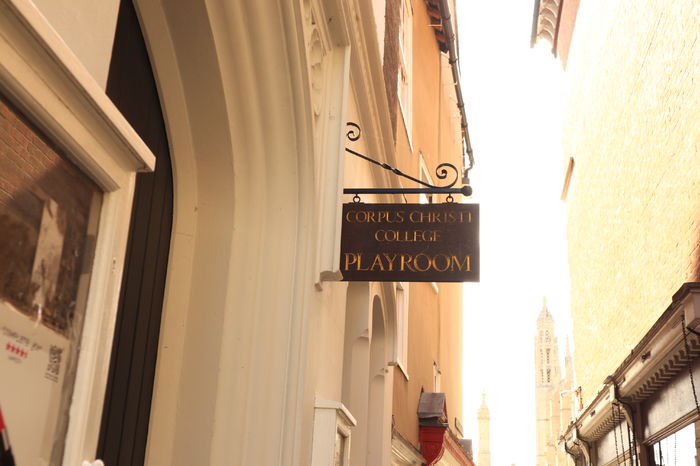
Many have been saying that Lent term’s At Your Leisure (Centre) was a comic masterpiece, split their sides wide open, permanently dislocated their jaws with unceasing cackles. Or rather, the 75 people who saw it on the Friday performance have probably been saying that. After a mid-week debut and follow-up performance that our company had thought generally successful, that Friday night of Leisure Centre blew our expectations for reception out of the swimming-pool water. The physical comedy sequences – my pseudo-CPR doll humping etcetera – had been expected to land, and so they did. We thought that on a great night there might be audible reactions to the more talky bits (like our receptionist character dissuading a bomb-threatener) and so there were. At no point did we anticipate audible responses for jokes which we ourselves had never gaffawed at in rehearsal. Yet, come Friday, characters simply scribbling in a birthday card message or cumbersomely arranging furniture seemed like genius gags to this gathered crowd. Naturally, we revelled in the enthusiasm, exchanging encouragement offstage and hamming it up gloriously onstage. It was a triumph.
“Having assembled something worthwhile, no company’s fate should hang in an ineffable balance”
Imagine our surprise when Saturday night rolled around and the first scene was met with dead silence. Then the next. And the next. Panic ensued in the narrow corner behind the Corpus Playroom’s stage entrance, ’Did we mess something up without realising? What could it be? In the next scene should we still say [x line]? Will they ‘get’ that? What about [x other line]? ’. As the narrative progressed, it became increasingly difficult to commit to the planned bravado. We briskly finished scribbling our card messages, we slammed our furniture around in an apologetic rush, and I curtailed my suspicious-CPR routine after catching wind of a lone squeal from someone in the front-row, cracking nervously under the hostile room atmosphere.
Time has passed, and I’ve (mostly) recovered from this experience of whiplash. I remain confident that At Your Leisure (Centre) was a fantastic production, but fantastic productions sometimes get poor showings. Well, call me a foolish idealist, but I don’t think this should be the case. Having assembled something worthwhile, no company’s fate should hang in an ineffable balance. So, let’s unpack the uncertainty surrounding audience reception and if there are ways it can be stabilised…
“If a brave outlander breaks the dam of pursed lips, the floodgates of hilarity may open”
My initial diagnosis of the issue was that Saturday viewership, for many, is a sober, partially-hungover-from-the-night-before experience. Friday nights invite students to attend before they go to the pub or nightclub. Saturday fits well for older townsfolk who have more conservative social habits, and the style of humour we offered was perhaps ‘not for your mum’. This version of events, however, does not fully align with the story our ticket-sales told. Revenue accumulated exponentially throughout the week, suggesting we thrived on word-of-mouth. The majority of viewers likely knew what they were in for beforehand and it is thus hard to believe that our fateful Saturday consisted of insusceptible demographics. A different explanation, then: why audiences respond is mostly arbitrary, whereas how they respond is significant.
A recent UCL study monitored the heart rates and skin responses of selected theatregoers at the same show, and found that pulses sped and slowed in unison. This suggests that when humans are together during emotionally significant experiences, they replicate each other’s bodily impulses. I strongly suspect laughter works in the same way: subconsciously, our funny-bones bend to the will of conformity. To muzzle a whole sea of chuckles permanently, can only take a few grumpy grouches that spread a wave. Yet do not despair! The inverse of this silencing process may also be true. If a brave outlander breaks the dam of pursed lips, the floodgates of hilarity may open. The objective of theatremakers seeking to avoid the horrors I’ve described, is to engineer conditions such that audiences are prepared to react appropriately from the opening.
“Some version of crowd-control is important to ensure hard work does not go to needless waste”
We do this more commonly in other mediums: a large part of a cabaret emcee is to chide shy applause before songs can commence, stand-up hosts tend to warm-up the masses by interrogating a few viewers about their personal lives (British people never fail to chuckle at their peers’ humiliation). There isn’t an equivalent of these roles for comic plays, so we need to get creative. Maybe a charismatic in-character ‘please silence your phones’ announcement to earn goodwill, or a cold-open gag to stimulate a surprised chortle, perhaps even interactive performers planted in the auditorium as it opens to spark engagement. Some version of crowd-control is important to ensure hard work does not go to needless waste.

If I could wave a magic wand, all theatregoers would chill out and laugh: for the sake of their own enjoyment, for the sake of performance quality, for the sake of performers’ sanity, for the sake of the 10-to-14 sterling pounds each audience member exchanged for the experience. There is no magic wand, sadly, but there is work to be done. Great plays will attract full houses, but great comedy productions need loud houses too; you must let the audience in on the joke.
 Comment / The Cambridge drift1 June 2026
 News / News in Brief: Corpus climbing, climate cash, and commendable contributions1 June 2026
 News / Cambridge psychologist warns against blanket social media ban for under-16s1 June 2026
 Theatre / CUMT’s The Wind in the Willows brings a classic to life 31 May 2026
 News / Venue cancels Cambridge talk by right-wing commentator Matt Goodwin after backlash28 May 2026
 Music / We need to talk about Kendrick2 June 2026
 News / University support staff strikes end after month of action2 June 2026
 Arts / To the letter2 June 2026
- News / Cambridge psychologist warns against blanket social media ban for under-16s1 June 2026
 Sport / Caius beat Magdalene in last-minute thriller to clinch mixed netball Cuppers final1 June 2026