The Boat Race: What does it take to win?
Tristan Sykes delves into the preparation and selection process for the Varsity Boat Races

The 171st Boat Race saw a spectacular display of sporting skill and grit, watched on by over 250,000 spectators, standing shoulder to shoulder along the Tideway. But for those rowers who battled across choppy waters, the 19 minutes of gruelling physical endurance which decided this prestigious contest marked only the finale of just under a year of intense preparation.
Competing in the Boat Race brings no financial reward, yet requires the same level of physical and mental resilience as winning an Olympic medal according to Patrick Ryan, CUBC’s head women’s coach. Rowers themselves will train two to three times a day consistently from August through to the race in early April, and even more for those determined to represent the Blue boats. In fact, Cambridge and Oxford boat clubs’ senior leadership begin drawing up plans for the following year’s contest soon after the race concludes.
“Both clubs are able to procure a range of Olympians and world championship competitors for both their Blue and reserve boats”
Recruitment of world-class rowers plays a key role between April and the restart of the academic year in October. It is a testament to the Boat Race’s enduring presence on the international stage that both clubs are able to procure a range of Olympians and world championship competitors for both their Blue and reserve boats. What equally displays the integrity of the race is that these boats are, in part, made up of rowers who began their journey rowing for their college sides. In this year’s contest, OUBC’s women’s dark blue boat saw Spanish Olympian Esther Briz Zamorano and GB’s Kyra Delray face off against CUBC’s Carys Earl, who had never rowed prior to her time at university and yet had gone on to win the Boat Race in 2024 and 2025.
Despite sharing a similar standard of exceptional athletes, the two boat clubs differ in their internal structure, as well as their training regimes. Mark Fangen-Hall, appointed as OUBC’s head men’s coach in the summer of 2024, has implemented radical changes to the club’s hierarchy since his arrival. Fangen-Hall has moved the club from a traditional sporting committee structure towards what could be considered a more corporate approach. The aim was to create a new culture in the University’s rowing, attempting to escape the Oxford men’s rut of six defeats in seven years ahead of 2026’s race. Prior to taking on his role at OUBC in 2024, Fangen-Hall coached at Eton (crossing paths with CUBC’s Goldie rower Simon Nunayon), as well as working with Rowing Australia and Queen’s University Belfast.
Speaking to Varsity before the Boat Race, OUBC men’s Blue (2025), and now CUBC rower Felix Rawlinson discussed the differences between the two clubs’ preparations and coaching. Rawlinson described CUBC’s training programme as more physically rigorous than Oxford’s, with a greater focus on pieces (a type of training exercise focused on repeated bursts of high-rate rowing) on the river. This is perhaps in part due to the flooding which occurs on the Isis (the portion of the Thames which is used by OUBC for some of their training), in contrast to Cambridge’s use of the Ouse in Ely, which does not suffer the same issues. On the water, outings are crucial for crew cohesion and technical improvement, something that gym-based work on ergometers (ergs for short) does not encourage.
At the start of the academic year, head coaches are typically presented with around five dozen aspiring rowers for each Blue boat, signalling the start of a ruthless selection process. It sees roughly 250 athletes reduced to a mere 32 by early to mid-March. Beginning with a demanding 5k test that pushes prospective rowers to their physical limits, both clubs’ training camps and preparatory races span the globe, with CUBC visiting Shanghai and Portugal in recent years.
Back on home soil, races at Fours Head typically mark the only time when OUBC and CUBC compete directly against one another before the race. In early December, the loser of the previous year’s Boat Race issues a formal challenge for the next year’s contest. Trial eights on the Tideway and one final 5k test mark the final stage of selection prior to the end of Michaelmas term, before the process resumes with the pre-Boat Race fixtures in February.
“CUBC and OUBC’s Blue boats face off against international rowing’s top eights, including tests against the Dutch, Oxford Brookes, and the GB feeder squad”
In these contests – taking place in the final stages of both universities’ preparation – CUBC and OUBC’s Blue boats face off against international rowing’s top eights, including tests against the Dutch, Oxford Brookes, and Leander, the GB feeder squad. Consisting of two half-course pieces on the Tideway per fixture, these contests provide a crucial opportunity for the men’s and women’s Blue boats to send an emphatic message to their upcoming opponents in the Boat Race. Their performances against the same crews provide a relative indicator of what is to come in the ensuing weeks. The fixtures also serve as a final opportunity for rowers to prove themselves to their coaches, with the final crew selections being issued shortly after, or even during, these contests.
The selection process is equally rigorous for the two clubs’ coxswains. With the Boat Race described by Fangen-Hall as the ultimate coxing challenge, the outcome of the contest can be decided by those in charge of guiding their crew through the challenging Tideway waters, as well as by bringing out the best in the eight rowers seated in front of them. 2023 saw Cambridge cox Jasper Parish execute an audacious move in the early stages of the race, moving away from the conventional racing line into shallower water, giving his crew a lead of a length which would prove decisive in CUBC men’s underdog win that year. In 2025’s women’s Boat Race, a clash of blades at the Fulham Wall led to an unusual restart as a result of aggressive coxing from Oxford’s cox Daniel Orton. Both coxes attempted to steer into the faster water to obtain the most optimal racing line. Prior to this year’s race, Varsity spoke to Sarah Winckless, the umpire of the 2021 and 2025 men’s Boat Races and a former Olympian. She explained that, although the coxes had been spoken to in the days prior to the Boat Race, the umpiring team nonetheless expected tense, side-by-side encounters in this year’s choppy conditions.
“The combination of exceptional sporting spectacle and rich historical tradition highlighted the Boat Race’s prestige as one of international rowing’s premier events”
While the lightweight and veteran races saw the crews navigate more challenging waters – which took place on the day before Saturday’s Boat Race – by the afternoon of the Blue boat contests, the Tideway appeared more manageable than expected. A fast start by the OUBC women’s boat pulled them a length clear within 250 metres as they rounded the first bend. This was accompanied by groans from supporters as they struggled to access Channel 4’s maiden coverage of the race due to poor connection on the Putney embankment, before Oxford women secured a relatively comfortable victory at the finish in Mortlake. The mood among CUBC fans was soon bolstered by a confident performance from the men’s boat, with president Noam Mouelle and cox Sammy Houdagui leading their crew to a fourth consecutive victory for the light blues, to go alongside wins for Cambridge in both reserve, lightweight, and veterans’ races.
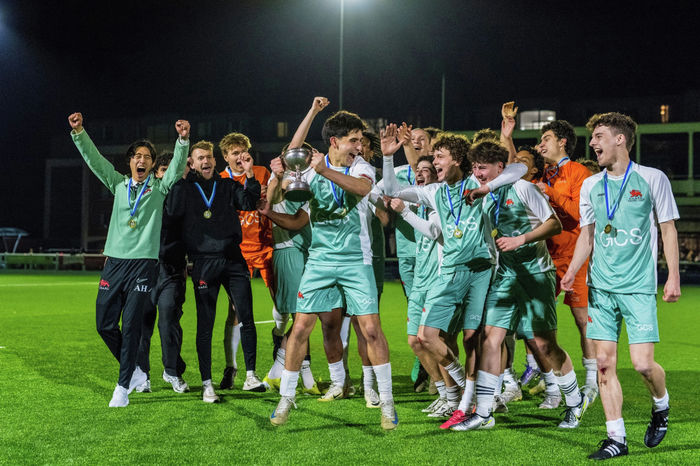
With CUBC emerging yet again victorious in the men’s Boat Race, and Oxford securing its first women’s Blue boat win in eight years, the combination of exceptional sporting spectacle and rich historical tradition highlighted the Boat Race’s prestige as one of international rowing’s premier events.
 Comment / The Cambridge drift1 June 2026
 News / Cambridge psychologist warns against blanket social media ban for under-16s1 June 2026
 News / University support staff strikes end after month of action2 June 2026
 News / News in Brief: Corpus climbing, climate cash, and commendable contributions1 June 2026
 Music / We need to talk about Kendrick2 June 2026
 Comment / Top of the slops: the competitiveness of college dining4 June 2026
 Interviews / Bible Scholar Mattie Mae Motl: “God is a woman”4 June 2026
 Features / One big happy (college) family?4 June 2026
 Theatre / Bold beginnings in the Corpus Playroom 3 June 2026
- Music / We need to talk about Kendrick2 June 2026