In conversation with Cupid
Ruby Randall goes behind the scenes of Cambridge’s Y2K dating website
Most of your single friends will have something to say about dating in Cambridge – something bad, that is. We usually mention combing through Crushbridge or Camfess, multiple eye-contact Sidg-uationships, the desperate urge to go to a house party and meet someone you didn’t already know, and routinely fending off the creepy middle-aged men who seem to just spawn in on a night out.
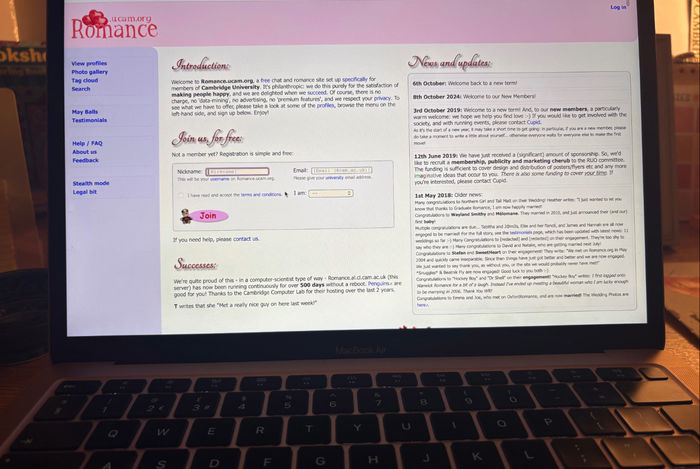
Unsurprisingly, this isn’t a new problem. There’s always been the issue of the ‘Cambridge Bubble’, and since the dawn of the internet, there’s always been a space for online dating. You might have heard of romance.ucam.org (RUO3): a website which was created at the start of the millennium, that has experienced an unprecedented influx of members in the last few months, likely because of a Camfess post advertising it as a refreshing alternative to Hinge. I sat down to talk to the website’s co-creator, Richard Neill, to learn more.
“In Cambridge, almost the entire University has impostor syndrome”
In 1999, while studying Natsci at Trinity, Richard dreamt up the idea of a Cambridge dating website with his friend, John Surcombe from St John’s: “We basically thought: well, there’s this new thing called the Internet, you can even order a pizza online, and the Americans have come up with these online dating sites. Why don’t we have this in Cambridge?”
John handled the code, and Richard adopted the title of Cupid – essentially an admin-slash-matchmaker – which he still holds 26 years later.
So, why did Cambridge need a dating website?
“Dating in Cambridge is hard. I suspect it’s hard now for different reasons than it was back then, but the biggest problem was that everyone was far too shy. The stupid thing is, in Cambridge, almost the entire University has impostor syndrome. I know of a couple who had been making eyes at each other since Freshers’ Week, but only got together after Finals, because neither of them could find a way to broach the subject.”
“The joke used to be that without booze, the country would die out”
“It was especially a problem in the sciences: if you were a physicist or an engineer, only a fraction of the class were women. It was alright if you were the kind of person who could just go into a nightclub, get absolutely plastered, and then somehow feel comfortable making your introduction to the person you woke up next to the morning afterwards. The joke used to be that without booze, the country would die out. But if you wanted to do things normally, there were few opportunities for it.”
Do you think things have changed?
“I think that’s gone and people are much more comfortable with each other, but because people are so wrapped up in their own worlds – or their own devices – nobody knows how to break into another person’s consciousness anymore.”
And dating websites have been replaced by apps now. But there’s always meeting through friends, right?
“That works brilliantly if your friend circle continues to include a pool of people you haven’t met. Usually, however, it freezes absolutely solid at some point. But in terms of dating apps, there’s just been a complete erosion of trust. I mean, we know that if you use Facebook, you’re the product, not the customer, because you’re being sold as an advertising demographic. People have lost trust in technological institutions because they’re invading their privacy; if you look at what they do, they’re not on your side.”
“Tinder has no desire to lose its users”
“The thing is, it’s horrible, and it’s because they’re all gamified: they charge you for sending priority messages; they gamify to trap you on the platform and sell you advertising; then they do some very dotty things with your ‘super likes’ or whatever it is. Tinder has no desire to lose its users. If they could actually find the perfect person for you, they might well not show them to you. There was a time when people were moving on from the site to dating apps, but I think this recent rise in RUO3’s popularity can be attributed to people realizing those other platforms are taking advantage of them. We’ve always put the user first.”
So what was different about RUO3?
“What made us different, in short, were our ethics (we are doing this to make people happy, not for the money), locality (everyone is a member of the University, so you can easily meet someone for coffee the same day), and cost (or lack thereof – it’s always been free). We also care deeply about people’s privacy.”
“We came up with a lot of different ways to find potential matches, whether this was through a keyword search (a lot of people find it easier to list 10 things they like, rather than write a paragraph), or through the photo gallery page where you could mark who you fancied by liking photos, rather than messaging them, which kind of predated Tinder as an idea. I think we did it slightly better, because of the lack of gamification. Many people don’t have photographs, and while this originates from an era where if you wanted a photo, you had to borrow a scanner, it results in a culture where people often open conversations with something more profound.”
“You have to figure out how to end up with two people happy together”
But don’t you have to play a kind of game in matchmaking, to push people to get past those first few awkward hurdles?
“I think the description of a riddle fits best, because it’s the problem of: how do you find the person who likes you, and you like them, and you’re both single at the same time, and you’re both kind of thinking how to make the first move, which is still very difficult. You have to figure out how to end up with two people happy together.”
How does the site help you solve it, then?
“A lot of people don’t want to tell everything about themselves. They may want to talk about something they love but not who they are. I would encourage people to talk about their interest in Shakespeare rather than their identity. The least interesting thing about you is your name, address, college. So why share that first? People often create personas or imaginative profiles too. That’s okay, I think, as long as other users are in on it.”
I suppose it’s about striking the right balance, then. How do you balance being both “Cupid” and a website administrator?
“Some time ago, I was a member of the site to date, as well as to administrate, which meant I had two personas. I was very careful to keep the two ‘hats’ strictly separate, because being the site admin could be seen as an unfair advantage – though I haven’t used the site myself for quite some time.”
In your time as Cupid, you’ve brought about at least 16 weddings, according to the site’s testimonials. Is there an element of living vicariously through the couples you’ve brought together?
“It is a great feeling to know that you’ve made someone else happy. You know, it’s much easier to host a party than be a guest, especially if you’re organising it, because then you’ve got a reason to be there.”
“It encourages a community more focused on honesty and the will to give each other a little grace”
Operating in a smaller and better-aligned dating pool, which runs against the current of ‘gamified’ algorithms will definitely alter your perspective, most likely for the better. If RUO3 is a force for any kind of change in the future of Cambridge dating, I think it encourages a community more focused on honesty and the will to give each other a little grace, which, at the end of the day, is a lot closer to how actual human relationships work.
The website is at romance.ucam.org. If you’d like to get involved with RUO3 and organising in-person events, contact Richard at cupid@ruo3.org.
 News / C4P vandalises University offices over divestment10 June 2026
 Comment / Top of the slops: the competitiveness of college dining4 June 2026
 Comment / ‘On the Poverty of Student Life’: sixty years on10 June 2026
 Interviews / What’s the story behind Pages coffee house?8 June 2026
 News / News in Brief: Cambridge crowns, council confirmations, and competitive cricket8 June 2026
 Theatre / Varsity‘s favourite productions of 202612 June 2026
 Arts / Look, don’t touch12 June 2026
 Music / The paradox of the live album12 June 2026
 Film & TV / Motherland writer Helen Serafinowicz on comedy12 June 2026
 Lifestyle / In conversation with Cupid12 June 2026