C4P vandalises University offices over divestment
Activists targeted the Cambridge University Endowment Fund, calling for the University to divest from companies linked to weapons manufacturing

The activist group Cambridge For Palestine (CP4) vandalised the University of Cambridge Investment Management (UCIM) office building at the end of last month, in protest against its investments in companies linked to weapons manufacturing.
The activist group painted the phrase “CUEF Blood On Your Hands” on the wall and “divest now” on signage outside of the building. In response, a University of Cambridge spokesperson said: “we strongly condemn criminal vandalism to CUEF offices. Such actions intimidate and harass our students and staff. The police have been informed”.
UCIM manages the Cambridge University Endowment Fund (CUEF). CUEF manages approximately £4.4 billion in investments.
A spokesperson for C4P told Varsity: “Cambridge University claims to uphold academic freedom and ethical standards, yet they invest millions in companies like BAE Systems, Lockheed Martin, and Raytheon – the very corporations supplying the weapons enabling Israel’s genocide in Gaza”.
They added: “this isn’t just about money; it’s about complicity in the weapons industry that profits from the destruction of people and the planet. Every day that Cambridge refuses to divest, they are actively funding the destruction of Palestinian lives.”
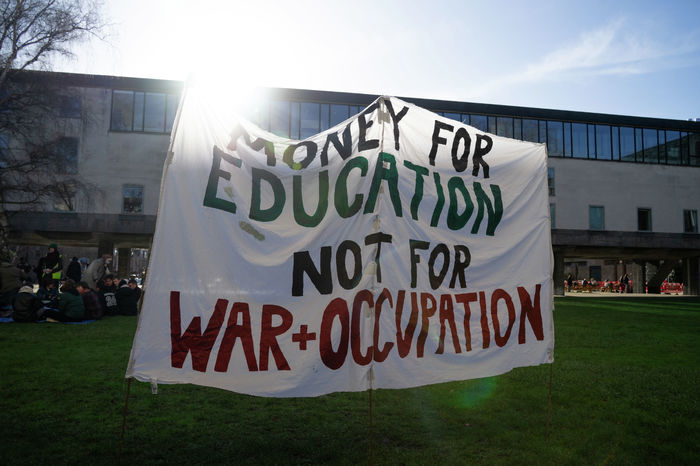
The demonstration took place a day before the University Council met to discuss a Grace calling for divestment from arms and fossil fuel companies. Last Monday (01/06), activists linked to C4P stood outside the meeting, holding banners with phrases including “Cambridge Stalls, Israel Kills” and “Money for Education, not for War and Occupation”.
The Grace has been signed by 155 members of Regent House and states that CUEF should be an “ethical collective investment scheme” and that the Council and CUEF should oversee “progressive divestment from conventional and controversial arms companies”.
The proposal draws on recommendations made in a report by the Working Group on Investment in October 2025. The group included representatives from Cambridge for Palestine.
Following the report, the University agreed to divest from “any company which manufactures weapons illegal under UK law”. However, it has not divested from “conventional weapons”, which include standard-combat weapons that are not classified as nuclear, chemical or biological.
In a statement on 16 April, the Council argued that complete divestment from conventional weapons, or a 1% cap on conventional weapons investments, would compromise the “funds of funds model and future returns of the CUEF”.
The Council instead proposed a “transparency reporting regime”, under which the CUEF would release annual reports detailing investments and ensuring thresholds of investments in “sensitive investment categories, including conventional weapons” are not breached.
C4P rejected the proposal, arguing that transparency alone does not address the University’s financial ties to the arms industry.
The group’s key demands include “immediate and complete divestment from all arms companies complicit in Israeli apartheid and genocide” and the “establishment of an independent ethics review board to oversee future investment decisions”.
C4P said that there are “clear democratic mandates” for divestment in the university community, citing “more than two years of campaigning by students, staff, and faculty” for the University to “immediately divest from companies manufacturing weapons used against Palestinian citizens”.
In January, C4P activists projected the message “Our Fees Fund Genocide” onto the front of St John’s College. Later that month, the group also held a sit-in at Sidgwick Site calling for divestment.
The University has not publicly reported on the outcome of the discussion of the Grace.
 Comment / Top of the slops: the competitiveness of college dining4 June 2026
 Interviews / What’s the story behind Pages coffee house?8 June 2026
 News / News in Brief: Cambridge crowns, council confirmations, and competitive cricket8 June 2026
 Comment / The Cambridge drift1 June 2026
 News / Cambridge researchers produce ‘world-first’ AI vaccine6 June 2026
 News / C4P vandalises University offices over divestment10 June 2026
 Interviews / ‘Central banking gets under your skin’: Sarah Breeden on working at the Bank of England 10 June 2026
 Theatre / The recipe to success this Easter term 10 June 2026
 Music / To Be Forever Yung10 June 2026
 Comment / ‘On the Poverty of Student Life’: sixty years on10 June 2026