Look, don’t touch
Ellie Buckley reflects on the sensory gap between art and its viewer

Back in April, I visited the Wellcome Collection with a specific object in mind: a medieval birthing girdle. This rare artefact was worn by women during childbirth, its surface inscribed with prayers and images of Christ’s wounds, believed to offer protection in a moment of extreme danger. Now enclosed in a glass case, illuminated briefly by a timed light, it exists as something to be looked at carefully and from a distance. Yet it once functioned very differently. It was wrapped tightly around the body, handled repeatedly, and used with urgency. The visible wear on its surface – its faded inscriptions, rubbed illustrations – alongside scientific evidence of bodily fluids embedded in the fabric, testifies to its active role in birth. What we now preserve as history was once an intimate, tactile tool.
Because of its intricate decoration, the girdle can easily be classified as art. But this designation risks misunderstanding its original purpose. For those who used it, it was not an object for contemplation but for action. The shift from tool to artefact marks a broader transformation in how such objects are encountered. In the collection, the girdle is encountered visually, its meaning mediated through glass and controlled lighting. To wear it is for the girdle to become useful, to ease a passage in some way. Its tactile dimension – once essential to its function – is no longer accessible, and this loss of touch fundamentally alters the relationship between object and viewer.
“The textured surfaces of certain paintings can produce an almost physical response”
This contrast raises a wider question about how art is experienced. Many museums privilege sight above all other senses, encouraging a mode of viewing that is observational rather than participatory. Yet there are notable exceptions. At Kettle’s Yard, for example, Harold Offeh’s exhibition ‘Mmm, Gotta Try a Little Harder, It Could Be Sweet’ created an immersive environment in which sound, fabric, and movement shaped the experience. Wearing headphones, the viewer entered a soundscape that extended beyond the visible room, while suspended textiles invited physical interaction. Moving through these fabrics altered both perception and spatial awareness, producing a temporary sense of enclosure that was disrupted whenever another visitor entered. Here, engagement became active, where the viewer’s body became part of the work.
Experiences like this suggest that sensory involvement deepens our connection to art. Even within more traditional settings, such as the Fitzwilliam Museum, visual encounters can evoke other senses. The textured surfaces of certain paintings can produce an almost physical response, as if the eye alone were enough to register depth and materiality because the eye links to our sense of dimension and physical sensation. This reaction is not purely visual; it is informed by memory and embodied perception. Smell, texture, and sound, whether directly present or imaginatively reconstructed, can trigger associations that connect the viewer’s present experience to their personal past. In this way, engagement with art becomes active rather than detached.
“To preserve the object is, in some sense, to restrict how it can be experienced”
However, this sensory richness is often limited by the practical demands of preservation. The glass case surrounding the girdle, like the controlled lighting that governs its visibility, is designed to protect it from damage. These measures are necessary, but they also impose distance. Objects become flatter, more remote, less able to reflect the three-dimensional, sensory nature of the bodies that once interacted with them. The result is a tension between conservation and connection: to preserve the object is, in some sense, to restrict how it can be experienced.
This tension is not insignificant. The power of art to affect us sensorially is evident in moments when it is disrupted, such as acts of protest in which artworks are defaced. These incidents provoke strong reactions precisely because they intervene in the visual and material presence of the work. It is body-on-body crime, where the body of the viewer interferes with the body of the art. They remind us that art is not only seen but felt, and that its physical form carries meaning beyond representation.
“Art has the potential to involve the whole body”
Plato famously argued that art deals only in appearances, offering an imitation rather than the absolute essence of an object or person. Yet this view underestimates the role of the viewer. When we look at a painting such as Van Gogh’s Chair, we do more than register its image. We imagine its texture, its solidity, even the sensation of sitting upon it. In doing so, we extend ourselves into the work, engaging not just visually but imaginatively and bodily. The experience of art is therefore not confined to surface appearances; it is shaped by the interplay between object and viewer, perception and memory.
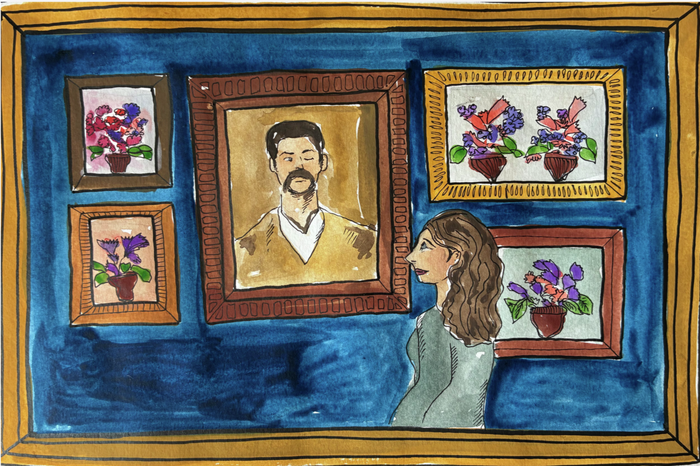
To encounter art fully is to engage more than the eye. Whether through direct sensory stimulation or through the mind’s capacity to reconstruct it, art has the potential to involve the whole body. When this happens, the boundary between viewer and object becomes less fixed, and the experience of art becomes not merely observational, but immersive and deeply felt, where the world of the art has the power to impact ours.
 News / C4P vandalises University offices over divestment10 June 2026
 Comment / Top of the slops: the competitiveness of college dining4 June 2026
 Comment / ‘On the Poverty of Student Life’: sixty years on10 June 2026
 Interviews / What’s the story behind Pages coffee house?8 June 2026
 News / News in Brief: Cambridge crowns, council confirmations, and competitive cricket8 June 2026
 Theatre / Varsity‘s favourite productions of 202612 June 2026
 Arts / Look, don’t touch12 June 2026
 Music / The paradox of the live album12 June 2026
 Film & TV / Motherland writer Helen Serafinowicz on comedy12 June 2026
 Lifestyle / In conversation with Cupid12 June 2026