Finding a (Latin) home among the halls
Lucia Requejo Tabares reflects on the solace Latin spaces provide in Cambridge
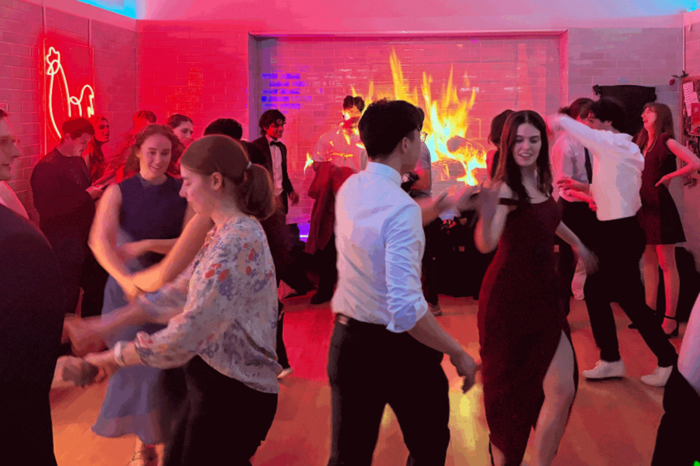
Freshers’ Week at Corpus was surprisingly loud for such a small college. And between endless introductions, formal swaps and repeated club nights, it felt almost impossible not to be overwhelmed by the sheer scale of it all. At times, I was transported to the massive family gatherings I attended in Colombia as a child – greeting distant relatives I had never met before and would probably never would again, joining in the celebrations before eventually crashing out on the couch as the party continued around me.
But there was one crucial difference. I wasn’t in Latin America and I couldn’t just leave once the music stopped. It was at this moment, as Freshers’ Week drew to a close, that the silence beneath the noise became increasingly difficult to ignore. It dawned on me that during my many trips to Spoons, Revs and random college bars, I hadn’t yet met a single other Hispanic student. I had also failed to notice at the time the striking absence of Latin American music in the Cambridge clubs. As someone deeply in touch with their roots, I couldn’t help but feel somewhat unfulfilled. And though I was profoundly grateful for the lasting memories and friendships made during that first week, I realised that if I was going to remain sane for the next three years, I would have to seek out the cultural connection I felt I was missing.
“It dawned on me that I hadn’t yet met a single other Hispanic student”
I quickly found that in a university defined by magnitude and grandeur, the Latin American community, by contrast, emerges in smaller, more spontaneous spaces – easy to miss if you’re not looking for them. Indeed, I first found my way into the community not through a society or a class, but via a DM from a fellow Latina that had gone totally unnoticed during the relentless buzz of my first week. It was through these incidental moments that I slowly forged meaningful cultural connections and discovered Latin events that I otherwise would have never known existed. Who knew that Kiki’s hosts Latin nights on Saturdays as a lesser advertised alternative to the widely known La Vida Sundays? Or that a Latin American society exists, but just doesn’t have a table at Freshers’ Fair since it isn’t officially registered? The Latin American community in Cambridge has predominantly grown through individual effort and word of mouth, and I feel immense pride in observing and partaking in its quiet expansion, but students shouldn’t have to search high and low to find spaces that feel like home when they’re already so far from it.
“Students shouldn’t have to search high and low to find spaces that feel like home”
This struggle is made all the more striking when considering the recent globalisation of Latin culture. Following Bad Bunny’s album of the year win at the Grammy Awards and historic Super Bowl halftime show last month, Latin music has become increasingly mainstream, with its cultural impact reaching far beyond Latin America. Yet, the lyrics and rhythms offer more than mere entertainment – they carry the power of shared language and a profound nostalgia for home. Simply hearing one reggaeton song in the club can make me feel so much more connected to my culture, and can ease the sense of detachment from my roots that rings so loud among the frenzy of this city. Icons like Bad Bunny will leave an enduring legacy that deeply resonates in Cambridge’s hidden spaces – be it at Cuban salsa classes or Las Iguanas, where Latin culture can really be shared, celebrated and deeply appreciated.
For me, some of my happiest moments in Cambridge have been standing alongside the Hispanic friends I’ve made, arms around one another, belting out our favourite Bad Bunny song at the Latin nights we’ve organised. While my identity isn’t entirely defined by being Latina, these moments of cultural unity offer a safe space I can rely on when in need of fulfilment and connection in a place that doesn’t always feel like home. If Latin American culture has come to fill the world’s largest stages, then I have no doubt it will find its place, and ultimately leave its mark, within Cambridge’s historic halls, too.
 News / Venue cancels Cambridge talk by right-wing commentator Matt Goodwin after backlash28 May 2026
 News / Cambridge researchers warn of ‘underestimated brilliance’ if AI grades essays26 May 2026
 Interviews / Cambridge MP Daniel Zeichner on political realism and the ‘politics of grievance’29 May 2026
 Lifestyle / Blind Date: ‘I should’ve changed my socks’24 May 2026
 Comment / The no man’s land between triposes25 May 2026
 Film & TV / Project Hail Mary’s production design shows the power of human creativity30 May 2026
 Music / This music DOES contain hope30 May 2026
 Sport / Should we play more BUCS?30 May 2026
 Features / The language of optimisation and the architecture of merit30 May 2026
 Comment / We must support our strikers29 May 2026