Antony Stokes on the Foreign Office, Mars and LinkedIn
Vienna Kwan sits down with Antony Stokes to discuss all things diplomacy
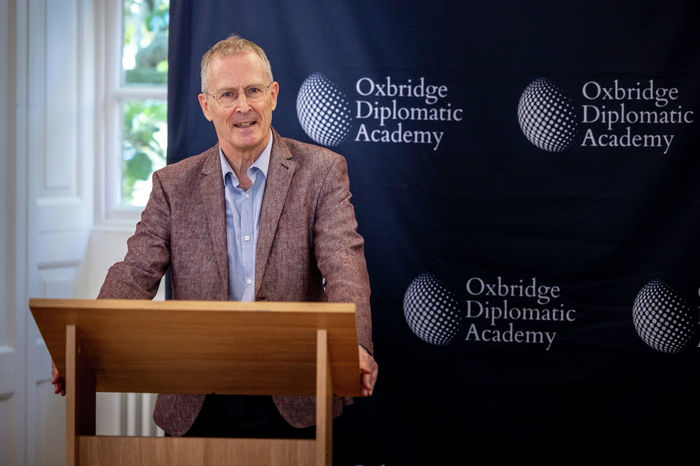
Havana, Hanoi, Bangkok. Those are just a handful of the locations Dr Antony David Stokes LVO OBE has represented the British Crown in, having studied Engineering at Queens’ College Cambridge. He later completed a PhD at University College London in 1990, before joining Her Majesty’s Diplomatic Service in 1994. Early in his career he served in Bangkok, Seoul, and Riga, and he later became Head of Mission to Latvia. He was then appointed British Ambassador to Vietnam, and subsequently served as British Ambassador to Cuba until 2022. After this, he became a diplomacy consultant for Ambassador At Large, contributes to its weekly gazette while also sharing insights about the world of diplomacy with more than 50,000 LinkedIn followers.
Were you part of any societies or extracurriculars during your time in Cambridge?
I did a lot of stuff, but none of that had anything to do with politics, international relations, or diplomacy. The only diplomat I’d ever met was through one thing I did at Cambridge; I led a scientific expedition to study poison arrow frogs in the Colombian jungle. That was supported by the Royal Geographical Society, and I also did some work there for the Natural Astronomy Museum.
“Stop thinking about it and do something that’s difficult in an environment that you don’t understand”
What did you do after Cambridge?
When I left Cambridge, I did a PhD in UCL. I wanted to become an expert in something. I loved learning again and I wanted to understand what it meant, what academia was about and how it worked, and it’s very difficult to really understand things unless you’re inside them. And that’s the advice that I give to a lot of people who try to understand what they want to do or learn about something. Stop thinking about it and do something that’s difficult in an environment that you don’t understand, and that way you learn a lot about the thing that you’re doing and the context you’re working in. That’s why I went into academia.
What did you do after your PhD?
I think a PhD was the right level of academia for me. And then I thought, how do you really get things done in the world? You need to know how to run things; you need to be a manager and understand how to engage with the corporate world. So I went to a big company called Mars and worked for them in commercial management negotiations, and then later as their Human Resources manager for a year. I also did consultancy for a company called the Centre of the Exploitation of Science and Technology.
How did you begin to think about a career in diplomacy?
I did some environmental work, and then I started engaging a bit with the government and the Foreign Office, and they were recruiting at the time.
“There was a question at the final selection board about the UN, which I didn’t know anything about”
How old were you when you switched to the diplomacy route?
I’m not unique in having joined at 30. I think the Foreign Office found it odd at the time. I mean, when I applied for the Foreign Office, it was very speculative. I really did it out of curiosity. I wanted to know what it was about. It wasn’t that I had a burning desire to be a diplomat. And I never thought that diplomacy was even a remote possibility for somebody like me.
What was the application process like?
I had to go through the standard steps of the Civil Service process first. We had to sit down and do numerical tests and verbal tests, and that was all fine. The process surprised me because they didn’t really test anything to do with knowing anything about foreign policy or international relations. But, there was a question at the final selection board about the United Nations, which I didn’t know anything about. They asked me “should Japan and Germany be permanent members of the Security Council?” Somehow I managed to answer. But until that point, it was all about ‘can you communicate, can you organize, can you manage? ’
Was it an easy decision to change careers?
I said to [the Civil Service]: “I don’t really want to do a job that a graduate is going to do. I’d want a more senior job. And also, I’m being paid quite well at Mars and I don’t want a graduate salary. You’re going to have to pay a little more and give me a more senior job.” A day later, they came back and said: “Okay. We’ll give you a higher level job and a higher salary than the normal starting grade.” I was very surprised, I have to say, and quite impressed, because I didn’t think the bureaucracy would allow them to be that flexible.
“I did it for 100 days in a row, and there was an enormous appetite for it”
How did you get involved with social media and LinkedIn?
I think that there is a gap that we would do well to work hard to fill, and that’s really what I’m trying to do myself with social media. I started writing on LinkedIn because people were asking me questions about being an ambassador. People didn’t really understand what an ambassador did. I thought, I’ll just spend 15 minutes before I go to bed to write on LinkedIn. I did it for 100 days in a row, and there was an enormous appetite for it.
How did you get involved with Substack and The Gazette?
People want to work in diplomacy and in some way with diplomats, so how do they get to do that? That’s what I’ve been writing about, and that’s why I’m now publishing on Substack because LinkedIn doesn’t have that much space, and it’s a medium that rewards writing in a certain way. So I’ve started very recently with The Gazette, which I’m publishing every week to help people decode what diplomacy is about.
 News / Venue cancels Cambridge talk by right-wing commentator Matt Goodwin after backlash28 May 2026
 Interviews / Cambridge MP Daniel Zeichner on political realism and the ‘politics of grievance’29 May 2026
 Features / The language of optimisation and the architecture of merit30 May 2026
 Comment / We must support our strikers29 May 2026
 Lifestyle / Blind Date: ‘I should’ve changed my socks’24 May 2026
 Film & TV / Project Hail Mary’s production design shows the power of human creativity30 May 2026
 Music / This music DOES contain hope30 May 2026
 Sport / Should we play more BUCS?30 May 2026
- Features / The language of optimisation and the architecture of merit30 May 2026
- Comment / We must support our strikers29 May 2026