The paradox of literature
Katy Wong explores how reading for her degree impacts how she reads for pleasure
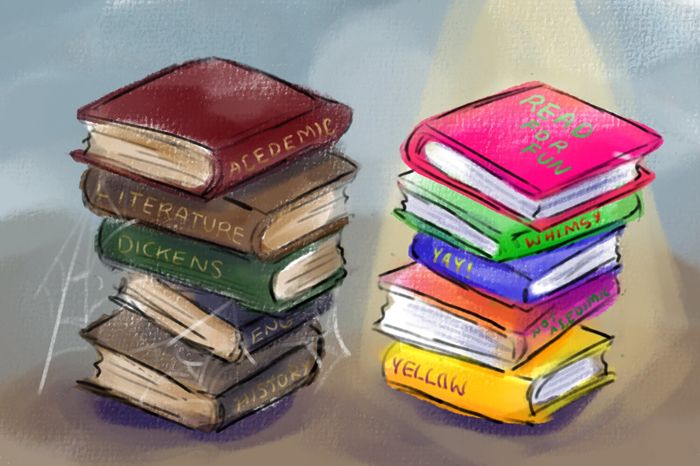
I like to know as little as possible going into a book. Not knowing the twists and turns or how tropes are utilised or subverted allows me to experience the full range of shock and excitement. I read for these heightened emotions, for what they say about real and fantastical worlds. Like many others, I pursued an English degree because of my love for literature. Yet I was quickly confronted by the disturbing paradox embedded in literature degrees: we study literature because we love to read, but these degrees force us to read in ways that detract from enjoyment, corrupting our original motivations.
To anchor myself in dense, archaic language, I read summaries of works like Sir Gawain and the Green Knight or Paradise Lost. This makes it easier to relate the meanings of individual words and sentences to the plot but ruins all surprises for myself. A typically immersive reading experience is disrupted by the frenetic search for some intelligent insight I could write 2000 words on before my next supervision. The rigorous analysis of texts when reading and writing, combined with the time pressure, have prevented the books I’ve read for my degree so far from becoming favourites.
“We study literature because we love to read, but these degrees force us to read in ways that detract from enjoyment”
But I don’t think that, to derive the greatest possible pleasure from reading and to preserve our love of literature, we have to turn our brains off. We shouldn’t need to neglect fascinating significations of character interactions, plot twists, settings. Fiction moves us deeply because it touches us and the world we live in. As Ralph Waldo Emerson puts it: “Fiction reveals truth that reality obscures.” Fantasy may comment on rebellion and hope, historical fiction on trauma and courage, mystery on justice and deception. When reading recreationally, thinking critically in a stress-free manner throws characters and the narrative into sharp relief, deepening my attachment to them.
This is not to say critical analysis of literature in an academic (particularly Cambridge) setting takes all the joy out of reading. While the reading process itself may be laborious, the individual and collaborative analysis that follows has evoked a new, unexpected enjoyment of literature, different from what first compelled me to study it. You begin with trying to present and unpack complexities on the page without confusing yourself or your work’s own reader, stretching your understanding of the text as you transform vague bullet points into cogent paragraphs. Discussions with peers and supervisors then bring ideas you dimly registered but couldn’t quite pinpoint into light, simultaneously complicating ambiguities and investigating how they relate to past and present human experience. This arduous but more rewarding kind of analysis enlarges the world of the text, guiding me to territories I didn’t know existed and revealing how much more there is to see.
“To read is to step through a door into an unknown world”
Having that initial love for reading taken away when studying literature is unsettling, but there’s a complementary harmony in it. The fulfilling exhaustion of pushing my mind to its limits through academic reading and analysis strengthens the need for the pleasures of recreational reading. A more relaxed analysis, potentially just a collection of inchoate thoughts, leaves room for immersion in fantastical universes. To read is to step through a door into an unknown world: sometimes we may want to equip ourselves with magnifying glasses and sensors to see everything there is to see, but there’s also a time for travelling light. There’s wonder in examining the nuances of texts and commending the writer’s artistry and mastery, but also in relishing the texts’ emotional impacts without interrogating how they’ve been achieved. It’s valuable to let a story carry you away instead of gripping it tightly, admiring its mystery instead of trying to see through its construction. In other words, there is value in both exploring the ‘truths’ with which literature connects itself to our world and appreciating literature in and of itself, as “a thing in the world,” as Susan Sontag puts it: “Not just a text or commentary on the world.”

Enjoyment of literature is multifaceted. It encompasses the satisfaction of unravelling complexities, approaching some grand truth that might or might not exist, the magical delight of falling in love with characters and worlds without dissecting why they speak to us the way they do: there is awe in knowing and not knowing. Studying literature doesn’t have to be paradoxical. If we recognise that, just as a kaleidoscope yields infinite, colourful patterns rather than a singular view, the experiences we draw from literature can be as wide-ranging as the literature itself.
 Comment / The Cambridge drift1 June 2026
 Comment / Top of the slops: the competitiveness of college dining4 June 2026
 News / Cambridge psychologist warns against blanket social media ban for under-16s1 June 2026
 News / University support staff strikes end after month of action2 June 2026
 Music / We need to talk about Kendrick2 June 2026
- Comment / Top of the slops: the competitiveness of college dining4 June 2026
 Interviews / Bible Scholar Mattie Mae Motl: “God is a woman”4 June 2026
 Features / One big happy (college) family?4 June 2026
 Theatre / Bold beginnings in the Corpus Playroom 3 June 2026
- Music / We need to talk about Kendrick2 June 2026