A potty display?
Yulianna Nunno reflects on the ethics of the art in the bathroom of 196 Bar
If you go down to Mill Road, cycle towards the train station, cross the bridge that goes over the tracks and keep going just a bit further, you’ll find the 196 Bar. This candlelit, cozy spot invites you in; the handwritten menus create a personable touch, the drinks are delicious. Now, being a cocktail bar, it’s only a matter of time before you’ll check out the bathroom. And for the minute or two you are there, I invite you to have a look around.
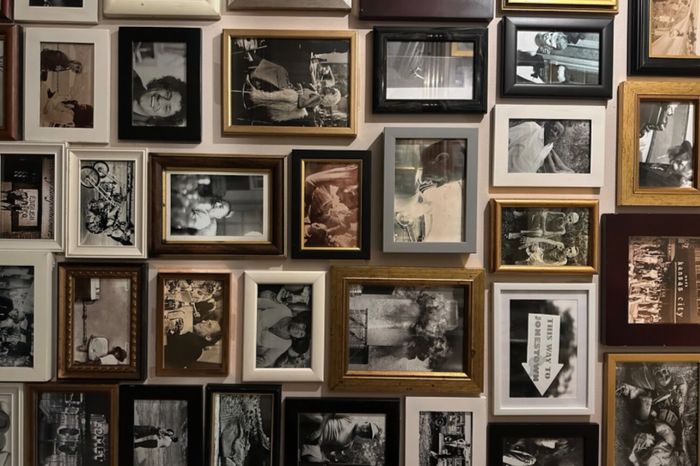
All four walls are covered floor-to-ceiling with famous photographs wrapped in unique frames, seemingly collected over years of antique browsing. The photographs are mostly black and white, many of them on film. They depict some of the most famous photographed people, events, icons, and symbols in visual culture. There’s Elvis Presley, Martin Luther King Jr., Marilyn Monroe, Elton John, Billy Preston, Bridgitte Bardot, Lucio Battisti. There’s the ‘Hippie Bus’ from Woodstock in the 60s, Theresa Needham in her renowned Chicago bar, ‘Theresa’s Lounge,’ Olympian Mary Decker’s fall at the 1984 Olympics, a McDonald’s happy meal, a Prozac pill. But there’s also a photograph depicting the moment before United Airlines Flight 175 hit the South Tower. Near that, there’s the KKK burning a cross, emaciated war prisoners, U.S. segregation-era water fountains labelled “coloured” and “white”. There are photographs from the Holocaust, Andy Warhol’s Electric Chair, scars on the back of an enslaved man, and more. These photographs depict the worst of humanity. And they simply hang there, an artistic choice, in the bathroom of a cocktail bar.
“Suffering and celebrity, through your act of seeing art, became one and the same”
I left the bathroom with more questions than answers. Who curated it? To what end? Are they using art to make a point? Or is it merely aestheticised suffering, just another trendy bar inundated with 20th-century nostalgia? I felt the bathroom had made a spectator out of me. It took what would normally be a private space and staged a panoptic scene with myself and the toilet at the center. As I stood there, gazing upon the face of celebrity, the face of suffering, I was forced to reckon with my own act of seeing. Look at how you see these photographs, the walls seemed to whisper. Look at how suffering and celebrity, through your act of seeing art, became one and the same. I thought about the work of Guy Debord, Jean Baudrillard and Samuel Weber on the spectacle of visual events. Perhaps making the spectacle of famous photographs visible to guests was the point.
At the same time, I felt that the context rendered design choices questionable. Too often, as bell hooks reminds us, art turns to Black history, culture and suffering to build aesthetic, without proper engagement or even awareness of the context from which it takes. Much the same can be said about the media’s treatment of war; think Hollywood’s cheesy, propaganda-esque, commodified shock-value renditions of World War II, Vietnam, the ‘War on Terror.’ On this count, the 196 Bar bathroom seemed guilty as charged. Photographs take on meaning from their context. In a museum, Bar 196’s curation might have made more sense. In a bar, however, the photographs are understood by the viewer as décor, with art taking on a different meaning. There are different ethical considerations involved in the depiction of suffering under these circumstances. Besides, there is only so much critical engagement one can expect from bar guests in the bathroom.
“In a museum, Bar 196’s curation might have made more sense”
Nevertheless, I found myself curious about the curator. The bartender proceeded to explain that the owners of the bar are avid photograph collectors. Sometimes, he said, people get offended by the photographs. They ask the owners to take them down. I found a review on Trip Advisor to this effect: “[I] was informed that these [photographs] were ‘deliberately provocative, iconic moments in history.’ Whilst I do understand the power of an uncomfortable photograph in changing people’s perception for the better, there was no context and I’m not sure most people out for a drink want to see photos of murder in the loo.”
The bar’s décor creates an odd situation where two opposing claims seem true at once. The bathroom is unethical. There is an equivalence drawn between suffering and popular culture without care for the viewer. The context that visual media has in a bar versus a museum, alongside the questionable anonymity of the curator, makes the laissez-faire depiction of suffering careless at best, horrific at worst. The bathroom should not exist in its current decorated form. And yet, the fact that it did exist prompted a reflection on spectatorship, one which forced me to look inward, to be critical of my own viewing practice. Is this enough to justify the photo wall? Given everything, I think not. It seems too charitable to give the owners critical artistic intent. Not these photographs, not this context. Yet it’s unlikely that the bathroom décor at Bar 196 is going anywhere – my Internet sleuthing found that it’s been a mainstay since at least 2017 – but maybe that’s why it’s worth thinking about.
 Comment / The Cambridge drift1 June 2026
 Comment / Top of the slops: the competitiveness of college dining4 June 2026
 News / Cambridge psychologist warns against blanket social media ban for under-16s1 June 2026
 News / University support staff strikes end after month of action2 June 2026
 Music / We need to talk about Kendrick2 June 2026
- Comment / Top of the slops: the competitiveness of college dining4 June 2026
 Interviews / Bible Scholar Mattie Mae Motl: “God is a woman”4 June 2026
 Features / One big happy (college) family?4 June 2026
 Theatre / Bold beginnings in the Corpus Playroom 3 June 2026
- Music / We need to talk about Kendrick2 June 2026