From cloisters to concrete
Ben Bailey tracks the stylistic development of Cambridge buildings

Sat in Lecture Room One in Scroope Terrace, listening to a talk by the American, rather elderly, architect Peter Eisenman and his (less elderly) wife Cynthia Davidson, I was struck by the fact that all architects appear to peak in their eighties and nineties. Frank Lloyd Wright, Norman Foster, the late Frank Gehry all reached the peak of their powers as octogenarians and nonagenarians. This led me to wonder whether I would have to wait 71 years before I would earn my rightful place as a star-chitect alongside them, and whether becoming a successful architect is some kind of evolutionary competition – whoever lives the longest will become the most successful. A survival of the functionalist.
In the midst of my existential crisis, Eisenman talked fascinatingly about his time teaching at Cambridge. At the time (during the 50s and 60s), it was an important place in the world of architecture. This is the period when the department of architecture was led by Leslie Martin, a very prominent modernist architect in Britain who designed the Royal Festival Hall and made a significant imprint on the post war architecture of London, Oxford, and Cambridge. Most notably for Cambridge, he designed Harvey Court for Gonville and Caius and the William Stone Building for Peterhouse.
“Harvey Court in particular is indicative of Martin’s approach to the university’s expansion”
As the lead professor in the department, Martin had significant influence over the architecture of the new faculty buildings and colleges as the university rapidly expanded in the 1960s. Harvey Court in particular is indicative of Martin’s approach to the university’s expansion: there was a sense of appreciation for the traditional college layout, with its quadrangle court structure and its ability to create a feeling of enclosure and privacy in an academic community. But he brought new materials to these existing forms and, being the cold modernist he was, removed any ornamentation or frivolities. There was no effort to incorporate the cloisters or detailed stonework of the older colleges in some kind of neo-gothic, kitsch Poundbury-style imitation; this would have been sacrilege to his modernist contemporaries. But his ability to combine the rationality and functionality of new materials and strong geometric forms with the existing precedents of the ancient city should be noted – he was empathetic rather than radical. This spread to his approach to the geographic expansion of the city. He suggested the expansion should occur in rational, functional clusters, like Sidgwick Site, where academics of different departments could interact within campuses of similar disciplines.
The key to Martin’s success, Eisenman suggests, was his ability to network with the rising architects of the time and to bring attention to their work. Colin St. John Wilson, Alison and Peter Smithson and James Stirling were all beneficiaries of Martin’s generosity and would all become leading figures of modernist architecture in their own right. Particular attention should be given to the Smithsons and Stirling, some of the most important architects of the twentieth century in Britain. The Smithsons, who could be seen as the first proponents of what was later termed brutalism, are best known for the Robin Hood Gardens Estate, the remnants of which can be seen at the V&A East Storehouse. Stirling, another early adopter of brutalism, is best known for his university buildings, in particular the brick behemoth of Sidgwick Site that is the History Faculty Library. Sadly, Stirling later fell victim to the allures of postmodernism and his work took a turn for the weird in the 70s and 80s. Despite this, the most prestigious architectural prize in the UK was posthumously named after him.
“Architecture is not just about designing; it is about being able to think about designing and therefore being able to write about it”
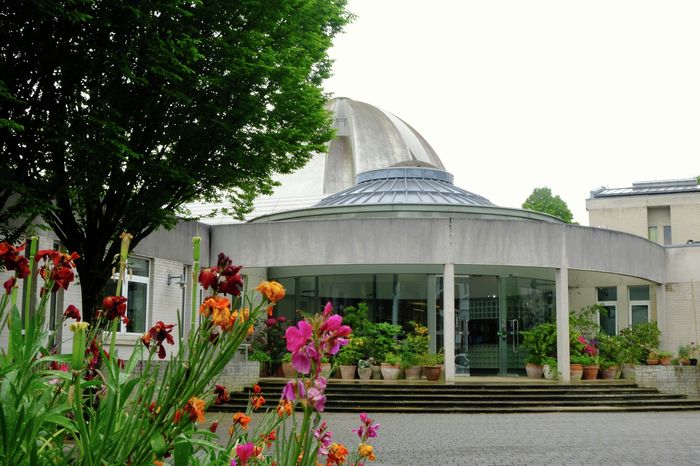
Martin’s eye for architectural talent was clearly very effective and he should be given credit for boosting the reputations of these younger architects. Yet it is important to remember that he was also a talented architect himself. This can be seen locally, not just in his designs for Caius and Peterhouse, but also on a visit to Kettle’s Yard, where the understated and elegant extension was designed by Martin. His contemporaries may have been brutalist enthusiasts, but he was not. There is a much more considered, clean look to the extension of Kettle’s Yard, which is far more in line with the Nordic simplicity of Alvar Aalto than the harsh concrete forms of the Smithsons. The focus of the addition is on providing light and space to the art.
In Eisenman’s talk, though he often went on meandering but absorbing tangents about the aforementioned architects that he worked with, his main message was clear. Architecture is not just about designing; it is about being able to think about designing and therefore being able to write about it and communicate your ideas. This was the key to Martin’s success. Although, his influence on the modernist expansion of the university is not without fault, as to this day a significant tension can be felt between the old and the new. That said, it is hard to imagine another British architect during a period of fervent ahistoricism being quite as sensitive and logical. He also managed to get a knighthood for his services to architecture at the tender age of 49. I can only hope to follow suit.
 Comment / The Cambridge drift1 June 2026
 Comment / Top of the slops: the competitiveness of college dining4 June 2026
 News / Cambridge psychologist warns against blanket social media ban for under-16s1 June 2026
 News / University support staff strikes end after month of action2 June 2026
 Music / We need to talk about Kendrick2 June 2026
- Comment / Top of the slops: the competitiveness of college dining4 June 2026
 Interviews / Bible Scholar Mattie Mae Motl: “God is a woman”4 June 2026
 Features / One big happy (college) family?4 June 2026
 Theatre / Bold beginnings in the Corpus Playroom 3 June 2026
- Music / We need to talk about Kendrick2 June 2026