Documenting a war in 2000 Meters to Andriivka
Annabelle Werner attends the Cambridge Ukrainian Society’s documentary screening
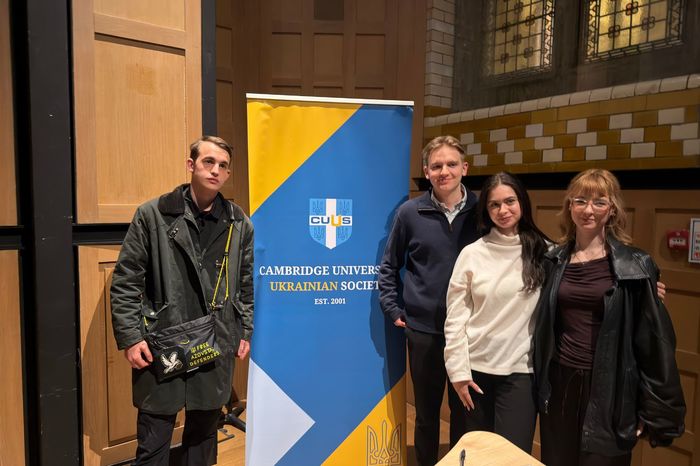
On a Friday night in the Gonville and Caius auditorium, viewers were able to peer into the lives of soldiers on the frontlines of the Russia-Ukraine war through the screening of the documentary, 2000 Meters to Andriivka.
The award-winning film was produced through body-cam footage of trench warfare. Harrowing images of combat are contrasted with quiet conversations in the foxholes. The opening scene is as feverish as it is haunting – the audience feels as if they are alongside the soldiers in the dark armoured personal carrier, waiting for orders to begin the assault. The door swings open, and the 3rd Assault Brigade is immediately bombarded. The horrid fog of war envelops the men. The last image is from the view of a wounded solider as he looks up at the sky from the bottom of the trench.
The film is straightforward in depicting Ukraine’s objective: the 3rd Assault Brigade must, inch by inch, engage in infantry-style fighting to push the Russians out of a narrow forest and recapture the town of Andriivka. The forest is mined on either side, so if they are to retake the town and reassure their allies amid the struggling counteroffensive, they must fight their way through the forest. Journalists Mstyslav Chernov and Alex Babenko embed themselvesin the unit and tell the stories of the men tasked to do so.
We get to meet the soldiers in the foxholes. The audience is stirred by the surprising ‘normalcy’ of their conversations of past university days, or moved by the heartfelt concerns of a grandfather, Sheva, for his wife back home. A Hollywood-made action film might soon cut to these soldier’s triumphs and homecomings, assuring the viewers that their sacrifice was rewarded, but here the viewer learns after these two interviews that the men are later killed. The film shows another soldier, Gagarin, fighting before being killed in action. We see his funeral procession before the scene pans out to the massive, expanding graveyard. Now that we have been informed of the human cost of the counteroffensive, the 3rd Assault Brigade succeeds in capturing the town. Sergeant Fedya plants the flag and rescues a stray kitten. The audience then learns that the town was later recaptured by Russians.
This film strips out the aggrandizement of war found in action movies and shows it for what it is: a bloodbath. The audience is astonished by heroism of everyday people, but this film more aptly reminds us that there are Vonnegut-esque worlds existing right now in European cities. The audience left the theatre imparted with glimpse of a place not physically far, but worlds away from the medieval towers of Cambridge.
“This film strips out the aggrandizement of war found in action movies and shows it for what it is: a bloodbath”
Co-producer Alex Babenko, who filmed from the trenches, attended the screening and fielded questions from the audience. He described how the war has changed since he and Oscar- winning director and producer Mstyslav Chernov were in Andriivka. He discussed how onecould not create such a documentary now due to the use of drone warfare which has created a kill-zone along the frontlines. When asked about the filming process, Babenko also shared that the greatest challenge he faces as a storyteller is showing the things people don’t want to see. “War will be lost if there is no word from Ukraine,” he told us.
Members of the Ukrainian Society at Cambridge coordinated the event. Sofiia Shypovych, a final-year PBS student, was moved by how the film depicted humanity in such inhumane places. She referenced the brotherhood shown between the soldiers, particularly one of the final scenes where the remaining soldiers of the brigade called out in unison, “present,” for attendance of the fallen soldiers.
“War will be lost if there is no word from Ukraine”
This film was shown the same week as the four-year anniversary of Russia’s full-scale invasion of Ukraine. It in some ways acts as an intimate memorial for the soldiers: the audience gets to meet them in the only place they remain alive. In other ways, it is a message to leaders that the battleplans and negotiations they pen from afar are paid for by real people.

2000 Meters to Andriivka was received well by the Cambridge community, and students shared about being moved by the film’s message.
Additionally, Babenko reported that the cat recused from the town was named Andriivka and is happy, healthy, and now has become quite large.
 Comment / The Cambridge drift1 June 2026
 News / Cambridge psychologist warns against blanket social media ban for under-16s1 June 2026
 News / News in Brief: Corpus climbing, climate cash, and commendable contributions1 June 2026
 Theatre / CUMT’s The Wind in the Willows brings a classic to life 31 May 2026
 News / Venue cancels Cambridge talk by right-wing commentator Matt Goodwin after backlash28 May 2026
 Music / We need to talk about Kendrick2 June 2026
 News / University support staff strikes end after month of action2 June 2026
 Arts / To the letter2 June 2026
- News / Cambridge psychologist warns against blanket social media ban for under-16s1 June 2026
 Sport / Caius beat Magdalene in last-minute thriller to clinch mixed netball Cuppers final1 June 2026