The Sleep of Reason Produces Monsters, or so they say
Ludovica De Lorenzo reflects on the fine line between hope and nihilism in Goya’s haunting print
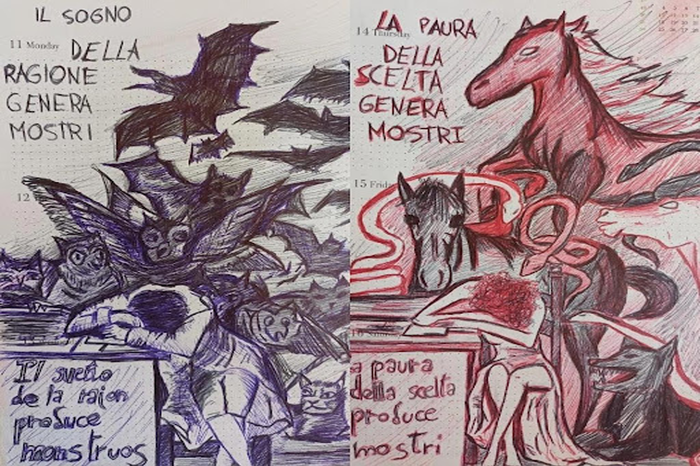
Six years ago, I was leafing through the pages of a Spanish art history book when I discovered Francisco Goya’s print of 1799, The Sleep of Reason Produces Monsters. What immediately struck me was the overwhelming number of owls, animals I knew preannounced death and misfortune. I had seen them in paintings before, but never as enraged and unruly as in Goya’s print. A man sits in the foreground, looking hunched and dazed: it is unclear whether he is sleeping, ignoring the owlish mob, or protecting himself from their attack. Even years later, my first impression of this artwork and the intense feeling of sorrow it communicated to me has stayed in the back of my mind.
Then, recently, I was reminded of Goya’s artwork, while sunbathing under a punishing sun and reading Pablo Neruda’s poem ‘Walking Around’:
The smell of barbershops makes me break into hoarse sobs.
The only thing I want is to lie still like stones or wool.
The only thing I want is to see no more stores, no gardens,
no more goods, no spectacles, no elevators.
Reading the poem, I felt a curious feeling of cold, so similar to that first impression of Goya, which almost made me forget the heat of the summer sun and scorching sands. The link I found between Neruda’s poem and Goya’s artwork was neither historical nor properly geographical: it was simply the way I felt after reading the poem that brought them both together in my mind.
“Like Goya’s maddened owls, the maddening facts of everyday life ambushed Neruda, making him want to live where nothing else remained”
That poem helped me grasp what I didn’t get when I was younger, which was the nihilistic attitude of Goya’s print. In Neruda’s poem, stores and gardens and all other material elements are a disturbing, distracting, disabling presence in the author’s life. Stuck in his own thoughts, Neruda perceives reality so intensely that even simple things, like the smell of barbershops, cause him discomfort. The poet’s vulnerability is the reason why he repulses simple things. Like Goya’s maddened owls, the maddening facts of everyday life ambushed Neruda, making him want to live where nothing else remained.
So, nihilism is what binds the artwork and the poem together. Goya makes its cause explicit in the title of his piece: ‘The Sleep of Reason Produces Monsters’. What did Goya mean by that? I wondered to myself as I put my copy of Neruda down on the sand. Perhaps Goya was pointing to the insanity that had caused and followed the Peninsular war in Spain, his work responding to and satirising the times. Or perhaps it was something else. In the original title, the Spanish sueño can mean ‘sleep’, but it can also mean ‘dream’. This leads to another interpretation: ’The Dream of Reason Produces Monsters’. Goya is showing two faces of the same coin: too much thought can cause just the same monsters as too little. For Goya, mindlessness is just as dangerous as overthinking.
“It feels like nowadays there is more to think about, and more to overthink about”
When Goya made this artwork, he was in a vulnerable phase of his life, physically feeble and now deaf. So his nihilism, like Neruda’s, reflects a feeling of helplessness, both as a person and as an artist. I sympathise with this feeling of helplessness as I look at what is going on around me today. Because of the absence of reason, terrible events and harms have occurred: we have witnessed a century of numerous injustices, some on a global scale. And, as I see it, the ‘dream’ of reason is also just as prevalent in our society today. It is arguably even more amplified. It feels like nowadays there is more to think about, and more to overthink about: phenomena like social media, fomo, and performative intellectualism are producing monsters. People are endlessly ending up in dark rabbit holes that detach them from reality. It is enough to make people feel bleak; to feel the same nihilism that Goya grasped over two centuries ago.

But nihilist artworks don’t necessarily have to make us feel empty and helpless. What fascinates me about The Sleep of the Reason Produces Monsters is that, even though this is one of Goya’s darkest pieces, we can find a glimpse of hope. Seeing Goya place so much importance on the effects of reason, it confirms to me that, if used in the right way, thought and analysis can be beneficial. If we can find the balance between ‘sleep’ and ‘dream’, then we can find the antidote to the poisons seeping through our society. Unexpectedly, the darkest and most pessimistic artworks, in Goya’s print and Neruda’s poem, are those that shed the best light on what’s really important and give me hope.
 News / Simon Goldhill resigns following sexual misconduct investigation16 June 2026
 News / Ted Yip elected Union President after contested race 19 June 2026
 Theatre / ‘Mental illness doesn’t exist in a vacuum’ says Obsessive, Compulsive, Divine 18 June 2026
 Lifestyle / You can’t always get what you want 18 June 2026
 Comment / Exercise, academia, and the Cambridge addiction to both17 June 2026
 Fashion / The trials and tribulations of sewing your own wardrobe19 June 2026
 Science / Science can tell us right from wrong19 June 2026
- News / Ted Yip elected Union President after contested race 19 June 2026
- Lifestyle / You can’t always get what you want 18 June 2026
- Theatre / ‘Mental illness doesn’t exist in a vacuum’ says Obsessive, Compulsive, Divine 18 June 2026