The Saab’s long road to Hollywood
Freya Compton dives deep into the history of the car brand’s movie stardom
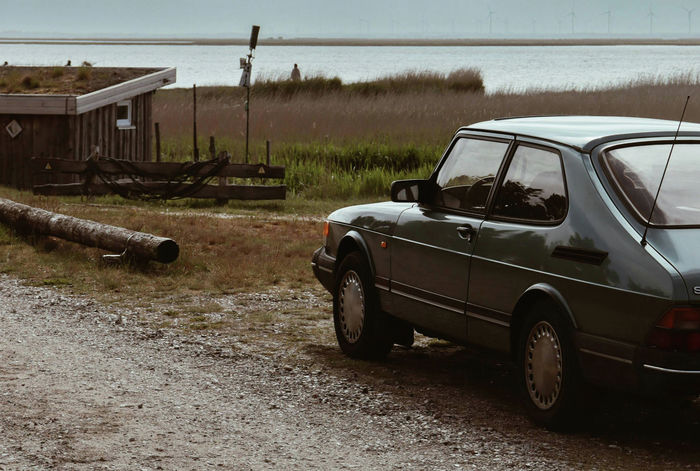
Every so often, a car becomes a movie star, but it’s usually an individual vehicle personified creatively, or beloved by a main character – think Herbie the VW Beetle, Chitty Chitty Bang Bang, or the Batmobile. It’s rare that a model, or an entire brand, becomes central to a film or series – and when it does happen, it can be the key to realising the brand’s image, changing its status by forever inscribing it into an iconic hall of fame. Bond and his Aston in Goldfinger (1964) for instance, the Alfa Romeo Spider Duetto in The Graduate (1967), the famous post-apocalyptic Ford in Mad Max (1974) and even Baby Driver (2017) reminded us of the rally magic of the Subaru WRX.
“It’s rare that a model, or an entire brand, becomes central to a film or series”
But one car brand which has resiliently held a significant place in cinema and TV, and for good reason, is the Saab. Yes, nowadays it may be one of many cars that you’ll see more frequently being blown up in action shots (several exploded in London Has Fallen (2016)) due to the decreasing value of individual older vehicles. This is, sadly, thanks to the company going bankrupt in the early 2010s. But let’s not forget that it’s a brand with absolutely legendary models – something which a quick look through its use in film history clearly demonstrates.
The car which launched the brand into stardom was the beautiful Turbo 99. The quality of this 70s, rally-bred sports sedan was reflected in its starring in The Human League’s ‘Don’t you want me’ music video, TV series such as BBC’s Luther, and films including The Hard Way, and The Four Seasons.
Bond himself drove their next titan – the infamous Saab 900 Turbo – before the Bentley and Aston pivot that the series underwent in the 80s. The scene where he smoothly approaches 200 km per hour cemented the iconic model, which was already quickly becoming a rising star, into the history books. From here, Saab became the pinnacle of grace, capable of impressive speed and reliable comfort – they were by now an internationally recognised brand with a quiet elegance. But they maintain their edge: Back to the future II featured one of Saab’s coolest prototypes which never made it to production – the Saab EV1 – reminding the cinematic world that its brilliance is in its versatility as much as its charm.
“These cars have the power to effortlessly round off a plot line or a character”
Moving into the 90s, the 900 had long achieved cult status, and new models such as the classy convertible 9-3, and comfort car 9-5, began to be popularised in romcoms like Sweet Home Alabama (2002), and The Sweetest Thing (2002). These cars have the power to effortlessly round off a plot line or a character; let’s not forget, in which car did an awkward but adorably likeable Colin Firth drive around Aurora, the Portuguese maid, in Love Actually (my personal favourite storyline of the film) – of course it was a Saab!
These cars have something special about them that shines through the screen – and it’s not just something that’s noticed by audience members who happen to be car-fanatics. It’s trustworthy, and it has an understated but intelligent vibe which compliments the thoughtful, quirky main character. In driving these models, they become someone sophisticated and spirited – for they chose a timeless car known for its quality, but desired for its panache.
More recently Saabs have made a resurgence, particularly in creating that distinctly British vibe that mixes well-dressed politeness with morally strong yet complex characters. Take detectives for example: in Ludwig (2024) the quintessentially British protagonist played by David Mitchell has a Saab as his humble but smooth vehicle, as does DI Annika Strandhed in Annika (2021-23). The adaptability of the Saab look undoubtedly contributes to the car’s durability in British TV. Being able to move from an iconised Bond sequence which first raised its profile to the ordinary, but certainly not unnoticed, cars in TV dramas is a skill we shouldn’t underestimate – it’s certainly something that producers picked up on.
“[They can be] exactly the unobtrusive vehicles that ‘just fit’, or the statement car that draws our eye”
They don’t have to be flashy, or any kind of boastful classic, the Saab is genuinely beloved – both for its smoothness, and its unpretentious but distinct style. When used well, it’s unmistakably a worthy replacement to the classic Volvo of the ordinary protagonist, or the BMW of the luxurious lifestyle (as the brand themselves liked to remind us, their roots were in fighter jet production)!
There is no doubt that Saab has carved out their place in cinematic history. They managed to create cars that can both occupy their own place in the narrative or act as the finishing touch to an admirable character’s persona. They can add flair, class, and quiet intellect all in one, being exactly the unobtrusive vehicles that ‘just fit’, or the statement car that draws our eye.

It may have been the clear choice for producers years ago precisely because it didn’t fit any one stereotype, yet managed to create an impressively honest and refined image nonetheless. Either way, keep an eye out for a Saab on your screen, you may spot them more often than you expect.
 Interviews / How sustainable is your college? CLOC on their college ranking system24 May 2026
 News / Cambridge researchers warn of ‘underestimated brilliance’ if AI grades essays26 May 2026
 Lifestyle / Blind Date: ‘I should’ve changed my socks’24 May 2026
 Comment / The no man’s land between triposes25 May 2026
 News / News in Brief: ducks, dinosaurs, and drama series25 May 2026
 Theatre / A letter to the student writers of Cambridge 27 May 2026
 Film & TV / The Saab’s long road to Hollywood27 May 2026
- News / Cambridge researchers warn of ‘underestimated brilliance’ if AI grades essays26 May 2026
 Music / Soundtrack your life26 May 2026
 Arts / Does Cambridge lack spaces for creative freedom? 26 May 2026