News in Brief: ducks, dinosaurs, and drama series
A light-hearted round-up of this week’s stories, including a Queens’ student’s Guinness World Record, and discoveries about dinosaurs
Goh-ing for a Guinness World Record
Queens' College student James Goh has received a Guinness World Record for the longest ever spin of a fidget spinner on one finger. The 23-year-old engineering student’s record-breaking time was 30 minutes and 34.54 seconds, beating the previous record by almost five minutes. Goh used the physics of gyroscopes, which he studied as part of his Manufacturing Engineering Tripos, to engineer his own fidget-spinner, citing the spinning top in the film Inception as his inspiration. Commenting on his record, Goh said: “This has been a hobby of mine since I was a kid, so I’m delighted to get the record – although my finger did ache a little bit after holding it in the same position for so long. I suppose in a way I’ve taken the fidget out of fidget spinning!”
A quacking journey
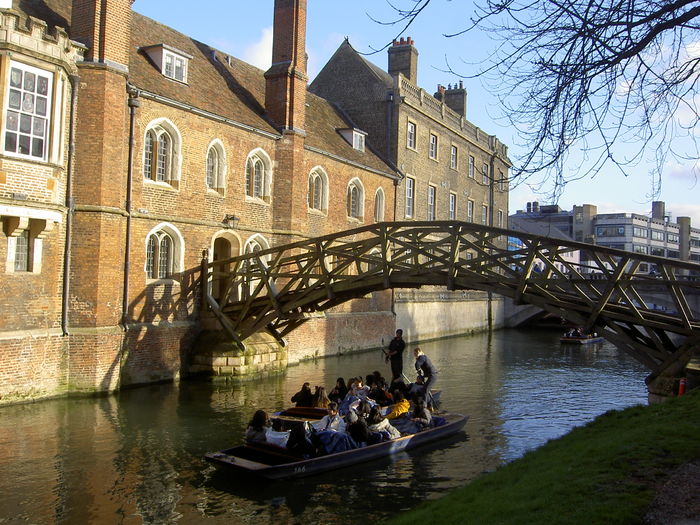
Cambridge porters have been helping ducklings complete their migration across Cambridge this term. The annual tradition sees porters from Corpus, Catz, and Queens' guide mother ducks and their ducklings along their way from Corpus, towards the River Cam. This year, a family of ducklings travelled from their nest across Trumpington Street, to Queens', where the ducklings jumped into the river from the Mathematical Bridge - as opposed to previous years when mother ducklings have tended to enter the water via the bank on the other side of the bridge.
Dinosaur discoveries
Researchers at Cambridge and UCL have discovered the likely reason for several groups of carnivorous dinosaurs such as the T. rex, evolving tiny arms, attributing it to the development of large, powerful skulls and jaws, which they used to attack prey. A team, which included Fellow of Girton College, Dr Elizabeth Steell, analysed data for 82 species of theropod (two-legged, primarily carnivorous dinosaurs), among which five groups developed shorter arms, including tyrannosaurids. They also suggested that the dinosaur’s use of their jaws and head rather than their claws was due to the increasing size of prey. Steell said: “We’ve just confirmed what many people have suspected, which is that if you’ve got a big skull and you’re tackling big prey, then you don’t need your arms as much, and arms become a bit redundant.”
A T-riffic return

ITV crime drama Professor T is set to return for a sixth season, following the airing of season five later this year. The series is based in Cambridge, and stars Ben Miller, a Catz alum, as a University of Cambridge professor in criminology. His character, Jasper Tempest, is a genius who has obsessive-compulsive disorder. According to the show’s synopsis, Tempest is “obsessed with cleanliness, structure and order but his genius for solving crimes means he is constantly having to get his hands dirty, helping the police crack their most difficult cases.”
 Comment / Top of the slops: the competitiveness of college dining4 June 2026
 Interviews / What’s the story behind Pages coffee house?8 June 2026
 News / News in Brief: Cambridge crowns, council confirmations, and competitive cricket8 June 2026
 Comment / The Cambridge drift1 June 2026
 News / Cambridge researchers produce ‘world-first’ AI vaccine6 June 2026
 Arts / Don’t rush me – I’m reading!9 June 2026
 Lifestyle / Don’t Cry at Me, Argentina – a next-year abroad story8 June 2026
- News / News in Brief: Cambridge crowns, council confirmations, and competitive cricket8 June 2026
 Science / Failure is the foundation of science8 June 2026
 Fashion / The hidden gems of formal fashion8 June 2026