Captain’s Corner: Brazilian Jiu-Jitsu
Sam Ho speaks to Blues co-captains Jay Vasireddy and Harry Marsh following an incredible debut year for Cambridge’s BJJ society

Exponentially growing as a sport worldwide with over two million practitioners, Brazilian Jiu-Jitsu (BJJ) has started gaining traction among the next generation of martial arts fighters. The influence of the Ultimate Fighting Championship (UFC) has seen the discipline expand in popularity and prestige. High-level fighters, such as Charles Oliveira, have been particularly impactful in giving the sport credibility. This trend has extended to Cambridge, with the BJJ society attracting a wide array of students, having only been set up at the start of this academic year. I sat down with Blues’ captains Jay Vasireddy, a fourth year astrophysics post-graduate, and Harry Marsh, a third year law student, to discuss all things Brazilian Jiu-Jitsu here at Cambridge.
Can you talk to me about your martial arts background and future aspirations?
Jay: Well, a lot of my friends are big into MMA, and I went to a few BJJ sessions with them almost three years ago. Since then, I joined a local gym back at home and started training in Cambridge whenever I could. I got my blue belt a few months ago. It takes approximately two to three years to get it. At this point, you will be able to win in a grappling match against anyone of any weight. The goal is to get a black belt over time, but on average it will take another 10 to 12 years to achieve.
“ I think a Brazilian Jiu-Jitsu Varsity is definitely on the cards, and the growth will be insane”
Harry: I started when I was a kid, as my dad used to do a bit of fighting, but I stopped just before Covid. I did a bit of judo at the start of university, including BUCS and Varsity, but I decided to focus more on BJJ. It can be quite difficult to balance training with exams, but I hope to keep improving in the coming years.
Aspiring to attract as many people as possible to Brazilian Jiu-Jitsu in Cambridge, how would you describe the sport as being distinct from other martial arts?
Jay: I believe it evolved from old Japanese jiu-jitsu and judo. In its original form, it is self-defence involving strikes. Now, it has developed into a sport which includes a lot more grappling. For example, while BJJ is predominantly a grappling form of martial arts, karate is far more about strikes. You should think about BJJ beginning once you get to the ground. It’s about submitting your opponent on the ground, rather than wrestling, which focuses on getting your opponent to the ground in the first place.
Who is your sporting idol?
Harry: Probably Ilia Topuria. He has the mindset of being as prepared as you can and having everything done in the training room. The fight is just the operation of playing out what you have already done in camp. He is inspiring just from the faith and confidence he has in himself.
Jay: Charles Oliviera. He has a really inspirational story. Following the birth of his daughter, he went from being an average UFC fighter to a man on a mission to win the lightweight title as he wanted to secure his family’s future. Watching the way he implements modern jiu-jitsu in the context of MMA gives the sport a lot of credibility.
How does a usual Brazilian Jiu Jitsu match work?
Jay: The concept is trying to get your opponent to the ground, as well as scrambling to get around people’s legs and arms. It is usually a points system, but submitting the other person is a straight win. Usually, each fight is one five- or eight-minute round. In a knockout tournament, you are rewarded for getting quicker submissions as it conserves your energy.
Harry: The most recent and biggest fixture was the Warwick Quintet – almost a precursor to BUCS, as the league is still being set up. Each team had a combined weight of 425kg for five people, with the objective of eliminating each member of the other team. Imagine it as throwing people in Pokémon until every person has been submitted or is timed out after five minutes.
Who are the best teams around the country?
Jay: I think Warwick and Loughborough, considering they were in the final of the Warwick Quintet competition. It was great that Cambridge could send so many teams. We had an intermediate, two beginners’, and a women’s team.
How is BJJ set up at Cambridge?
Jay: Currently, there are over 40 members, and at least 20 people come to each class. We have three different coaches from local Brazilian Jiu-Jitsu gyms in Cambridge, as well as having some student-run classes.
“The sport is almost like a game of chess, with the consequence being that you get tapped out”
Where do you see Cambridge’s Brazilian Jiu-Jitsu society going in the coming years?
Jay: I think it will be the most popular martial arts society in Cambridge pretty soon, as there is no head impact. The actual game of BJJ is really strategic and really ticks a lot of people’s interests.
Harry: I would describe the sport as almost like a game of chess, with the consequence being that you get tapped out instead of being checkmated. It attracts the sort of people we have here in Cambridge, intellectual people. It will get recognised even more next year, and I think a Brazilian Jiu-Jitsu Varsity is definitely on the cards, and the growth will be insane. I think it could get half-Blue or Blues status soon.
How can people get involved with Brazilian Jiu-Jitsu at Cambridge?
We train five times a week, all of which take place in the Sports Centre. There is an open mat between 3:30-5:30pm on a Tuesday, then Wednesday 8-10pm, Friday 3:30-4:40pm and on the weekend between 9-10:30am.
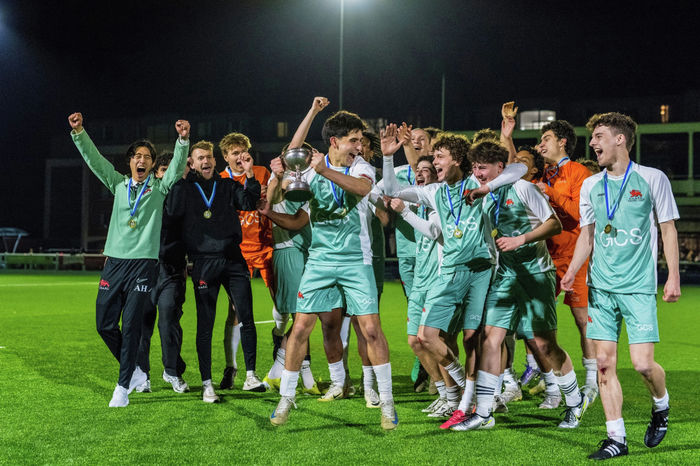
It’s really good if you are a beginner, as everyone is super friendly and it’s a relaxed environment. Anyone can join and have a good time as there is a range of abilities. Feel free to follow @cambridgeuniversitybjj on Instagram to stay in touch with everyone Brazilian Jiu-Jitsu related at Cambridge.
 Comment / Top of the slops: the competitiveness of college dining4 June 2026
 News / Two more women allege sexual harassment by classics professor Simon Goldhill 28 April 2026
 Comment / The Cambridge drift1 June 2026
 Features / One big happy (college) family?4 June 2026
 News / Cambridge psychologist warns against blanket social media ban for under-16s1 June 2026
 Music / T.S. Eliot meets Eurovision: LYR + Natalie Wildgoose at The Storey’s Field Centre7 June 2026
 Features / Chronic illness and the Year Abroad6 June 2026
 Film & TV / What to watch this Pride Month6 June 2026
 News / Cambridge researchers produce ‘world-first’ AI vaccine6 June 2026
 Comment / Should we still read Philip Larkin?6 June 2026