
On April 29th 1826, at the Horticultural Society’s Regent Street headquarters, colonial administrator Sir Stamford Raffles convened the first meeting of the Zoological Society of London. The attendees, including Humphry Davy and Robert Peel, were a distinguished bunch – but even they could hardly have known that their fledgling passion project would soon become a treasured British institution.
Galvanised by Paris’s Jardin des Plantes, an early public zoo founded after the French Revolution, Raffles declared Britain needed an animal collection on an even grander scale. Crucially, this zoo would be scientifically run, dedicated to the classification and study of “new and curious subjects of the Animal Kingdom”. But it would be another two years before London Zoo opened its gates – something Raffles never lived to see. Access was initially reserved for ZSL Fellows, before financial pressures forced the zoo to admit an increasingly curious public in 1847.
London Zoo soon became a place where city-dwellers could admire animals from distant, dreamt-of lands – its collection bolstered when the Tower of London’s Royal Menagerie closed in 1831. The first giraffes arrived in 1836 and were walked, with a police escort no less, from Blackwall Docks to the zoo, to the delight of Londoners. The elegant Tuscan Giraffe House, designed by Decimus Burton, remains one of the zoo’s most iconic landmarks: a rare survivor from an era that also saw London Zoo open the world’s first aquarium, insect house, and reptile house.
“London Zoo soon became a place where city-dwellers could admire animals from distant, dreamt-of lands”
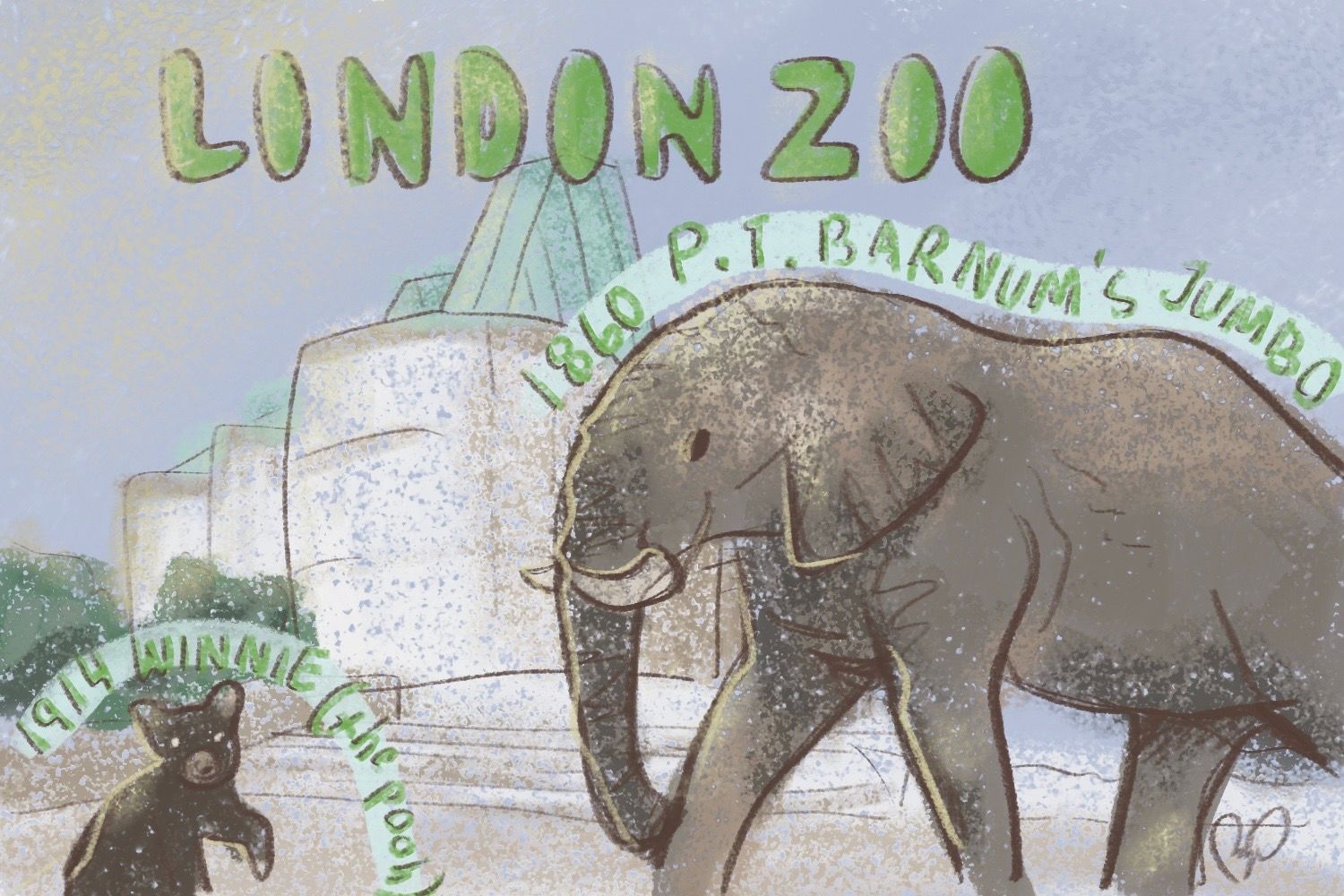
Other star attractions included Obaysch, the first hippopotamus in Europe since Roman times, and Jumbo, the famous African elephant later – controversially – sold to American showman P.T. Barnum. The Society’s patron, Queen Victoria, was a regular visitor, as was Charles Darwin, whose study of the zoo’s expressive orangutan, Jenny, helped convince him that man was indeed “created from animals”.
Bestriding this golden age like a colossus was Abraham Bartlett, the zoo’s Superintendent from 1859. Often considered the father of ‘zoo biology’, Bartlett combined scientific insight with an instinctive affinity with animals, skilfully studying and caring for species never before kept in captivity, from aardwolves to aye-ayes. Under his watchful eye, Sumatran rhinos set longevity records far exceeding those seen in American zoos a century later. And when the zoo’s first red panda puzzled keepers by stubbornly turning its nose up at a platter of lovingly prepared meats, it was Bartlett who saved the day. Taking the sickly animal on a walk, he noticed its interest in flowers and berries, correctly deducing the species was, in fact, herbivorous.
Bartlett’s death in 1897 could have signalled decline, but the Society’s second golden age was fast approaching. In 1903, it appointed Scottish zoologist Peter Chalmers Mitchell as its Secretary. Inspired by Hamburg Zoo, Mitchell commissioned spacious, naturalistic enclosures that gave tropical species access to fresh air. In 1913, an imposing concrete mountain range, the Mappin Terraces, was built using hidden moats to create a panoramic landscape of waterbirds, bears, and goats. One famous inhabitant was an American black bear called Winnipeg – Winnie for short – who won the heart of a young visitor named Christopher Robin. Winnie was later immortalised in the timeless classic written by Christopher’s father: A.A. Milne.
“One famous inhabitant was an American black bear called Winnipeg, who won the heart of a young visitor named Christopher Robin”
Mitchell’s vision reached its apotheosis when the Society commemorated its centenary by buying a sprawling, 600-acre farm in Bedfordshire. After five years of construction, Whipsnade opened its gates in 1931 as the world’s first open-range zoo. It soon became synonymous with breeding rare megafauna such as Indian rhinos, snow leopards, and cheetahs, and served as a refuge for extinct-in-the-wild deer and antelope. Possibly Whipsnade’s greatest coup came in 1970, when it was entrusted with 20 rare white rhinos – the nucleus of today’s captive population.
Meanwhile, London Zoo was thriving. By 1939, it was quite possibly the greatest animal collection the world had ever seen. The list of acquisitions that year would make any self-respecting naturalist green-eyed with envy: a harpy eagle, multiple birds-of-paradise, three giant pandas, and the first-ever captive golden snub-nosed monkey. Meanwhile, ZSL’s first female Curator of Reptiles, Joan Procter, became an authority on Komodo dragons, demonstrating the lizards’ surprisingly gentle nature by walking them around the grounds and, to the horror of scientists, even into academic meetings.
It was not to last. War hit London Zoo hard and, although few animals were killed, several buildings, including the Zebra House, were damaged during the Blitz. One memorable night, Mitchell’s successor, eminent zoologist Julian Huxley, chased an escaped zebra through Regent’s Park – while still in his pyjamas. Huxley later confessed he had been terrified of being kicked, to which a keeper pityingly replied: “Cor, bless you, sir, you needn’t have been frightened – ’e’s a biter, not a kicker!”
The post-war years were initially marked by renewed optimism. Brumas, the first polar bear to be reared in Britain, was born in 1949. The following year, attendance soared to over three million – a figure never matched since. The public imagination was also captured by Guy the gorilla, giant panda Chi-Chi – the elegant model for naturalist Peter Scott’s iconic WWF logo – and David Attenborough, who rose to fame filming the zoo’s animal collecting expeditions.
“Soon a beloved national institution was itself teetering on the brink of extinction”
By the 1960s, however, the seeds of decline were being sown. Many of the zoo’s majestic Victorian buildings were torn down and replaced by modernist monoliths. Cambridge alumnus Hugh Casson designed a hulking brutalist elephant house, while Lord Snowdon produced a fanciful aviary, but neither structure was ever truly suitable for its inhabitants. These expensive statements drained the zoo’s coffers, and its once-encyclopaedic collection gradually diminished.
Worse still, an institution that was once world-leading had fossilised. Across Britain, conservationists led by Gerald Durrell were adding a third duty to the traditional educational and scientific role of zoos: saving rare and overlooked species. The snowy-haired scientists on ZSL’s ruling Council, however, remained curiously uninterested – both in captive breeding and in the very zoos they had been elected to run.
In 1985, the bears left the Mappin Terraces, now a mothballed symbol of a Society seemingly in terminal decline. Four years later, Margaret Thatcher scrapped the zoo’s government stipend, and soon a beloved national institution was itself teetering on the brink of extinction. A donation from Kuwait and an energetic band of Fellows staved off closure, but the zoo’s self-confidence was shattered. It appeared caught between its roots as a serious cultural and scientific institution and commercial pressures to ape the ‘theme park’ tendencies of many American zoos.
“The zoo may yet seize a vital opportunity: to showcase and preserve the obscure, unusual, and often endangered diversity of life on Earth”
The 21st century has seen the zoo capitalise on flashy exhibits for a few crowd-pulling species, while a lack of investment in its heritage has led to the closure of the iconic Aquarium and Reptile House. And yet, there is cause for hope. Recently, London Zoo has brought in various rare and little-known species, some through pioneering ‘rescue missions’ for evolutionarily distinct creatures such as Darwin’s frog. With its unparalleled history and expertise, the zoo may yet seize a vital opportunity: to showcase and preserve the obscure, unusual, and often endangered diversity of life on Earth.
One species, perhaps more than any other, exemplifies this evolution. In 1901, ZSL Fellow Harry Johnston sent word from the Congo about an undiscovered ‘forest zebra’. The okapi – actually an extraordinary relative of the giraffe – became one of the greatest zoological discoveries of the 20th century. Shy and elusive, its early history in captivity was rocky, but today London Zoo plays a key role in the European breeding programme for this beautiful forest-dweller.
There is much to do before London Zoo regains its rightful place among the pantheon of the zoo world. For one, the Mappin Terraces remain criminally empty. There can be no return to the halcyon days of the 1930s, but if ZSL marries its traditional focus on “new and curious” species with a modern conservation ethic, it could once again become a bastion of zoological diversity – an oasis of wonder in an increasingly urban world.
