
Commercial Feature
Hair Transplant in Turkey: Read This First
Before Booking a Hair Transplant in Turkey, Read This
Hair loss was once a quiet topic. Now it’s in the spotlight, shared openly through social media, clinic videos, galleries, and candid conversations. Restoring hair has never felt more accessible.
For younger men, visibility can be reassuring but also create pressure. A hair transplant is still a medical procedure, not a quick decision, and should not be rushed due to trends or low prices.
This is especially important for UK patients considering a hair transplant in Turkey. While Turkey is widely recognised for hair restoration, knowing why is just the starting point. The next step is understanding how to thoroughly research treatment options before arranging travel.
Why Turkey became a leading destination for hair transplants
Turkey’s reputation in hair transplantation is not built on a single factor. Cost is part of the story, but not the whole story. Over the past two decades, Istanbul, in particular, has developed a large medical tourism sector. Many clinics are used to working with international patients, arranging airport transfers, hotel stays, translators, consultations, procedure days, and aftercare communication as part of a structured treatment journey.
For patients travelling from the UK, the package model often means that clinics handle airport transfers, accommodation, translation, and medical scheduling, providing a coordinated and less stressful experience than organising everything independently. This ease of planning often helps explain why Turkey is closely associated with hair restoration tourism.
Clinics like Cosmedica Clinic in Istanbul have boosted Turkey’s reputation by combining techniques with extensive support for international patients. However, a convenient package should never replace proper clinical evaluation. The real value lies in finding a clinic that clearly explains candidacy, technique, expectations, and aftercare.
Why UK patients are looking beyond Britain
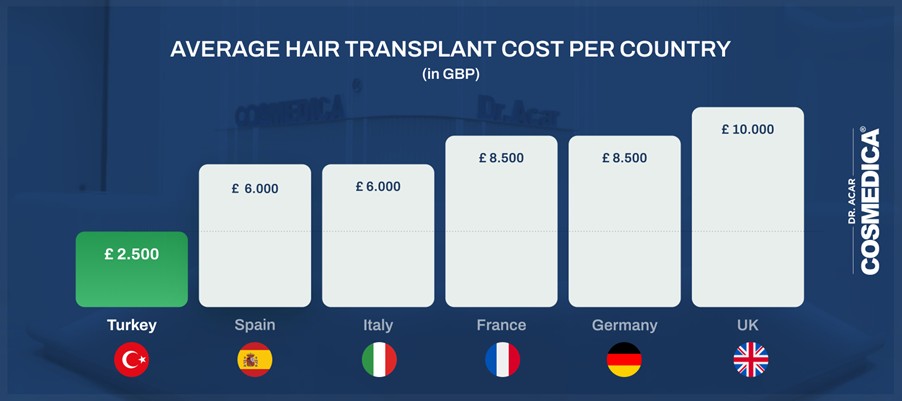
For UK patients, the decision often starts with comparison. Private treatment costs in Britain can be a major consideration, especially for those already comparing healthcare, dentistry, aesthetics, and wellbeing services online.
Turkey can appear attractive because clinics often present treatment as a combined package rather than separate costs. Flights from the UK to Istanbul are relatively straightforward, making treatment abroad feel logistically possible for students, graduates, and young professionals used to planning travel independently. But affordability should be one factor, not the deciding one. A lower quoted Turkish hair transplant cost may look appealing at first glance, but patients should ask what is included, who performs the medical procedures, what happens if something goes wrong, and how follow-up will work once they return home.
What patients should check before booking abroad
A sensible pre-booking process should go beyond “How much does it cost?” and “Can I get the dates I want?”
Before booking a hair transplant abroad, ask:
- Who will assess my donor area, hair loss pattern, and suitability?
- Will I have a proper consultation with a qualified clinician, not only a sales adviser?
- What technique is being recommended, and why?
- Is the graft estimate realistic for my donor area?
- How will the hairline be designed?
- Do hair transplant before-and-after examples include similar cases to mine?
- What hygiene, clinical, and regulatory standards apply?
- What aftercare is included once I am back in the UK?
- Who do I contact if I have pain, an infection, poor healing, or dissatisfaction?
- Could any extra costs arise?
The Royal College of Surgeons advises patients considering surgery abroad to check the surgeon’s experience, communication, insurance, aftercare, and what would happen in the event of complications. It also warns against agreeing to surgery before meeting the surgeon and visiting the hospital or clinic where the procedure will take place.
Consultation and realistic planning
A thorough hair transplant consultation should focus on developing an appropriate treatment plan, not on delivering a sales pitch.
The clinic should assess the donor area, pattern and stability of hair loss, patient’s age, expectations, medical history, and long-term hair-loss progression. A dense, low hairline may look tempting online, but it may not be appropriate for every patient, especially younger men whose hair loss may continue.
Graft count is personal. More grafts do not automatically mean a better result. A realistic plan balances coverage, density, donor preservation, and possible future hair loss.
Aftercare once back in the UK
Aftercare is one of the most important parts of choosing a clinic abroad. The procedure does not end when the patient boards a flight home.
UK patients should know how washing instructions, medication guidance, swelling, redness, scabbing, shedding, and early healing will be monitored. They should also know whether follow-up is handled by a named doctor or medical team, if photo reviews are available, and what support is offered if healing does not progress as expected.
The role of FUE, DHI, and Sapphire FUE
Hair transplantation is often discussed in terms of techniques such as FUE, DHI, and Sapphire FUE. These terms can sound technical, but the basic differences are fairly simple.
FUE, or follicular unit extraction, involves removing individual follicular units from the donor area, usually at the back or sides of the scalp, and placing them into thinning or balding areas.
DHI, or direct hair implantation, is a method where grafts are implanted using a specialised tool. It is often discussed in relation to placement control, density, and hairline work, although suitability depends on the patient.
Sapphire FUE is a FUE technique in which sapphire blades are used to create recipient channels. Clinics may describe this as a refined approach to incision-making and placement, but it should not be presented as automatically right for everyone.
No technique is universally “best”. The appropriate method depends on hair loss pattern, donor capacity, scalp condition, goals, hair characteristics, and clinical assessment. A reputable clinic should be able to explain why it recommends one option over another rather than simply pushing the most expensive package.
Where Cosmedica Clinic fits in
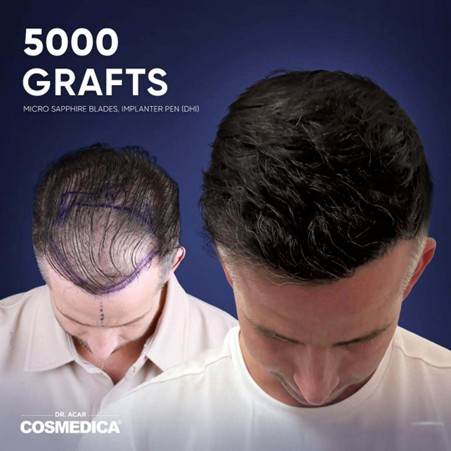
Cosmedica Clinic is an Istanbul hair transplant clinic serving international patients, including people travelling from the UK. The clinic is led by Dr Levent Acar, a Medical Aesthetics Doctor and founder of Cosmedica Clinic in Istanbul, whose public profile centres on hair restoration and techniques such as FUE and Sapphire DHI.
Dr Acar is described by Cosmedica as a graduate of Istanbul University, Capa Medical Faculty, and has been offering hair transplantation services through Cosmedica since 2007. The most relevant point is not status for its own sake but the clinic’s emphasis on consultation-led planning before technique selection.
For UK readers comparing treatment abroad, Cosmedica is best understood as one example of the Istanbul clinic model: personalised planning, English-speaking support, FUE, DHI, Sapphire FUE and related hair transplant methods, and package-based coordination for international patients.
Before-and-after results can help patients understand what may be possible in cases similar to theirs, but they should be interpreted carefully. Results vary depending on donor area, hair-loss pattern, graft survival, aftercare, and individual healing.
Cosmedica offers a free hair analysis, providing an initial step for individuals to explore suitability and technique options before making travel plans.
Final takeaway: research matters as much as destination
Turkey became known for hair transplantation due to low costs, many clinics, medical tourism infrastructure, package treatment, and experience with international patients. For UK patients, this can make Istanbul seem practical.
But the destination alone should not guide the decision. UK patients must judge any plan by essential questions: Who is assessing me? Is the plan realistic? What are the risks? What does aftercare include? What happens when I return home?
For suitable candidates, travelling to Turkey can be one route into hair restoration. The safest first step is not booking a flight. It is getting a personalised assessment, carefully comparing clinics, and making sure the medical plan makes sense before committing to treatment or travel.
 Comment / The Cambridge drift1 June 2026
 News / News in Brief: Corpus climbing, climate cash, and commendable contributions1 June 2026
 News / Cambridge psychologist warns against blanket social media ban for under-16s1 June 2026
 Theatre / CUMT’s The Wind in the Willows brings a classic to life 31 May 2026
 News / Venue cancels Cambridge talk by right-wing commentator Matt Goodwin after backlash28 May 2026
 Music / We need to talk about Kendrick2 June 2026
 News / University support staff strikes end after month of action2 June 2026
 Arts / To the letter2 June 2026
- News / Cambridge psychologist warns against blanket social media ban for under-16s1 June 2026
 Sport / Caius beat Magdalene in last-minute thriller to clinch mixed netball Cuppers final1 June 2026
