
Commercial Feature
The AUTODOC Customer Experience Explained Shipping, Returns and Support

Ordering car parts online sounds straightforward until the wrong component arrives three days before your MOT and the return process turns into a week-long ordeal. Knowing what to expect from delivery, returns and support before placing an order saves time, money and a fair amount of frustration.
Online auto parts retail has expanded steadily across Europe, and UK drivers are ordering from European platforms with increasing regularity. AUTODOC, one of the continent’s largest online distributors of car parts, publishes detailed information on its shipping, returns and support procedures making it a useful reference for understanding how the better-run platforms in this space actually work.
What actually affects your delivery time
Shipping times depend on stock availability, destination region and part type. Standard delivery to UK addresses takes several business days; components held at European distribution centres may take longer. Post-Brexit customs processing adds a variable that buyers should factor in when ordering from continental platforms. Checking whether an item is listed as in stock rather than available to order is the most reliable way to shorten the wait.
One factor worth knowing: in February 2026, AUTODOC launched its MARKETPLACE in the UK, having already rolled it out across nine other European countries bringing the total to ten markets where hundreds of sellers are now connected with millions of drivers. In 2025 alone, the platform processed more than 190,000 orders. For British buyers, the expansion translates into a wider product range, more competitive pricing and faster local delivery options. That said, for MARKETPLACE, listings, shipping and customer support are handled by the seller independently, not by AUTODOC. It’s a straightforward distinction, but one that affects estimated timelines and who you contact if something goes wrong. The platform labels products accordingly, so checking the seller before checkout takes seconds.
Why the wrong part arrives more often than you’d think
Compatibility errors are among the most common issues in online parts purchasing. A mismatched make, model or engine at the search stage and the wrong part ends up in the basket, regardless of how good the platform is.
On the AUTODOC website, the search works in a straightforward sequence. Select the make, then the model, then the engine. Three steps, and the catalogue filters down to parts confirmed compatible with that specific vehicle. Alternatively, UK drivers can skip the dropdowns entirely and search directly by their registration number, which pulls up the vehicle automatically.
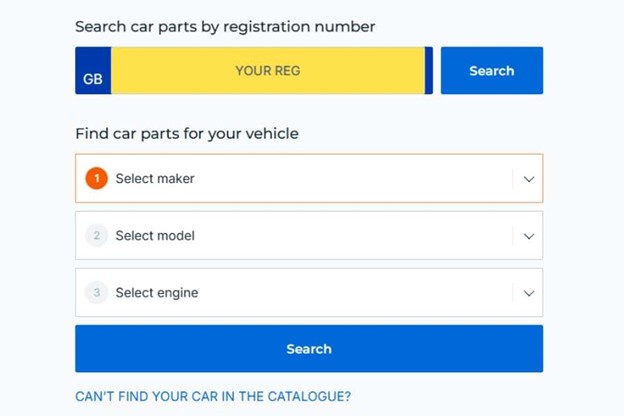
If a model doesn’t appear in the catalogue, AUTODOC’s support team can be contacted directly to help locate the correct part. It’s a practical fallback that matters more than it might seem, as older, rarer or grey-import vehicles frequently fall outside standard catalogue coverage.
Keeping those databases accurate is an ongoing challenge across the industry. Galyna Stepanova, Head of Customer Feedback at AUTODOC, describes the approach:
“We’re constantly enhancing our catalogue by adding rare and specific vehicle models—including uncommon variants and model years that competitors often overlook. Crucially, we’re refining our search mechanisms with more precise filters, like HSN/TSN codes and technical specifications, to ensure the system recommends only the exact, correct part every time.”
Returns are where most online retailers lose customers
According to Roland Berger’s Automotive Aftermarket Pulse 2024, incorrect orders and returns affect 15–20% of B2B transactions and 5–7% of consumer purchases in auto parts e-commerce. That makes the returns process more than a minor footnote.
In practice, the experience varies sharply across retailers. Recurring complaints across the sector include: customers covering return shipping costs when fault is disputed; delays caused by return transit time combined with warehouse inspection; confusion between “return received” and “refund issued” two separate stages with different timelines; and no straightforward route to exchange a part for the correct alternative.
Some platforms have addressed this directly. According to information published on AUTODOC’s website, returns are handled through a dedicated portal. Evgheni Colun, Customer Feedback & Reputation Expert at AUTODOC, describes the process: “ It only takes three clicks, and it really speeds up the process:
- Select the order: The system immediately draws up the respective article(s).
- Specify the reason: It is important for us to know what is wrong (it didn’t fit, inaccuracy in the description).
- Get a label: the customer tracks the parcel, and the system automatically prepares the refund.”
Where the fault lies with the company, return shipping is covered. Refunds reach the original payment method within 3–5 banking days after the return is confirmed, with an automatic notification sent at each stage. An extended 200-day return window is also available as an optional add-on at checkout.
The clearer the process is documented before purchase, the less room there is for disputes later.
What to check before you even contact support
Response times and available contact methods vary considerably between retailers. Before purchasing, verify that the platform offers live chat, phone support and a structured escalation path. When contacting support for any reason, having the order number, VIN and photographs of any defect ready shortens resolution time considerably.
Is AUTODOC safe and trustworthy?
For anyone buying car parts online for the first time, the question is AUTODOC safe is a reasonable place to start and based on verifiable indicators, the answer is yes. Whether AUTODOC is trustworthy follows the same logic, and the evidence points in the same direction.
AUTODOC operates across more than 25 European countries and is subject to EU and UK consumer protection regulations, including documented return rights and payment security standards. The company publishes its terms, return conditions and support contacts openly on its website, a basic but meaningful transparency signal. Dedicated roles such as Customer Feedback & Reputation Expert and Head of Customer Feedback suggest structured internal processes for handling disputes, not ad hoc responses. The 200-day return option and the automatic refund notification system are features consistent with a platform that expects to be held accountable.
No retailer is without complaints. For any platform, checking independent reviews on Trustpilot or Google before a first order remains sensible practice. But the operational infrastructure AUTODOC has made publicly visible is consistent with an established, regulation-compliant business not a risk.
What this means for drivers in Cambridge and across the UK
For students and residents in Cambridge — where running costs matter and older vehicles are common — ordering parts online rather than through a local garage can reduce costs noticeably. The trade-off is managing delivery windows and, occasionally, returns. Understanding the process in advance removes most of the risk.
Check compatibility by registration number. Read the returns policy before checkout. Keep packaging and documentation until the part is confirmed correct. These three steps resolve the majority of problems before they start.
For readers placing a first order before 31 May 2026, AUTODOC has provided a discount code 5% for use at checkout: ATD4J8S2VLL
 Comment / The Cambridge drift1 June 2026
 News / Cambridge psychologist warns against blanket social media ban for under-16s1 June 2026
 News / News in Brief: Corpus climbing, climate cash, and commendable contributions1 June 2026
 Theatre / CUMT’s The Wind in the Willows brings a classic to life 31 May 2026
 News / Venue cancels Cambridge talk by right-wing commentator Matt Goodwin after backlash28 May 2026
 Music / We need to talk about Kendrick2 June 2026
 News / University support staff strikes end after month of action2 June 2026
 Arts / To the letter2 June 2026
- News / Cambridge psychologist warns against blanket social media ban for under-16s1 June 2026
 Sport / Caius beat Magdalene in last-minute thriller to clinch mixed netball Cuppers final1 June 2026
