
Commercial Feature
That PDF in a Language You Don’t Speak? Yeah, We’ve All Been There.
It’s a universal student experience. You’re knee-deep in research, chasing down references for an essay that’s starting to feel like it writes itself. You finally unearth the perfect source the one that’s going to seal your argument. You click, the PDF downloads, you open it with a sense of triumph, and…
…it’s in German. Or Spanish. Or a language with a script you can’t even begin to decipher.
The information you need is right there on the screen. Visible. Real. And completely locked away. That moment of triumph curdles into a very specific kind of academic dread.
We’ve All Improvised Our Way Through This
Everyone who’s been through university knows this feeling, and everyone has their own scrappy workaround. Maybe you’ve copied paragraphs into a free online box, one by one, watching the formatting dissolve into a wall of text. Maybe you’ve tried to puzzle it out with a decade-old memory of GCSE French. Maybe you’ve sent a desperate text to a friend who actually took that language degree, hoping they’re not too swamped with their own essays.
Some of you might have even given up and looked for another source. I’ve been there. None of these options feel good, especially when the clock is ticking and that deadline isn’t moving.
What It Feels Like When It Just Works
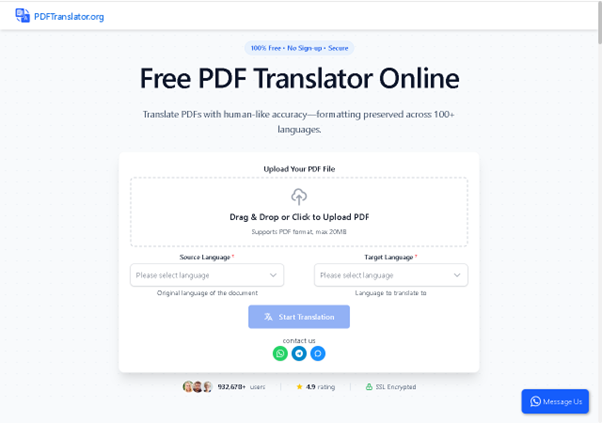
But imagine a different version of that story. You find the perfect article, this time in Italian. Instead of a sinking feeling, you open a website. You drag the PDF into a window. You pick your languages. You click one button.
Maybe you make a cup of tea. By the time you sit back down, there’s a new file on your computer. It’s the same article same layout, same diagrams, same footnotes sitting perfectly at the bottom of the page. Except now, every single word is in English. It looks like it was written for you from the start.
You read it. You find the killer quote. You drop it into your essay. You move on. The whole detour into translation took maybe two minutes and you barely had to think about it. That’s what a good free pdf translator should feel like. Not a project, just a tool.
Why the Way It Looks Actually Matters
If you’ve ever worked with academic papers, you know that the layout isn’t just decoration. A research paper’s data is in its tables. A historical document’s meaning can be in a handwritten footnote. A diagram’s labels are part of the explanation.
A bad translation tool rips all the text out and dumps it into a document with no structure. Suddenly, Table 3 is just a jumble of numbers floating in a paragraph. Footnote 12 is nowhere near the sentence it was explaining. You’ve got the words, but you’ve lost the context.
The good ones, like this pdf language translator, understand the assignment. They don’t just translate text; they translate documents. They see the page, figure out where everything belongs, and rebuild it perfectly in the new language. The tables stay tables. The footnotes stay footnotes. The diagrams still make sense. You get a file that’s ready to use, not a mess you have to fix.
The Moments That Actually Save You
Think about the times this term when a tool like this would have been a lifeline:
The 11pm panic. You remembered a source is due for tomorrow’s seminar. The only copy you can access is a scanned PDF of a Spanish journal from 1987.
The dissertation goldmine. You’re deep in the archives and find a scanned German pamphlet from 1919. It could be the piece of evidence for your chapter on post-war sentiment.
The bureaucratic maze. You’re an international student, and the council sends a PDF about your tax status. It’s full of terms you half-understand, and signing something you don’t fully get is a bad idea.
The impossible reading list. Your supervisor sent a list of “essential” articles. Three are in French, two are in Mandarin, and one is a scanned Urdu document.
In every single one of these situations, the document itself isn’t the problem. The problem is the language it’s wrapped in. Solve that, and you’re back on track.
The Best Part? It Just Disappears
Here’s what makes this kind of tool different from all the other things you’re asked to sign up for at university.
There’s no sign-up. No email to enter. No “free trial” that asks for a credit card. No spam later. No tracking cookies following you around. No database of your documents floating on some server.
You upload a file. It translates. You download it. An hour later, that file is permanently deleted from their system. The transaction is clean and finished. Nobody has your information. Nobody has your research. Nobody has anything.
For students, this matters. You’ve got enough accounts. Enough spam. Enough people asking for your data. A tool that just does its job and then gets out of your life? That’s surprisingly rare. And it’s exactly what you need when you’re dealing with sensitive research or personal documents.

When It Actually Counts
Most of the time, you’ll read your sources in English, take your notes, write your essays, and never think about translation tools. Life will be normal.
But then a moment comes. A critical article. A primary source. An official document. The thing that could make your argument, unlock your understanding, or solve a stressful problem arrives in a language you don’t speak.
In that moment, waiting isn’t an option. Manual typing isn’t practical. Forwarding it to someone else just adds delay and another favour to owe.
What you need is something that looks at that PDF, reads every word, and hands you back a perfect copy in your language. Right now. Looking exactly the way it should.
And then you can get back to the actual work the reading, the thinking, the writing. The stuff that matters. Because the translation was never the point. It was just the thing standing between you and what you needed.
 News / Classics professor gave female student unconsensual ‘slobbery kiss’10 April 2026
 News / Rowers fined nearly £4.5k for Lent Bumps misconduct9 April 2026
 Arts / The Cambridge cult-ure14 April 2026
 News / C4P protesters rally against Israel’s ‘execution law’13 April 2026
 News / News in Brief: planetariums, plaques, and plastic pollution12 April 2026
 Music / On CamFM and confidence boosts14 April 2026
 News / Former Cambridge vice-chancellor named preferred candidate for chair of UKRI14 April 2026
 Lifestyle / Advice on not losing your mind14 April 2026
 Comment / Oh, when it ‘All Falls Down’14 April 2026
- Arts / The Cambridge cult-ure14 April 2026
