On Cam FM and confidence boosts
Presenting over the airwaves strengthens your voice both live and in person, says Scarlett Boswell
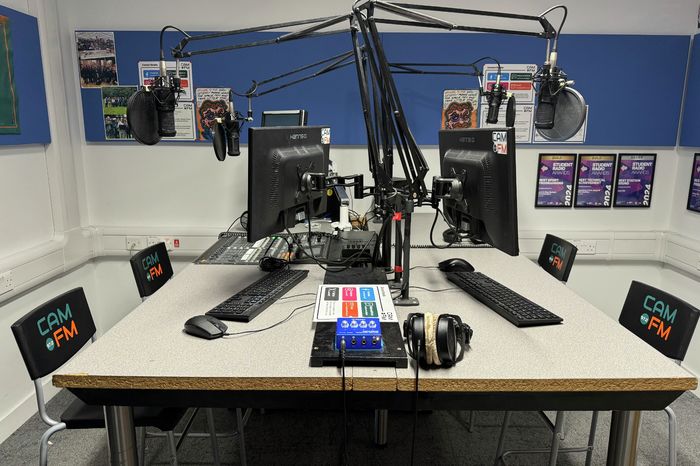
Unless sharing music recommendations with friends counts as training, I had no experience in music broadcasting when I joined Cam FM. Yet somehow, within two weeks of signing up, I found myself sitting in a studio, headphones on, staring at a microphone and a countdown clock, about to speak to a faceless audience. The first few times I hit the airwaves Morrissey’s maudlin voice would ring in my head when I felt I’d messed up. Would my listeners really hang me if they thought I was dull or my choices were bad, or just switch to a well-produced Goalhanger podcast? In short, I felt incredibly nervous, but somewhere between nervously pulling down faders and mixing up jingles, I realised that talking into the void was strangely liberating. With no one to stare back at me, and no immediate reaction to overanalyse, I began to find a voice I didn’t know I had. This voice was confident, expressive and, most surprisingly, spontaneous.
“I realised that talking into the void was strangely liberating”.
With no judgement in the room, you stop overthinking your words. What replaces it is freedom. There is no audience to react to an awkward silence, or to wince if a joke doesn’t land. Instead, you’re left with space to try things out, to play with tone and to say the things that would usually stay in your head. You start to realise that radio, especially student radio, isn’t about delivering perfectly timed links between two songs, but really speaking to your audience, not hiding behind your own nerves. While it feels like you are having a conversation with yourself, you’re not. There is a recipient, one who, like you, cannot see the other side of the conversation. The challenge is learning to bridge the gap: to step beyond the absence of presence and connect through one voice alone. And the only real way to do that is to open up and trust that sincerity, humour and a little vulnerability will travel far enough.
At some point, and again without noticing, you begin to learn the language of the studio. Words that sounded technical start to make sense: faders, beds, back-timing, SOLO. You start to gain a sixth sense for when a song is ending, when to let a song breathe and when to stop talking before you’re narrating over the best bit of the song. The specific-to-the-second clock stops feeling like a torture device and more like a co-conspirator. The mess of buttons and dials and faders in front of you stops feeling like it’s made to trip you up and more like your arcane instrument (think Excalibur). The language of the studio is half technical knowledge and half gut feeling, and at some point, you’ll start sounding like someone who actually knows what they’re doing.
This will carry over into your everyday life. You’ll find it hard to resist the urge to narrate your life with the words “and coming up next…”. Conversations start to feel like links, and silence something you’re obligated to fill. Music will start to sound different: songs become potential intros, beds or an emergency play as you mess around with what to say next. You will start noting songs with long enough introductions to talk over, which is both useful and a sign the studio has rewired your brain.
“If you say something honestly people will meet you halfway”
On the other hand, the best development is the confidence that creeps in a little at a time. You trust in yourself to be funny and engaging not just in the studio but out of it as well. The voice that hesitated over a sentence becomes a bit more loose-lipped and a little quicker to speak up. You stop worrying about whether everything you say lands perfectly and trust instead that if you say something honestly people will meet you halfway. If you can fill a link before the song kicks in, you can probably fill those awkward supervision silences. If you can talk comfortably into a microphone for an hour, you can probably survive awkward faculty dinners with your supervisor who you’ve only ever discussed Latin syntax with.

And when the show ends and the faders slide down for the last time, you’ll realise that something unexpected has happened: you didn’t just learn how radio works, but how to trust your voice. And if somewhere out there a listener briefly considers shouting “hang the DJ”, the beauty of radio is that you’ll never know.
 News / Venue cancels Cambridge talk by right-wing commentator Matt Goodwin after backlash28 May 2026
 News / Cambridge researchers warn of ‘underestimated brilliance’ if AI grades essays26 May 2026
 Interviews / Cambridge MP Daniel Zeichner on political realism and the ‘politics of grievance’29 May 2026
 Lifestyle / Blind Date: ‘I should’ve changed my socks’24 May 2026
 Comment / The no man’s land between triposes25 May 2026
 Sport / Should we play more BUCS?30 May 2026
 Features / The language of optimisation and the architecture of merit30 May 2026
 Comment / We must support our strikers29 May 2026
 Arts / A retrospective on Robinson Art Festival29 May 2026
 Science / Where science meets policy29 May 2026