
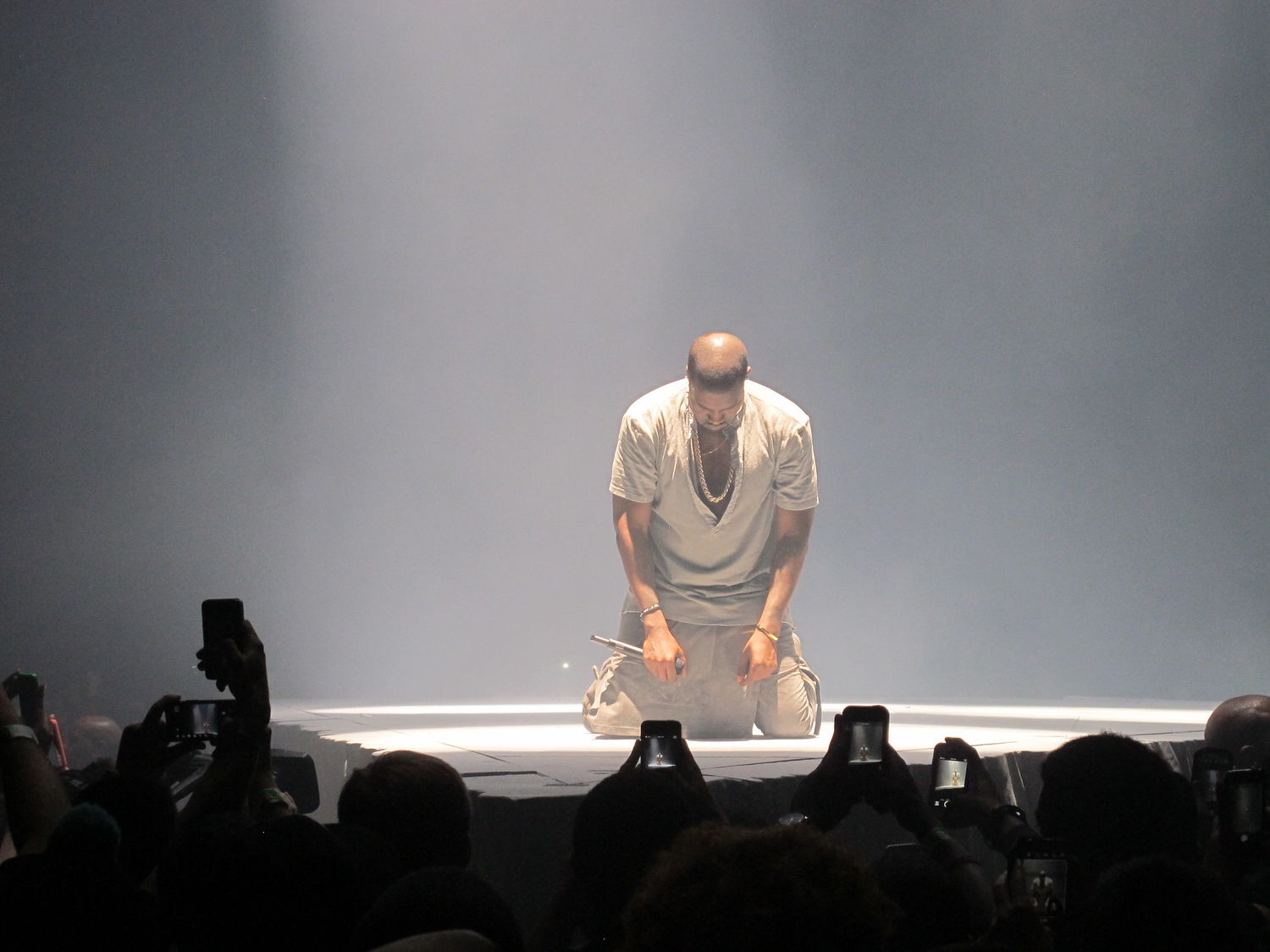
Right around now is that time of frantic summer planning – making sure you and your friends have the ideal itinerary booked, so that the next few months of staring listlessly through the library window becomes somewhat bearable. The Home Office, however, recently threw quite the spanner in those works for many: one hopeful act of heroism attempting to combat Kanye West’s raging antisemitism, and the entirety of Wireless Festival ‘All Falls Down’. It’s funny – that song is pretty much the only thing that’s come out of his mouth that I’m somewhat fond of.
There are of course endless things to say about this decision and its consequences, mostly tying back to the classic free speech debate we can’t seem to get enough of. But, as a Jewish student (and admittedly an avid Wireless attendee throughout the years), I’d honestly much rather highlight some personal grudges I have with how it ‘all fell down’, rather than interrogating whether it should have. Because, to be honest, when it all fell down for West, I can’t help but feel as though I was dragged down with him.
Generally speaking, when controversy like this ensues, there’s a delicate procedure by which people must handle it and its victims. It’s on this front, as a victim to one of West’s various displays of hate, that I feel let down. Most, if not almost all, sentences on the issue start with the banal and platitudinal preface “of course I don’t agree with him, but…” The question then glares at me – bold, italicised, and underlined in my brain: “but, what?”
“He has subtly been presented by many as a credible character who ‘fell ill’, not as having an ill character”
“But, he suffered from bipolar disorder” – that’s one common response. “But he apologised” – that’s another. “But what about Gaza?” “But there are worse people that are allowed into the country,” and so on.
I find myself having these immediate, unintentional, but nonetheless very real reactions to the way people talk about West. While I find the responses (admittedly, some more than others) valid in some sense, I can’t help but feel angered by them. I don’t want to be, and sometimes I even feel unjustified for being so, but I am.
That moral clarification, for example – that preface “obviously I don’t agree” – just doesn’t seem like enough. I know it’s used by people outside of my community with the intention of showing support for it; but framing West’s antisemitism as something that is even within the realm of possible agreeability is off-putting to me. Why?
Yes, people point out West’s suffering from bipolar disorder, but they often miss out the fact that he himself admitted that it was a misdiagnosis of autism. Yes, people often cite his four month long ‘manic episode’, but conveniently fail to crunch this number against a timeline of consistently abhorrent behaviour spanning over ten times this period. These clarifications to me aren’t pedantic, they’re constitutive of the non-negotiable, bare minimum analysis of the issue. Why?
“When antisemites supposedly lose, the floodgates open for people to think that the antisemites might actually have a point”
I feel the need to point out that antisemitism, like all forms of oppression, comes in differing degrees, types, and forms. There are subtle micro-agressions just as there are blatant hate crimes. Yet, all the way down the scale of hate – shattering all metrics – is creating an entire song praising Hitler, selling Swastika T shirts, consistently feeding into Jew-hating myths, explicitly labelling yourself a Nazi with the desire to kill numerous Jewish people, and topping it all off with an apology riddled with gaslighting where we are assured that you “love Jewish people” (not to mention a song lyric that charmingly clarifies your love for the community: “how I’m antisemitic? I just fucked a Jewish b****”). Again, why do I feel like I need not just to point all that out, but to write it in all capital letters and draw a circle around it?
For me, the analysis of West’s character from young festival-lovers seems so surface-level and superficial, leaving it an open question how seriously they take my victimhood. He has subtly been presented by many as a credible character who ‘fell ill’, not as having an ill character. That matters, not just because the timeline of his hate so obviously misaligns with his claims to have “lost touch with reality”, but because it frames his Jew hatred as something far closer to the realm of normality than anyone in the community would ever feel comfortable with.
And truthfully, the desire to blurt out exactly how bad I think West’s antisemitism is comes from a place of real anxiety. More specifically, it comes from the worry – whether rational or otherwise – that those who are mad about West’s mic getting taken away from him will retaliate by taking mine away too.
This is something I want to be unapologetically honest about, because otherwise I feel as though there’s something missing from how we talk about antisemitism. In fact, the very act of calling myself a victim, of choosing to focus only on West’s antisemitism and not on his misogyny or other forms of racism (both of which are worth articles of their own) is very much intentional. The intention being to demonstrate that my anxiety relates to how the response to this controversy upholds the very structure of antisemitism.
“Am I allowed to be a victim of antisemitism at Cambridge? Or am I always either the oppressor or the pseudo-oppressed?”
The uniqueness of antisemitism is its inherently conspiratorial nature. Often, then, when antisemites supposedly lose, the floodgates open for people to think to themselves that they might actually be onto something, that the antisemites might actually have a point. That is, when Jewish people take it upon themselves to spell out exactly how severe and damaging antisemitism (in this case, literal neo-nazism) is, the antisemites can actually win. They can convince people of the harmful conspiracies that fuel Jew hatred.
More specifically, the double-edged sword of Jew hatred thickens – where we are both the oppressors and the pseudo-oppressed: we control the flow of money and information, we selfishly look down on everyone below our large noses, we all automatically and irreparably support genocide under Netanhayu’s payroll; but we also complain needlessly, we make up problems and place them on a pedestal, and with every inch of criticism we receive comes a desire twice as large to strengthen the manner with which we oppress others. And that’s exactly what we did to West; we got the government to ban him because our weak, feeble, yet simultaneously selfish backbones couldn’t fight our own battle for us. Suddenly, all around me, both sides of the sword get sharpened.
This rhetoric isn’t new – but it’s powerful, dangerous, and it leaves Jewish students like me in a pit of horror. This pit keeps you on your toes; it raises the volume on that little voice in your head which feeds you cynical (hopefully inaccurate) judgements about what your non-Jewish peers really think. And, it’s a pit that I can feel growing inside me because of how young people have reacted to this news.
The size of this pit also varies contextually. Right now I’m on the train back to Cambridge, and I can feel it slowly increasing the further away I get from my Jewish-majority North West London bubble, edging closer to my Cambridge one. Suddenly I’m typing more cautiously and reluctantly, worried about how my words will affect the interactions I have and the relationships I’m able to build or develop at university. I’m worried because I’m complaining, expressing fear, and being vulnerable as a Jewish person.
Seeing how young people respond to the most extreme degree of Jew hatred makes me question whether that’s something I’m actually allowed to do here. Am I allowed to be a victim of antisemitism at Cambridge? Or am I always either the oppressor or the pseudo-oppressed? Anyway, I’m at the station now, so I guess I’ll find out.
