CamGraPhIC’s crusade to curb the AI energy crisis
Benjamin Pine speaks to Professor Andrea Ferrari about how CamGraPhIC’s graphene transceivers could help solve AI’s growing energy crisis
Data centres currently use nearly 2% of Europe’s electricity – roughly equivalent to the electricity consumption of Romania. By the end of the decade, this proportion is expected to triple, driven by the rapid expansion of AI.
As a result, countries’ net zero carbon commitments are increasingly under strain. Last year, a University of Cambridge report described the UK Government’s ambition to lead in AI development whilst meeting its climate goals as “magical thinking”. Last month, that warning gained further weight, as officials admitted that data centre emissions could be 100 times higher than previously accounted for.
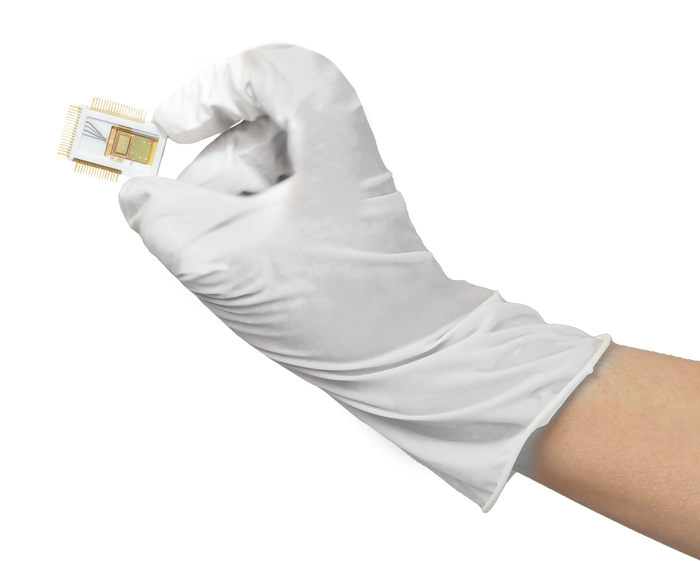
Professor Andrea Ferrari’s transceivers could form part of the solution. Developed by CamGraPhIC, a company he co-founded in 2018, they are designed for use in data centre chips, converting electronic signals into optical ones so that information can be transmitted using light rather than electricity. By integrating graphene – a one-atom-thick sheet of carbon – the chips can become significantly more efficient than traditional transceivers, which rely solely on silicon.
According to Ferrari, this means data can be sent across chips with greater speed and capacity, reducing data centre energy use by up to 80%.
“Reducing data centre energy use by up to 80%”
CamGraPhIC says the technology could be commercially available within three to four years, and it is already attracting serious attention. Earlier this year, the company secured investment from an assortment of venture capital firms; just hours before our interview, Ferrari had spoken to tech giant Nvidia; and last month, the company was awarded a €211 million grant from the Italian state, approved by the European Commission because of the technology’s strategic importance.
The funding is thought to be the largest ever awarded to a company spun out from the University of Cambridge. When asked whether securing the grant had been a long process, Ferrari laughed: “It’s a lot of work, yes!” The Commission asked “a lot of questions,” and every EU member state had the opportunity to object.
Nevertheless, Ferrari was grateful for the experience, which he said was not “purely administrative”. The tough vetting process and rigorous scrutiny from experts showed that the company’s case was “very competitive”.
The grant will allow CamGraPhIC to build a pilot facility in Northern Italy, hiring more than 100 staff to begin production. The decision to develop the facility outside the UK is partly due to funding. According to Ferrari, Britain’s post-Brexit funding scheme is “around 10 times smaller” than Italy’s.
However, the grant will still benefit Cambridge. CamGraPhIC continues to work with the University on fundamental research, while the University owns many of the key patents used in the technology, which it licences to the company. Cambridge also remains central because expertise in graphene photonics is scarce, making the city “a very good place to find talent”.
Ferrari encourage students to bear that advantage in mind. Asked what advice he would give to those aspiring to similar success, he said: “A lot of students get obsessed with finding a job at the end of [their degree] and they get very stressed […] and I tell them come on! You are graduates from Cambridge. The companies are going to fight with each other in order to hire you at the end! Spend your time learning.”
He added that being a student is “kind of the best time,” being students can use “all the facilities you could ever want to have” and “pick the brains” of leading academics.
“Cambridge also remains central because expertise in graphene photonics is scarce”
As for how he reached his current position – leading multiple companies, working as a professor, and directing Cambridge’s Graphene Centre – Ferrari’s advice was, only half in jest: “Don’t!” The role requires long hours, and he admits he misses spending time in the lab making theoretical discoveries. Still, he relishes the “intellectual challenge” of developing products beyond laboratory prototypes and into commercial reality. He also enjoys the perspective that comes from working with investors: “You have the big picture, and that is very exciting at the moment.”
But that bigger picture remains uncertain. AI demand continues to rise, while tech companies such as Google and Microsoft have begun to water down their environmental commitments – in some cases arguing “we are never going to meet our climate goals anyway”.

So, are more efficient chips the solution? They don’t feature in the recommendations of the University of Cambridge report criticising “magical thinking,” which instead calls for increased government scrutiny, stronger oversight, and greater international cooperation.
But an innovation that could reduce energy use by 80% – with, Ferrari tells me, the potential for further efficiency gains in the future – cannot be overlooked.
If coupled with bold action from global leaders, CamGraPhIC’s crusade could help ensure that AI’s rapid growth does not come at an impossible environmental cost.
 News / C4P vandalises University offices over divestment10 June 2026
 Comment / Top of the slops: the competitiveness of college dining4 June 2026
 Comment / ‘On the Poverty of Student Life’: sixty years on10 June 2026
 Interviews / What’s the story behind Pages coffee house?8 June 2026
 News / News in Brief: Cambridge crowns, council confirmations, and competitive cricket8 June 2026
 Lifestyle / Confessions of a May Ball crasher12 June 2026
 Lifestyle / May Week horoscopes12 June 2026
 Lifestyle / The finalist’s bucket list12 June 2026
 Theatre / All of Cambridge is a stage12 June 2026
 Music / ‘It’s feminine intuition’: predictions for OR312 June 2026