Is artificial intelligence rotting our brains?
Lucy George explores whether the use of AI in our degrees is making us less intelligent
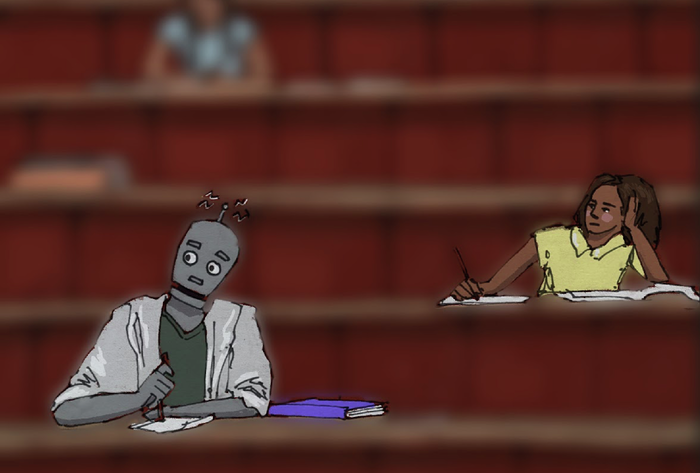
At the very beginning of the academic year, the University of Cambridge announced that students are now permitted to use AI tools in order to “support personal study, research, and formative work”. Nowhere has this change been more apparent than in our libraries – in any given study space, it’s likely that ChatGPT will be open on at least one laptop screen. As more students increasingly rely on the use of generative AI to write elaborate supervision essays and complex Python scripts, does this new guidance throw into question the ideology that ‘degrees make us smarter’, especially as less of our work becomes authentically our own? Is there anything science can tell us about the potentially detrimental effects of AI use on our brains, or are we jumping to false conclusions too soon?
One particularly common motivation among students for using AI is to seek help with writing the occasional supervision essay. Researchers from MIT set out to understand the effects of using AI on our brains by comparing the brain activity of people who wrote essays using either ChatGPT, traditional search engines, or no online tools. Those who used ChatGPT to write their essays displayed fewer, weaker connections between different parts of their brains, highlighting how using AI can influence the brains’ underlying architecture. Moreover, the writers who used ChatGPT found it much more difficult to quote their essays correctly, if they could even quote them at all, unlike those who used traditional search engines or no online tools.
“Those who used ChatGPT to write their essays displayed fewer, weaker connections between different parts of their brains”
Throughout the process of writing an essay or studying for an exam, the hippocampus – a small, seahorse-shaped structure within the brain – is responsible for converting short-term memories into long-term memories. The hippocampus also stores important memories and retrieves them later on when needed, enabling us to remember crucial information from our previous study sessions during exams. However, using generative AI tools to write eloquent essays or make detailed lecture notes may lead to weaker activity in areas of the brain linked to memory formation, making it harder for us to recall important information when we need it most.
Researchers are also investigating how the use of generative AI can influence what’s known as our ‘cognitive effort’, which reflects how much mental energy we invest into performing challenging tasks, such as solving problem sheets. Dedicating time to learning new information and solving complex problems is thought to be essential for keeping our brains fit and healthy, as engaging in difficult learning tasks can potentially help to rescue dying brain cells in the hippocampus – supporting the idea of ‘use it or lose it’ in maintaining a healthy brain. Avoiding this crucial learning process, such as by using generative AI to perform difficult learning tasks for us, may harm the survival of thousands of our brain cells every day.
“This could pose the risk of AI harming our emotional intelligence”
Essay writing and note-taking are not the only reasons why students are turning towards AI for help. Some of the most popular motivations for using AI chatbots include coping with life’s challenges and providing an inexpensive, readily accessible alternative to therapy. This could potentially pose the risk of AI harming our emotional intelligence, especially considering the tendency of AI chatbots to agree with the user’s viewpoints, which runs the risk of reinforcing negative feelings. Relying on AI for emotional support during our most stressful times at Cambridge may add another layer of complexity to the potential impacts that AI could have on our lives.
While provoking news headlines may lead us to think otherwise, it is important to note that there is currently no evidence to suggest the long-term use of AI has a detrimental effect on our brains. To claim that ‘AI is making us stupider’ is therefore an inaccurate way of summarising what we currently understand about how generative AI use influences our intelligence and brain health. Many students would argue that using AI can actually enhance our education, for example, by structuring exam revision and guiding us towards up-to-date resources. Using AI tools to perform the time-consuming, inefficient parts of our studies is referred to as ‘cognitive offloading’, which allows us to devote more time and mental resources to delving deeper into the course content that interests us most. It’s certainly possible that cognitive offloading could ultimately improve the depth of knowledge we develop throughout our time at university, assuming that we only devote the additional mental resources to our studies.

Depending on the evidence that will inevitably emerge over the next few decades detailing any precise impacts of AI on our intelligence, Cambridge granting its students permission to use AI could either be a helpful or harmful addition to the more traditional aspects of our education. Our motivations for using AI to aid our studies, whether this is for essay planning, emotional support, or writing a shopping list, may also play a key role in determining the precise impacts of AI use on our brains. Crucially, we are in complete control over how we use AI tools within our degrees – whether or not we choose to embrace them is up to us.
 News / C4P vandalises University offices over divestment10 June 2026
 Comment / Top of the slops: the competitiveness of college dining4 June 2026
 Comment / ‘On the Poverty of Student Life’: sixty years on10 June 2026
 Interviews / What’s the story behind Pages coffee house?8 June 2026
 News / News in Brief: Cambridge crowns, council confirmations, and competitive cricket8 June 2026
 Lifestyle / Confessions of a May Ball crasher12 June 2026
 Lifestyle / May Week horoscopes12 June 2026
 Lifestyle / The finalist’s bucket list12 June 2026
 Theatre / All of Cambridge is a stage12 June 2026
 Music / ‘It’s feminine intuition’: predictions for OR312 June 2026