Cambridge for Palestine hosts sit-in at Sidgwick demanding divestment
Cambridge for Palestine organised a sit-in to pressure the University Council to support full arms divestment at a meeting on Monday
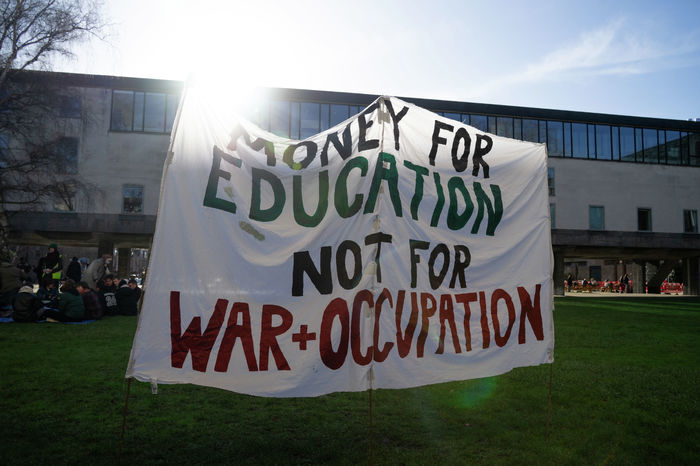
Cambridge For Palestine (C4P) held a protest on Sidgwick Site on Wednesday (28/01), calling on the University Council to vote for full arms divestment at a meeting on Monday.
The protesters gathered on the lawn of the humanities campus at 10:45am. Throughout the sit-in, they heard speeches from professors and activists, and wrote letters to the Filton 24 – the name of a group of people currently in prison, most awaiting trial for allegedly breaking into and damaging equipment at the Bristol factory of Israeli arms manufacturer Elbit systems in 2024.
One of the lecturers who spoke was Dr Thomas Jeffrey Miley, a professor of political sociology, who told the demonstrators that what academics in favour of divestment are “demanding on Monday is accountability”.
Banners and pamphlets were set out on on a table, as well as tea, coffee, and sweets for the protesters. One of the banners read: “Money for education, not war and occupation”.
The protest comes as the University Council is set to vote on three options proposed by a Working Group on Investment in October: to simply monitor arms investments, to set a formal 1% cap, or to divest from weapons manufacturing entirely.
C4P support the latter option, telling Varsity: “We live in a world today that is incredibly militarised. This is not only about Palestine but about ongoing imperialism, as we saw in Venezuela recently. All we are asking is for our academic institution to not be complicit.”
A Research Fellow in Arts, Humanities, and Social Sciences at Caius, who was at the protest, commented: “I am appalled at the University’s links to arms companies and firms. Following the example of one of its colleges, King’s, the University can take a significant step towards better fulfilling its mission by divesting from direct and indirect investments in arms companies and companies engaged in illegal activities.”
Other academics have come out against the idea of divestment, with Prof Richard Penty, Head of the School of Technology, writing: “The investment fund does not invest in weapons illegal under English law. The UK needs to be able to defend itself, so the idea that the University should turn its back on UK national security, particularly at a time of increased global turmoil, is dangerous and unethical.”
One of the students at the sit-in told Varsity: “I think it’s really important at the moment, with the commitment to partial divestment and current genuine potential for full divestment, that students make our voices heard about wanting to be at a university that isn’t funding the institutions bankrolling genocide. Hopefully we will have a real impact on the university figures making the decision.”
C4P has been escalating its protests ahead of Monday’s vote. On Thursday, activists were seen holding banners saying, “End the Occupation” and “Come to the People’s University of Palestine” on the bridges of Queens’, Clare, and St John’s, as well as in the Queens’ dining hall.
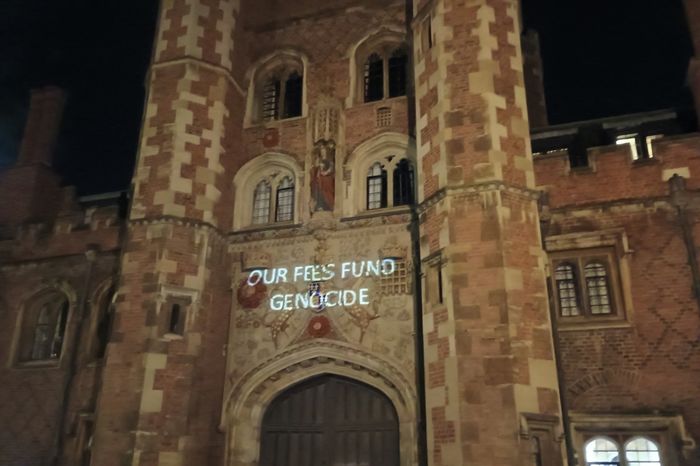
Last Friday, the group projected slogans onto the front of St John’s to urge its master, Heather Hancock, to vote for divestment.
C4P was also involved in a vigil organised by Cambridge Stop The War on Thursday evening “commemorating the 2nd Anniversary of the murder of 5-year old Hind Rajab by the Israeli Occupation Force”.
 Comment / The Cambridge drift1 June 2026
 News / News in Brief: Corpus climbing, climate cash, and commendable contributions1 June 2026
 News / Cambridge psychologist warns against blanket social media ban for under-16s1 June 2026
 Theatre / CUMT’s The Wind in the Willows brings a classic to life 31 May 2026
 News / Venue cancels Cambridge talk by right-wing commentator Matt Goodwin after backlash28 May 2026
 Music / We need to talk about Kendrick2 June 2026
 News / University support staff strikes end after month of action2 June 2026
 Arts / To the letter2 June 2026
- News / Cambridge psychologist warns against blanket social media ban for under-16s1 June 2026
 Sport / Caius beat Magdalene in last-minute thriller to clinch mixed netball Cuppers final1 June 2026