Don’t rush me – I’m reading!
Vienna Zhang defends reading at a slower pace
Last year, popular BookTuber Jack Edwards read 135 books. He plans to read 150 this year. Goodreads – the popular book-tracking and reviews app – reported that its average user managed 17 in 2025. Online, it can appear like everyone is reading more than you are.
It seems our relationship with books is changing. Reading, which has always been one of life’s private pleasures, has been conscripted into the “productivity-maxxing” discourse. In the self-improvement or productivity-grind space on social media, it’s easy to find the following statements: “Top CEOs read 50 books a year”, “Triple your reading speed”, “Here are 10 short books to help you achieve your reading goal.” On BookTok, people are completing ambitious reading challenges, announcing how many books they’ve read in a month. Apps like Blinkist will sell you a 15-minute summary of any major nonfiction title, promising the “key ideas” without the inconvenience and time it would take to pore into the book yourself.
“It’s easy to feel perpetually behind because, simply put, there is always more to read”
If there’s one weakness I have, it’s the susceptibility to the online discourse that I should always be doing more to achieve my goals. I’ve tried the 5 a.m. wake-ups, the habit-stacking, the podcasts during commutes, and some changes have made me more productive. However, when I came across social media posts instructing me to increase my reading speed, I felt conflicted. When I see influencers boasting they’ve read 20 books in a month, naturally, I start to feel a bit bad about myself. Studying English, I’ve spent the last few months wishing I could read faster or more productively without feeling like I’m being disingenuous to the process of reading. There is really no other option with such long reading lists (and the amount of secondary reading to supplement them) to keep up with the ritual of writing weekly essays. It’s easy to feel perpetually behind because, simply put, there is always more to read.
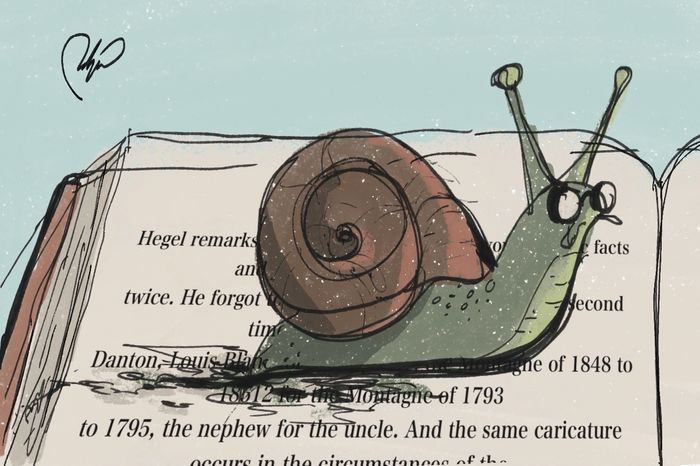
Growing up, I was admittedly a self-proclaimed “slow reader”, finishing books perhaps a bit slower than my friends, who could race through them at twice my pace. I enjoyed reading at a speed that matched how someone might speak in a movie or real life, “experiencing” in real time the pauses and rhythms of speech on the page. I liked to pause and muse on phrasing, as well as re-read passages to “re-live” exciting moments. Now, when it feels like there’s always more ground I should be covering, to read feels like a luxury. I can’t help but think that, in one way, to read slowly would be to waste my time.
“Most importantly, I gave myself full freedom to finally be a “slow reader” again”
Online productivity culture reframes reading primarily as a means to self-improvement, rather than as an art to be experienced or a leisure activity. While reading has long been a tool for acquiring knowledge, especially in education, focusing solely on maximizing reading speed to save time can undermine the depth of what is learned. Many software tools, such as those using “rapid serial visual presentation” (which flashes words rapidly so your eyes never move), promise greater reading efficiency. However, scientific evidence is skeptical: a 2016 review in Psychological Science in the Public Interest found that increasing reading speed reduces comprehension. Ultimately, there is no shortcut for reading quickly and fully understanding the material – even if speed helps you reach a target like 100 books in a year.
After worrying that I might have lost the pleasures of recreational reading to the demands of my course, after Michaelmas term, I decided to allow myself to start reading whatever books I wanted, without any pressure. Most importantly, I gave myself full freedom to finally be a “slow reader” again. During Lent, I read The Vegetarian, a shorter book which had been on my list for a long time, and it took way longer than I once would’ve thought it ought to have taken. Yet, in the absence of numerical goals or time pressure, the enjoyment returned almost instantly.
I think reading goals can be valuable in encouraging you to pick up a book more. I think reading widely and prolifically is a positive ambition – especially amid worries about declining literacy. In James Marriott’s “The Dawn of the Post-Literate Society”, he states that in the UK, “more than a third of adults say they have given up reading.” Shouldn’t it be a good thing that reading is being encouraged, then, regardless? I believe there is a difference between reading a lot and sacrificing the depth you obtain from reading by doing so unnaturally quickly. There’s also a difference between reading performatively to “keep score” and reading for the genuine experience and knowledge you can gain from it. Amid a world where it seems so easy to fall behind, there is also value in experiencing life slowly.
 News / C4P vandalises University offices over divestment10 June 2026
 Lifestyle / A town with a view11 June 2026
 Comment / Top of the slops: the competitiveness of college dining4 June 2026
 Comment / ‘On the Poverty of Student Life’: sixty years on10 June 2026
 Sport / The imperfect privilege of Cambridge sport12 June 2026
 Lifestyle / Confessions of a May Ball crasher12 June 2026
 Lifestyle / May Week horoscopes12 June 2026
 Lifestyle / The finalist’s bucket list12 June 2026
 Theatre / All of Cambridge is a stage12 June 2026
 Music / ‘It’s feminine intuition’: predictions for OR312 June 2026