Discovering Caine at Clare Hall
Ryan Vowles reviews the recent exhibition, ‘Everyday Wonder to Revelation’
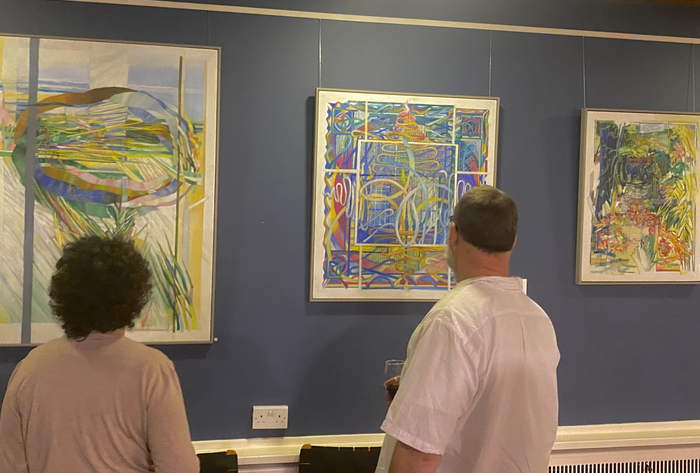
Alan Caine’s work is quite powerful. His inheritance from Cézanne and the post-impressionists is clear, and yet his approach is even less literal. His work is perhaps best described as ‘shimmering’, an effect created by his dense use of strips of colour. As is the cliché, it feels as though the viewer is able to see the world as Caine did: aflame with the light and colours of creation. His variety of work, from an intricate depiction of a mop-head to sweeping vistas of fields, were displayed this term in Clare Hall, and I was lucky enough to attend the opening reception.
“One can’t help but feel that this painting is beckoning you to see through to ‘the beyond’”
The room itself was quite unusual. The works were displayed across three levels and reached out into the surrounding corridors. I went up into the first level, and put my drink in a precarious position where it would be liable to knocking over. Having caused a small scene when it was in fact knocked over, I retreated to the second level. It was there that I found the enigmatic Landscape (recollections) from 2000, in which the retreating fields are set within a view hole of sorts. Caine’s work was inescapably spiritual, and one can’t help but feel that this painting is beckoning you to see through to ‘the beyond’, as a woman next to me put it. Apparently, Caine often spoke of ‘a shimmer’ he saw in the landscape, and this certainly comes through here. This painting in particular sits at the boundary between representational and abstract. The swirling ribbons, in primary blues and yellows, melt to become hills, blades of grass, and lines of wheat.
This ribbon motif is taken to the extreme in Illumination, in which Caine plays with the idea of the illuminated manuscript. This picture ceases to be representational at all and, for me at least, suffers for it. I heard someone compare his work to a ‘maypole’, and can’t think of a better comparison. Perhaps there is something in that symbol, of cooperation, childhood, the weaving of fates and narratives, that Caine identified in the every-day.
“His ability to draw out beauty from the most mundane is admirable”
I moved on to something different, and in Mallorca I recognised the form and colour of Cézanne. The way the landscape and mountains are constructed of soft planes of pastel colour, the warm yellows and greenish blues, are the qualities that I so love in Cézanne. The vertical stacking of mountain on fields on trees on rock, arranged in thick horizontal stripes of tone, take a similar compositional approach to van Gogh’s The Harvest. This was perhaps my favourite work in the room. It was the most creative and, being the most true-to-life, appealed to my traditionalism.
“His work combines some of the best qualities of the post-impressionists with an original clarity of spiritual and metaphysical meaning”
Perhaps most of all, I was shocked by the variety of style and subject on show. Of Garden, I heard someone say that it was “all inclusive,” which I feel applies to the exhibition wholesale. Caine was defined by his shimmering use of colour and spiritual wonder but little else, and experimented widely with styles that range from Hockney to Renoir. That undercurrent of revelation is nonetheless strong. As Blake wrote, it is as if Caine could “see heaven in a wildflower”. The exhibition guide reads that “through his exploration of the small, the infinite beckons; through his exploration of the wonder of the everyday, revelation becomes possible”. His work comes across as a celebration of the subject, whether it be a sweeping landscape or a mop-head. His ability to draw out beauty from the most mundane is admirable.
I was very grateful to visit the retrospective, and to discover Caine, whom I would confidently describe as ‘under-rated’. His work combines some of the best qualities of the post-impressionists with an original clarity of spiritual and metaphysical meaning. This is not to be mistaken for religiosity. He puts it well himself: “Spirituality (in art) is not a matter of being, or not being, religious or pious. It is about finding and using marks, shapes, materials; [it’s] about the pursuit of ideas and visions which may be scarcely understood, but matter.”
 Comment / Top of the slops: the competitiveness of college dining4 June 2026
 Interviews / What’s the story behind Pages coffee house?8 June 2026
 News / News in Brief: Cambridge crowns, council confirmations, and competitive cricket8 June 2026
 Comment / The Cambridge drift1 June 2026
 News / Cambridge researchers produce ‘world-first’ AI vaccine6 June 2026
 Arts / Don’t rush me – I’m reading!9 June 2026
 Lifestyle / Don’t Cry at Me, Argentina – a next-year abroad story8 June 2026
- News / News in Brief: Cambridge crowns, council confirmations, and competitive cricket8 June 2026
 Science / Failure is the foundation of science8 June 2026
 Fashion / The hidden gems of formal fashion8 June 2026