
Halfway through his tour across UK museums, Sir Joshua Reynolds’ Omai (1776) has made the journey to Cambridge’s Fitzwilliam Museum. In a collaborative display with the contemporary artwork of the SaVĀge Kʻlub, this exhibition purposefully removes the long-shone spotlight from Reynold’s canonical talent. Reynolds’ portrait of the first Polynesian individual to visit Britain shines not as stand-alone artwork, but as a source for new, inspired creation. A past of anglicised tradition is reconciled with the cultural voices of the present.
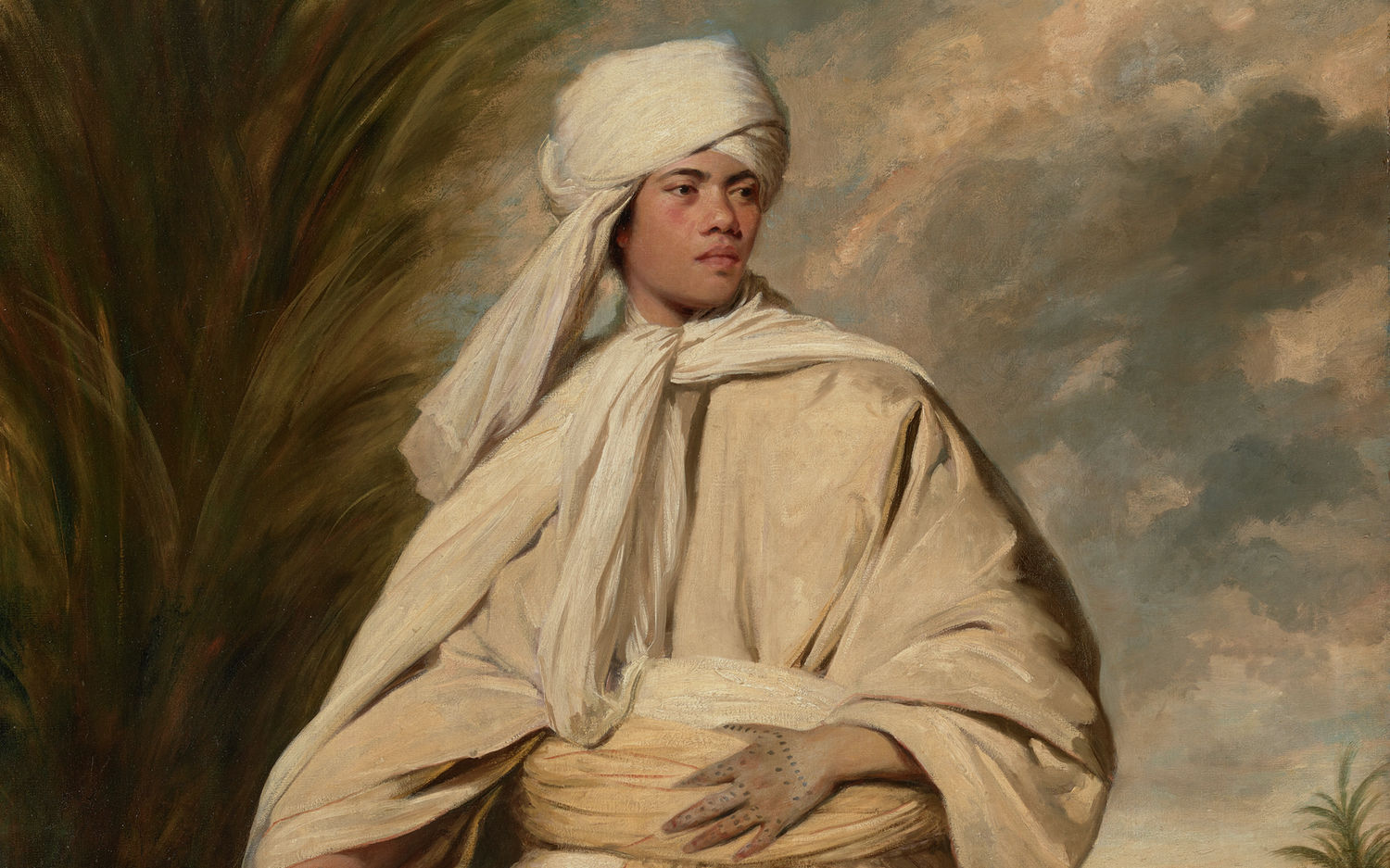
Mai’s umbilical connection to Tahiti was altered upon his journey to England in 1774. Intimately introduced into the inner circles of London’s elite, Mai became an admired and esteemed figure among English celebrities of the 18th century. One sees this sense of nobility in Reynold’s characterisation of him. Towering at seven feet tall, Mai is depicted as a figure of dignity and honour. He stands barefoot in adlocutio pose, left foot forward in striding motion, and hand elegantly outstretched as if on the precipice of speech. Renyolds, though working with oil, has rendered Mai as if sculpted. Inspired by the statues of Classical antiquity, particularly the Apollo Belvedere, Reynolds likens Mai to a Roman orator in his unfaltering, considered stance.

One of the finest society painters of Georgian England, and founder of the Royal Academy, Reynolds was accustomed to painting British elites from Dr Samuel Johnson to Laurence Sterne. That being the case, for Mai to have his portrait done by Reynolds was a feat of social advancement. Successfully transforming his status from ‘foreigner’ to noble, this one artwork demonstrates the capacity for aesthetic and cultural production to alter the social milieu.
“Reynold’s portrait seems a strange conflation of opposing cultures”
Yet Reynolds’ depiction of Mai is not without its wash of ‘exoticism’. A tropical landscape darkens behind Mai’s figure; palm trees loom in the shadows, and the riverbank glimmers under a dusky sun. Surprising is this choice to set Mai against his native homeland, considering that Reynolds himself had never travelled to the Pacific Islands, and thus could have only known its visual from indirect sources. Perhaps the painting shows is an attemptshowing attempt to pay respect to the Pacific culture. Adorning Mai’s hands are a pattern of traditional tatua (tattoo); this form of body art was, and still is, a powerful expression of identity for the Polynesian community, and the pride of this artform resonates throughout the Fitzwilliam’s exhibition. The same inked patterns can be spotted in the portraits of Tahitian individuals which hang on one wall of the room.
Draped in swathes of ceremonial robe, Mai’s high status takes on material signification in the form of his clothing. The heavy crease of the cloth suggests a luxurious thickness. Tied at the waist with a thick sash, and scraping the floor with wealthy length, the costume supplies Mai with a majestic grandeur. The cream-white colour of the cloth indicates it to be Tapa, a barkcloth made in the Pacific Islands, and used in traditional Tahitian dress. Yet an awareness of the European ideal seems inescapable; Mai’s white robes are also suggestive of classical Roman toga. Reynold’s portrait, then, seems a strange conflation of opposing cultures, native and new.
“No space in the room is without reference to Polynesian identity”
The SaVĀge Kʻlub, in their artistic response at the Fitzwilliam, have made efforts to work against Reynold’s idealism of Mai. Draped from floor to ceiling on one wall of the room is the same Tapa cloth which one sees on Mai in Reynolds’ portrait. Working with traditional materials, the contemporary artists have prioritised a faithfulness to historical accuracy. Moreover, the artists showcased in the exhibition, many of whom worked together on the project in Tahiti before transporting their creations to the Fitzwilliam, voice experiences from the same cultural background as Mai himself. Speaking to one of the SaVĀge Kʻlub artists, Rosanna Raymond, it became obvious that her connection to Mai was not confined to the museum’s one room of artwork. A shared cultural heritage was visible in her physical presence; her traditional tatau, her clothing and accessory, seemed artefacts themselves, extending the exhibition’s celebration of ‘ancestral roots’ into a present person.

Raymond explained the need to honour the “lived experience” of the Tahitian people. Recognising how Reynolds had smoothed over Mai’s heritage to satiate the visual appetite of a European viewer, the SaVĀge Kʻlub artists turn their focus towards a pride for a continuing Tahitian existence. No space in the room is without reference to Polynesian identity. The walls are pinned with artefacts and photographs of contemporary artists at work. Handmade doilies, printed with the phrase ‘Toitū te Tiriti’ (honour the treaty), are pinned on the walls as a nod towards a new wave of activism in Māori, calling for protection of the indigenous Polynesian people. The exhibition’s contemporary relevance allows historical artefacts to be dug out of the past into a politicised present. Even the wallpaper itself has been re-covered to embrace the cultural symbolism; the room, painted red, glows with rich colour. Laid on the floor under Reynold’s painting are two empty shells, almost positioned as an offering to the esteemed Mai. Collected around the room are tao’a (treasures) borrowed from the Cambridge Museum of Archaeology and Anthropology: wooden weapons, fans of pandanus fibre, and clubs carved with intricate silhouettes of native animals. Instruments, a bamboo nose flute and a shell trumpet, first acquired in 1769 on Captain Cook’s voyage to Tahiti, are displayed next to headwear and jewellery.
“Perhaps the idealism of Reynold’s portrait has clouded the facts of Mai’s heroic ‘Adventure’”
But the exhibition, as Raymond suggested, is “part serious, part absurd” in its examination of history. Juxtaposed against century-old artefacts are some rather comical trinkets. Action-man figures and plastic dolls are decorated in customary dress. A plastic gecko toy is placed next to a series of traditional shell necklaces. One contemporary piece, Tahe Drollet’s Natural Flavours, showcases a pooling surface of lucky charm cereal; in the middle of this sea of modernity, a wooden sculpture floats upon a rubber dingy. A humorously ironic comment on the convergence between Tahitian and Western cultures.
Whilst Mai’s life-story was in many ways one of loss and difficulty, having already experienced the death of his father before arriving in England, and meeting his own death soon after returning home to Tahiti, the SaVĀge Kʻlub show a determination to find room for celebration of his existence. Previous artistic accounts have only focused on what occurred after the departure from Tahiti which led Mai to his fame. Often disregarded are the twenty-two years of his life before he embarked on the HSM Adventure and entered European high society. Perhaps the idealism of Reynold’s portrait has clouded the facts of Mai’s heroic ‘Adventure’. Mai’s decision to travel to England was one of strategy; seeking to reclaim ancestral land and procure weapons for war, his journey was motivated by the conflict and capture which he experienced in Ra’iatea.
The SaVĀge Kʻlub reconciles this often-ignored part of history. Raymond expressed this need to prevent Mai’s Polynesian past from being forgotten. Mai, she implied, has “become incidental himself” in Renyolds’ portrait: a mere symbol for the noble foreigner whose individuality is irrelevant. The exhibition, as a dialogue between canonical and contemporary artists, holds a responsibility to honour not only Mai’s life in England, but his home in the Polynesian Islands. Walking into ‘Journeys with Mai’, one enters a chronicle which comprehensively traces a Polynesian past to its present existence.
