The interval is theatre’s weakest act
Barney Sayburn offers insight into one of theatre’s most iconic yet artistically uneasy aspects

Looking ahead to the ADC’s Easter programming, one title – or titles – rather catches the eye. Edgar Harding’s double bill of Sophie Treadwell’s Machinal and Susan Glaspell’s Trifles, marks a true CamDram rarity. Bar a 2024 Fitzpatrick Hall pairing of Prairie du Chien and Bugles at the Gates of Jalalabad (catchy!), this format hasn’t featured in recent student memory. Both stories depict societies in which female material power is stripped and their intuition undermined. Staged successively at the Corpus Playroom, the director promises they’ll be ‘feeding off of each other to create a whirlwind of passion and accusation’. It’s a clever idea, livening the experience of each individual piece by incorporating the other’s dramaturgy. In the eyes of the beholder, characters become rich symbols of figures yet to appear or who came before. And what captures my attention most of all, perhaps, is what happens in between:
The interval. It is commonly thought of as the bit of the evening when one stretches their legs and rinses their bank account for more overpriced wine. I’ve occasionally been guilty of such reductionism myself, but Harding’s ambitious plans have me wondering if we’ve ever seriously reckoned with the interval’s true potential – and equally, with its failures.
You may be aware of the fast-growing discontent with this convention. Recent articles in The Guardian and The Stage cover how intervals are on the decline in the West End, theorising that appetite for theatre has diminished in the post-pandemic era. Prospective viewers must apparently now be won over on promises of sensible bedtimes. The suddenness of the shift towards straight-through productions does suggest the effects of COVID-19 have moved the needle. However, I’d argue the grievances around intervals aren’t simply new or practical, but deep-rooted and artistic. I am sceptical that most directors divide a five-act Shakespeare into two wonky halves by choice. An adapter probably does not find it easy or optimal to stretch out Life of Pi so that Pi twiddles his thumbs for Act One before the shipwreck at the curtain drop (at last) gives him something to do. Moreover, the opening minutes of many an Act Two frequently feel like a passion project’s unpassionate interlude, as fluffy and expository dialogue lets spectators remind themselves of the plot and finish off their ice creams.
“I’d argue the grievances around intervals aren’t simply new or practical, but deep-rooted and artistic”
Intervals were born for audience convenience, which has left their dramaturgical purpose a little wanting. On the dim side, this tension appears to remain mostly unresolved. On the bright side, artistic challenges are resolvable from the inside. (Were the current interval dissatisfaction truly about impatient people worried over train journeys, the future of live theatre would appear grim indeed.) We could get our blessed break back for good! I’d argue the interval needs to be reimagined as a part of the performance: a change of pace but not a lull, a facilitator of continuity as well as a break.
Which leads me back to Machinal // Trifles. When the house lights rise on the interval of a double-bill, one needn’t play poker face. Something has been witnessed in entirety: no tight-lipped hedging, no withheld verdicts necessary. Commentary can ensue. Voices will pipe up to ask, ‘How will what we just saw relate to what’s next? ’ – a question more interesting for being less answerable. It demonstrates that plays can be successfully disjunctive and distinctive between acts. That is, so long as they lean into it and don’t simultaneously offer limp continuity cues in an unsatisfying compromise.
“The interval needs to be reimagined as a part of the performance: a change of pace but not a lull, a facilitator of continuity as well as a break”
For productions leaning the other way, into the continuity instead, immersion is the key. Cabaret’s ongoing London revival gets this right. It has triumphed, in part, for transforming the Playhouse Theatre into ‘the Kit Kat club’, the underground Berlin nightclub at the musical’s heart. The interval directly precedes the second-act’s dark descent into Nazi-era dread, yet one hardly has time to zoom out. You’re kept firmly in the first-act’s thrill-seeking world as burlesque dancers parade the auditorium and streams of haze billow into your nostrils. Of course, adjustments for most productions wouldn’t need to be so extravagant. Small sensory cues – projected images, a faint soundscape of conversation in the unseen hours between curtain-fall and curtain-rise – will suffice to keep an audience suspended in disbelief, while still free enough to nip to the loo.
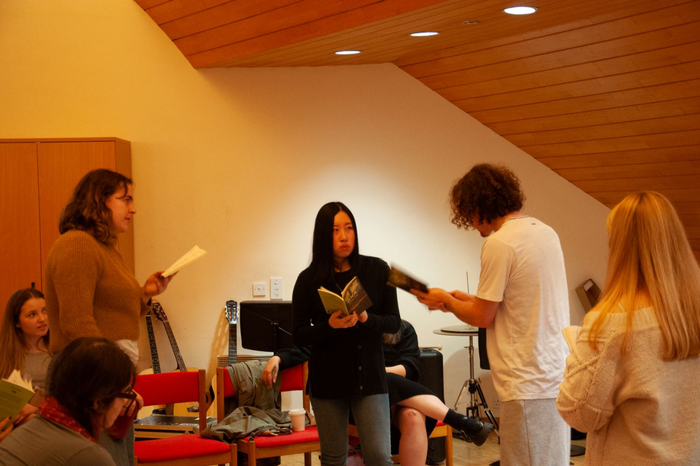
As small a matter as it seems initially, the interval’s window of opportunity is underutilised like no other popular theatrical device, and that negligence leads to plot problems. Theatremakers ought to fill the gap themselves through bold choices, rather than letting a text stretch over it and deform the tale in the process. This is even more true of student theatre, where the low risk-impact of creative ideas offers a unique opportunity for experimentation and outlandish direction. Harding’s upcoming double bill implicitly addresses the issue, but ultimately there’s a gap – an interval, even? – in the market here. Do mind the gap. If the interval is to be deployed it should be engaged with, treated as a miniature act of its own.
 Interviews / ‘You have to take it as it comes’: discussing content creation with Auden Barnes17 May 2026
 News / Science Park to ‘triple’ in size with £3bn investment21 May 2026
 News / Sons of imprisoned Saudi scholars urge Cambridge to call off deal with Saudi defence ministry22 May 2026
 Science / Forked over: dish-parity between college cafeterias17 May 2026
 Theatre / Crossing Points devastates the Corpus Playroom20 May 2026
 Sport / Fitzwilliam narrowly regain Cuppers trophy in tight affair with Selwyn22 May 2026
 Comment / The personal cost of reporting sexual violence at Cambridge22 May 2026
- News / Sons of imprisoned Saudi scholars urge Cambridge to call off deal with Saudi defence ministry22 May 2026
 Science / CamGraPhIC’s crusade to curb the AI energy crisis22 May 2026
 Film & TV / Hokum and the horror of guilt21 May 2026