Amadeus in the Chapel balances grandeur and intimacy
James Critchley argues this production comes alive with its arresting performances
Peter Shaffer spent his adolescence in pursuit of titanic stage performances. “London in the forties”, he recalls, “was like a city of Gods and Goddesses in one: it was the dwelling of the greatest actors in the world.” John Gielgud’s Richard II at Golders Green; Ralph Richardson’s Falstaff and Laurence Olivier’s “stuttering, frenetic Hotspur”; Peggy Ashcroft and Vanessa Redgrave’s innumerable star turns: the magnetising stage presence of these “master performers” became seared into the fledgling playwright’s consciousness. He would mourn, in the decades that followed, the recession of such arresting individuality onstage: “I know I will never see their likes again, anybody of that courage and daring and passion.”
“Leo Morad […] delivers a performance that is no less formidable than those of these illustrious predecessors”
No surprise, then, that his own work should be so drawn to epic central roles; mammoth parts that work to reinvigorate the forms of singular virtuosity that he so longed to recover. None is bigger than Salieri, and a glance at some of the names to have inhabited the role of Amadeus’ focalising protagonist gives some sense of its weightiness: Paul Scofield, Ian McKellen, F. Murray Abraham, David Suchet, Lucian Msmati.
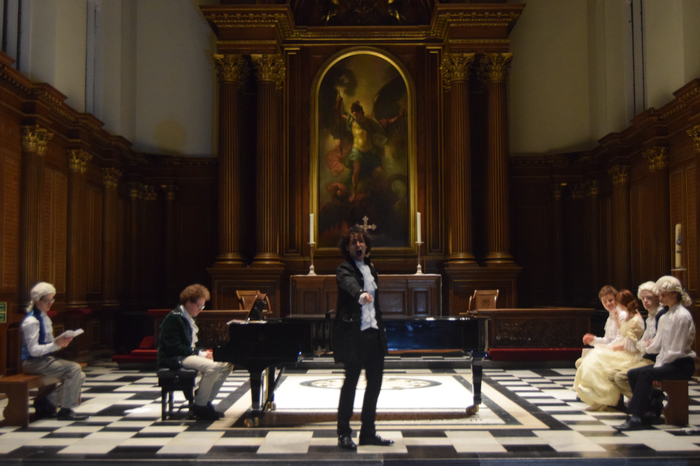
Leo Morad, in Theo Parkin’s production in the chapel of Trinity College, Cambridge, delivers a performance that is no less formidable than those of these illustrious predecessors. Performed in the centenary year of Shaffer’s birth, Parkin’s Amadeus is richly emotive, its venue lending fresh urgency to the play’s interrogation of the numinous process of artistic inspiration, the commerce between creation and divinity. At Morad’s first entrance, he is a picture of restless frailty; swaddled in a fusty cloak, frantically clutching a cane. When we see him last – after a bungled attempt at cutting his own throat – he is equally pathetic: helplessly consigned to the cool marble floor, quite literally shaking his fist at a God who seems to have abandoned him.
In between, Morad guides his assembled listeners through the dense story of Mozart’s rise and fall with stunning aplomb. He is, by turns, scheming, jealous, seductive, melancholic – stitching together the oscillating facets of his character’s inward being with captivating dexterity. His confessional soliloquies are intimately measured; their control standing in potent contrast to the shrieking giggles and squeals of Henry Jaspars’ brilliantly infuriating Mozart. Jaspars (who plays the piano throughout the performance with Mozartian skill!) is effervescently expressive: forever wildly gesticulating as he flits between ideas, lovers, royals – his manic presence shaking up whichever room he happens to have walked into.
“In light of the company’s sterling performances and the bountiful affordances of its setting”
Morad and Jaspars are ably supported by a tightly compressed ensemble cast. Isaac Sallé and Sam Whitby make for lively venticelli, the whispering gossips of the Viennese court, who Salieri relies upon for his intelligence. Davey Chattaway and Matthew Wadsworth are always amusing as von Strack and the Emperor respectively, infusing Shaffer’s campy satire of nobility’s fickleness with apt comic whimsy. Romola Goldfarb movingly plays Constanze, the helpless victim of Mozart’s self-destructive genius and decline into madness. A particularly painful moment comes as her husband, close to complete breakdown, sits vacantly at the piano: as she calls his name, he appears hardly to recognise her presence.
Parkin aimed at “a pared down, intimate study of Salieri’s confession”; and the setting throughout is generatively spare (a few benches and a piano facilitating the bulk of the action). Of course, this is to ignore the obvious grandeur of the production’s wider environs. Benjamin West’s sublime 1768 painting of St Michael binding Satan proves an imposing backdrop, aptly befitting the agonistic quality of Salieri’s spiritual torment. Helen Lyster’s costume design captures the glittery love of surfaces that pervades the life of Joseph II’s court: her wonderful conjuring of the rococo sees luscious jackets, waistcoats and white wigs donned throughout.
There is an amusing meta-theatrical gesture mid-way through the production, when a courtier asks Mozart whether he thinks an entertainment he has proffered is truly appropriate fare for a chapel. The same question, of course, might be asked of this production: my answer, in light of the company’s sterling performances and the bountiful affordances of its setting, is entirely in the affirmative.
 Interviews / ‘You have to take it as it comes’: discussing content creation with Auden Barnes17 May 2026
 News / Science Park to ‘triple’ in size with £3bn investment21 May 2026
 News / Sons of imprisoned Saudi scholars urge Cambridge to call off deal with Saudi defence ministry22 May 2026
 Science / Forked over: dish-parity between college cafeterias17 May 2026
 Theatre / Crossing Points devastates the Corpus Playroom20 May 2026
 Sport / Fitzwilliam narrowly regain Cuppers trophy in tight affair with Selwyn22 May 2026
 Comment / The personal cost of reporting sexual violence at Cambridge22 May 2026
- News / Sons of imprisoned Saudi scholars urge Cambridge to call off deal with Saudi defence ministry22 May 2026
 Science / CamGraPhIC’s crusade to curb the AI energy crisis22 May 2026
 Film & TV / Hokum and the horror of guilt21 May 2026