Improvisation is scary, but worth it
Barney Sayburn explains how conquering the fear and trying improv can make you a better actor
It is a strange phenomenon, but nearly every actor I know who isn’t part of an improvisation comedy group hates the idea of joining one. This isn’t because they dislike watching improv, but because they feel they lack the skill to perform it themselves. When I tell a castmate in rehearsal for a scripted show that I’m a proud member of the Cambridge Impronauts, their eyes bulge, their throat recedes, and they croak out, “Ooh, I could never do that.” Having encountered this response so many times in my first term here, I was beginning to worry that there was something I was missing, some scary part of improv no-one had informed me of, lurking around the corner…
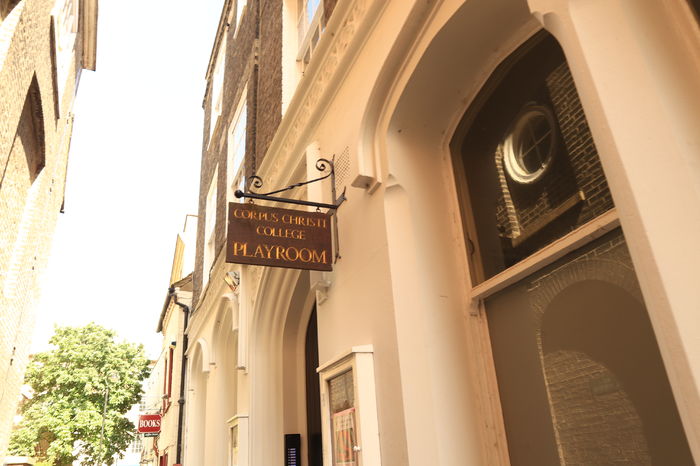
Then Lent term rolled around, and I chose to dive from the comfort of the weekly short-form members’ workshops into long-form improvisation at the Corpus Playroom. I’m now preparing to perform improv for the first time in Rushed Hour, a full-act-long, buddy-cop-themed Impronauts production. The challenge entails producing an hour’s worth of material by riffing on a small cluster of vague genre associations. These elements specifically strike fear in an actor’s psyche, and I confess that I discovered… I too am not exempt from the tremblings.
“Actors often claim to adore spontaneity, but the kind they prize still follows rigid lines”
Actors often claim to adore spontaneity, but the kind they prize still follows rigid lines. One can easily add a distinct pause, gesture unexpectedly, embellish a line with extra words here and there, if one has already been gifted a spotlight. However, without words assigned, an actor has no spotlight. In improv, we are forced to make them for ourselves. I quickly discovered with Rushed Hour that belonging to a long-form ensemble requires a lot of bravery and a lack of inhibition. Six people perform at once, stepping in and out of scenes at will, making up new characters on the fly and so on. Now, I could cope with the matter of ‘making stuff up’ when I had the space to play, in two or three performer workshop games. But this? In our first Rushed Hour rehearsal, my mind whirred: “Will I be interrupting if I say that? Someone will have a better idea. Eek, I’m not in it enough! But everyone here is definitely funnier than me – see, he just got a laugh – she’s already foreshadowing the next scene – oh, I should just abandon leading it to the rest of them and enter as the villain’s cat.”
This is all the more complicated by genre. When the curtains rise on a normal show, a majority of the mood-setting work has been done for the actors by an offstage tech crew. For a farcical comedy, the costume designers might fashion a sparkly jacket or a silly cone hat to don and boom, hilarity abundant the moment one waltzes on! For a cerebral drama, figures might be carefully cast over in glares and long shadows by the lighting designer and bam, doesn’t a monologue just sound serious? Well, in improv there is a tight budget and no-one’s role has been decided beforehand – not even slightly, as the initial characterisations and events take inspiration from audience prompts. Consequently, the technical support is minimal and the responsibilities of tone-curation fall to performers. In that first Rushed Hour rehearsal, as we attempted to rustle up buddy-cop feels, I felt myself grappling: “Do our Boston accents sound thick and contrived? Is it clear from my movements this is a high-speed car chase? Oh no, don’t cut a bomb wire, that’s cliche – oh no, don’t get confused over which colour wire to pick, that’s even worse. We must look completely cringe right now!” I left that rehearsal feeling very self-critical; it felt like no choice devised in the moment would be as good as one forethought.
“Suddenly my fears seemed ridiculous”
Yet in an instant it hit me; that was exactly the point. The audience, yes, are ideally meant to enjoy the story we create; appreciate the genre we homage, but they’re also meant to laugh at the trials – and errors – involved in assembling it on the fly. Suddenly my fears seemed ridiculous. What surprised me still, though, was that relinquishing control is something I’m meant to be good at. Directors are always pushing for actors to be present, to listen to scene partners, to forget what our faces are doing and play. If my instinct was to hedge myself here, in improv, I was also doing myself a disservice there, in the scripted world. And so too were the many improv-averse actors with whom I’d spoken, who feared it too. Their refusals to let loose were likely inhibiting the creation of collective creativity.
It appears to me that many actors have a naughty secret: they tend to forget their objective is not to perform perfectly, but to perform realistically. Being a part of the Impronauts (and Rushed Hour) is a journey I’m still learning from, but already it’s illuminated to me that giving oneself wholly to a project really does come at the cost of self-consciousness, and I don’t instinctively push myself to do that. Going forward, I’m working on doing that in both improvised and scripted productions. So, I’d encourage my fellow student actors to take that risk and step into scene – that is, the improv social scene – because you might learn something about yourself. Besides, affecting a thick and contrived Boston accent is actually quite fun.
 Comment / The Cambridge drift1 June 2026
 Comment / Top of the slops: the competitiveness of college dining4 June 2026
 News / Cambridge psychologist warns against blanket social media ban for under-16s1 June 2026
 News / University support staff strikes end after month of action2 June 2026
 Music / We need to talk about Kendrick2 June 2026
- Comment / Top of the slops: the competitiveness of college dining4 June 2026
 Interviews / Bible Scholar Mattie Mae Motl: “God is a woman”4 June 2026
 Features / One big happy (college) family?4 June 2026
 Theatre / Bold beginnings in the Corpus Playroom 3 June 2026
- Music / We need to talk about Kendrick2 June 2026