Austentatious is a roaring success
Nikita Vajrala revels in the chaos of this Jane Austen based improv at the Arts Theatre
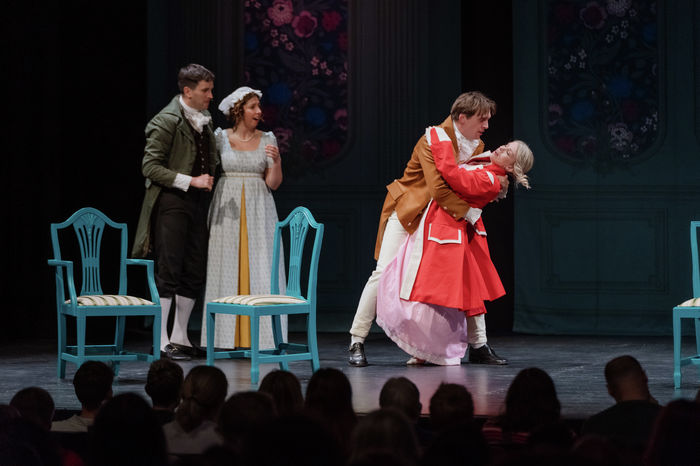
Austentatious: a witty pun that encapsulated this play, which is an impressive and confoundingly elaborate improvisation on Jane Austen’s novels.
Ostensibly (see what I did there?), Austen didn’t just write six novels, but over 900, and these undiscovered works exist only in the archives of the audience’s imagination. Members of the audience are encouraged to think of titles to shout out to the Austen Academic, a scholar versed in all her publications. Briefly outlined, and promptly rejected, suggestions included ‘Northanger Street’ and ‘Punts and Patience’, but it was ‘Harriet finds out who her parents are’ that was selected for stardom.
No two plays are the same. Each show is wholly improvised, a recipe for hilarious plot holes and unapologetic anachronisms, with a servant taking a vape break and the titular protagonist discovering her true origins before her upbringing at Jeremy Clarkson’s Diddly Squat Farm. The cast were a collection of brilliant, talented actors, including Charlotte Gittins as Harriet Clarkson, Graham Dickson as Michael Richards and Rachel Parris as Mary Hammond, to name a few. Props also to the stellar live pianist, Ed Zanders.
“Each show is wholly improvised, a recipe for hilarious plot holes and unapologetic anachronisms”
The play opens with bows of increasing deference between Harriet Clarkson and Cecilia Hammond as her sister, Mary Hammond, urges them to stop – ending with Harriet ludicrously prostrating upon the floor. It is then revealed that all three harbour affections for Mr Richards, an enigmatic and alluring character whose flower delivery to Harriet drives apart the trio. The two sisters also discuss the widespread suspicions of Harriet’s ancestry, or you might say lineage or … “quick what’s another synonym?” … ah yes, “herstory”.
Michael Richards is then introduced to us in the subsequent scene, engaged in a heated chess match with Marcus Gladwell. As they discuss Richards’ rumoured intimacy with Harriet, the conversation culminates in an intense, homoerotic staring match. This charged sexuality is taken further in Michael’s arousing adaptation of the macarena with the Reverend. I found Graham Dickson’s creation of Mr Richards particularly hilarious due to his endearingly awkward interactions with Harriet in opposition to the blatant homoeroticism with the male characters: a modern twist on the rigid sexual restrictions during the Regency.
Bizarrely, the audience’s glimpses of Michael’s loving connection with Harriet are third-wheeled by a llama that serves a pivotal role throughout the play, and not merely as a mode of transport; its later bilingualism enables the discovery of Harriet’s father’s secret scheme. The plot thickens as the first half mounts to the climax where Harriet’s mother professes that Harriet possesses the power to turn people to stone – an ability that necessitates her separation from Michael. I thought that this supernatural addition to the plot was peculiar and a difficult oddity to resolve, but the actors pulled it off spectacularly by making financial avarice the driver of the false accusation. The first half ends with Mary seizing her chance to marry the parish’s most eligible bachelor.
“The actors’ adaptability made the show a roaring success, with laughter from teenagers and grandmothers alike”
In the second half, five years have elapsed, years that felt like a 15-minute interval for the audience, and Mary and Michael are (un)happily married with a precocious three-week-old son. This son is miraculously able to form sentences and awkwardly reveal that “Dada loves Harriet”. However, Mary’s passion has run its course, and she confers her desires onto Marcus Gladwell. Harriet’s father’s underlying scheme is betrayed by Michael’s eavesdropping llama, as it is explained that she was abandoned at childhood to be found at Diddly Squat and live amongst the landed gentry, enabling him to claim her fortune if she remains unmarried. This surprisingly plausible motive in the otherwise senseless plot of the play was doubtless a product of that propitious 15-minute interval. Finally, the story culminates with a deus ex machina marriage of the two protagonists, with Michael getting a divorce from Mary, which would have made Austen (and Henry VIII) proud.
The actors’ adaptability made the show a roaring success, with laughter from teenagers and grandmothers alike. Their ability to incorporate wildly irrelevant Freudian slips into the plot was inspiring and hilarious to watch, and the troupe’s inclusion of contemporary references with the Regency backdrop created a comically pronounced disconnect between the period dress and far from historically accurate plot.
I highly recommend catching Austentatious in the West End or on tour, if you’re on the move. I was lucky enough to catch them in The Corn Exchange in Cambridge but they’re definitely worth the trip to London! If you see Austentatious you’re guaranteed an absurd, (loosely) Regency romance with witty rebuttals that’ll have you smiling even after you leave the theatre.
 Comment / The Cambridge drift1 June 2026
 Comment / Top of the slops: the competitiveness of college dining4 June 2026
 News / Cambridge psychologist warns against blanket social media ban for under-16s1 June 2026
 News / University support staff strikes end after month of action2 June 2026
 Music / We need to talk about Kendrick2 June 2026
- Comment / Top of the slops: the competitiveness of college dining4 June 2026
 Interviews / Bible Scholar Mattie Mae Motl: “God is a woman”4 June 2026
 Features / One big happy (college) family?4 June 2026
 Theatre / Bold beginnings in the Corpus Playroom 3 June 2026
- Music / We need to talk about Kendrick2 June 2026