Twelfth Night delights
Milly Kotecha reflects on this ‘genuine treat’ of a production

Marlowe Arts’ Twelfth Night opens exactly as you’d expect: the curtain rises, a ship is wrecked, and the plot is set in motion. Then, abruptly, a band is introduced, and the words ‘what you will’ are revealed to hang from the ceiling. This subtle shift re-frames the production: as the audience, we must make of Twelfth Night what we will.
I was immediately captivated by the humour that Theo Francis and Toby Trustred, playing Sir Toby Belch and Sir Andrew Aguecheek respectively, were able to bring out, particularly through their over-the-top physicality. In a play I find so genuinely funny, it’s always enjoyable to hear the audience laughing along with the drunken revelry playing out on stage, and I would attribute this to the cast’s excellent chemistry. A stand-out moment for me was the tricking of Malvolio, a scene delivered exquisitely by all performers involved. Though Eddie Adams (Malvolio) commanded the stage, the ‘conspirators’ still drew my attention, hiding behind potted plants and mimicking Malvolio in an explosion of liveliness and humour. Throughout the play, there was a strong sense of each actor being completely present onstage, which created a real sense of immersion.
“In a play I find so genuinely funny, it’s always enjoyable to hear the audience laughing along”
I was, in turn, touched by many of the moments of quiet emotion that the play’s actors brought out. Enya Crowley’s opening scene as Sebastian felt deeply tragic as they mourned the potential loss of their twin sister, despite taking place during a romantic encounter between Sebastian and Antonio (Max Parkhouse). With so many productions delicately circling around the undefined relationship between the two characters, I appreciated the commitment of director Michael Oakley in establishing their dynamic clearly.
That said, there were a few moments which brought about a disconnect. While Feste (Stella Williamson) was dressed in modern-style clothing, eating from a Kellogg’s box, Viola (as Cesario – H Sneyd) seemed to don Victorian uniform. This interplay between modern and traditional came through in some of the acting performances, too, making the time period difficult to place.
Credit must be given to lighting designer Christopher Nairne, who excellently matched the mood of each scene with a bold wash of colour. Where the staging faltered for me slightly was in the slightly unnecessary changes to the ‘what you will’. The lowering of the ‘w’s to hide behind made sense, but the continual removal and addition of a plant pot to the ‘o’ (which seemed to serve no purpose besides set dressing) soon became tedious. Similarly, the use of the ‘o’ as a sort of mirror for Viola and Sebastian to see each other through felt a bit on the nose, and in a production that veered away from stylisation, it felt out of place.
“This level of camp really suited the extravagant performances, and was delightful to watch”
Having said that, my favourite motif was the use of red heart balloons in every romantic scene. What began as three or four balloons falling from the ceiling suddenly became a blanket of balloons covering the stage at the end of the first act, with Malvolio happily dancing around and leaving delicate kisses on each. This level of camp really suited the extravagant performances, and was delightful to watch.
It would be a disservice not to mention Stella Williamson’s dulcet tones as Feste. Music was very much at the forefront of this production, and Williamson was given ample opportunity to bring Feste’s songs to life. While this worked for the most part, I do think that the ‘catch’ song with Sir Toby and Sir Andrew felt a little too clean and rehearsed for what was supposed to be a drunken trio whose singing wakes up the house.
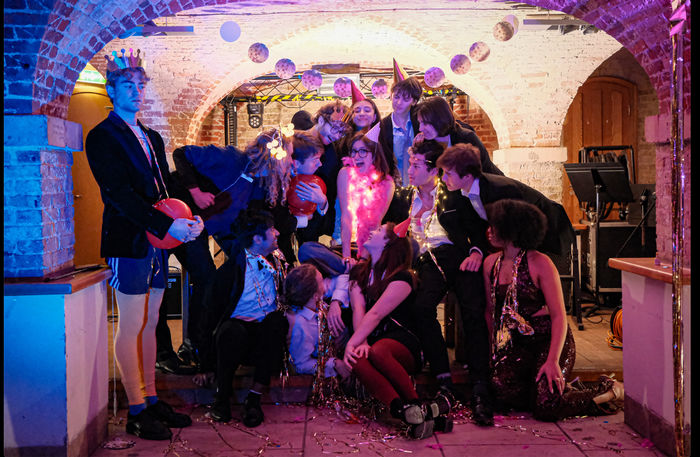
As the chaos of the final scene unfurled, and Feste closed the show with “a hey ho, the wind, and the rain,” I reflected on my miserable journey to the Arts Theatre in the rainy weather. But I did not leave miserable – rather, with the smile this joyous production left on my face. If I had to say one thing about Marlowe Society’s Twelfth Night, beyond its stellar performances and subtle motifs, it’s that it is a genuine treat to watch.
 Interviews / ‘You have to take it as it comes’: discussing content creation with Auden Barnes17 May 2026
 News / Science Park to ‘triple’ in size with £3bn investment21 May 2026
 News / Sons of imprisoned Saudi scholars urge Cambridge to call off deal with Saudi defence ministry22 May 2026
 Science / Forked over: dish-parity between college cafeterias17 May 2026
 Theatre / Crossing Points devastates the Corpus Playroom20 May 2026
 Sport / Fitzwilliam narrowly regain Cuppers trophy in tight affair with Selwyn22 May 2026
 Comment / The personal cost of reporting sexual violence at Cambridge22 May 2026
- News / Sons of imprisoned Saudi scholars urge Cambridge to call off deal with Saudi defence ministry22 May 2026
 Science / CamGraPhIC’s crusade to curb the AI energy crisis22 May 2026
 Film & TV / Hokum and the horror of guilt21 May 2026