All the world’s a stage
Barney Sayburn makes the case for site-specific theatre in Cambridge
Students in Cambridge are very lucky to have the ADC Theatre. It is both a fantastic venue and a (small but mighty) department of our university, acting as a powerhouse for young people to foster their creative voices. Beyond conservatoires, this provision remains largely unparalleled in UK higher-education institutions. Accordingly, the rituals of our theatre scene coalesce around it: pitching for, watching at, performing inside the ADC are obsessions of all camdram enthusiasts.
Yet amidst our gratitude, we might pause to consider the constraints imposed by this monopoly on stagecraft. Does the proscenium-arch stage of 6.67m x 11.1m not box us in, literally and figuratively? Does the main-show curfew of 22:30 not curb epic storytelling? Does the recycling of props, furniture, costume pieces and lighting rigs not muddy the vision at each new production’s helm?
Let’s unpack the mechanisms behind the ADC-ification of our amateur dramatics. If producers and directors ought to broaden their spatial horizons, how might we go about it? The architecture of this city tells a story of its own by virtue of sheer aesthetic brilliance. I’ll make a case for site-specific theatre, where the story on the page intermingles with the aura of the place in which it is staged.
“Can’t we go further, both stylistically and in our exploitation of scenic magic?”
Camdram does occasionally use our rich surroundings in this way. However, such efforts are currently Shakespeare-oriented. The Bard’s plays are performed outside during Easter term, gesturing towards the old-world feel of numerous college gardens. There are also upcoming adaptations of Hamlet and Measure for Measure in King’s and St John’s College chapels, as well as Twelfth Night in the newly-refurbished Arts Theatre. This trend persists because the Renaissance canon sells reliably. Prospective audiences recognise and enjoy these works, and since they’ve been reimagined so many times already, quirky settings become a welcome USP.
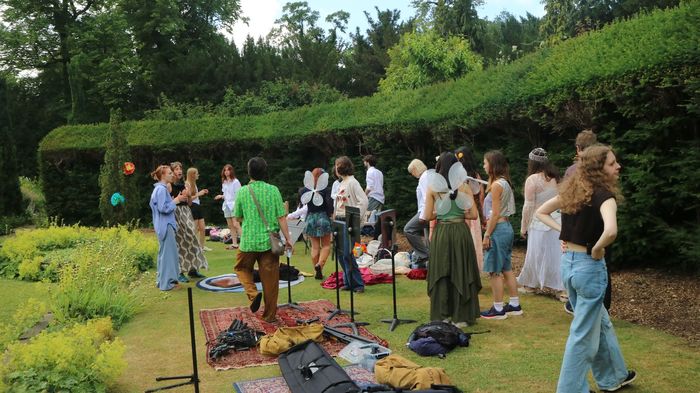
It disappoints me that this form of revamp is considered maximally adventurous. Can’t we go further, both stylistically and in our exploitation of scenic magic? Picture The Wind in the Willows staged along the backs: Mole punts down the Cam and disembarks at Trinity College, towering above as Toad Hall. Imagine Arcadia in the Wren Library: as Thomasina yearns for education, she gazes into Byron’s marble eyes and feels the binding of Newton’s original notebook. Visualise Antigone at Castle Mound: Creon speaks on high to all of Thebes, while beneath him the grief-stricken sisters plot beyond the city walls.
A great wealth of theatrical opportunity remains untapped in our environment. It begs the question, then, as to why it’s so often neglected. Unfortunately, for every opportunity a site offers, there’s also a constraint. How to license the location, to publicise without a trusted venue, to manage forgoing microphones, lighting, projection and special effects are all concerns outside of the ADC. Its tried-and-tested formulas sidestep these issues, and busy students often lack the capacity to resolve them. Hence, by the same token that productions risk being same-y, the lives of theatre-makers get substantially easier.
“Viewers are usually willing to forgive contrivances in the name of ambition”
Moreover, dramatists love drama (who’d have thought?), and competing to stage a show at the ADC is fabulously dramatic. When their pitch is crowned with a programme slot, the amateur creative feels a profound sense of reward: social status is elevated, rivals are defeated, and community is forged among the chosen few.
Nonetheless, I maintain that we can aspire to surmount these difficulties. Regarding artistic challenges, I would insist that creativity thrives under challenges. Need to show a time jump? Try choreography! Need a shift between night and day? Try practical lights! Need better acoustics? Try soundproof panels! Try moving the audience! Heck, even try megaphones! Without conventional tools, we are forced into inventive solutions. Even if they feel slightly contrived, viewers are usually willing to forgive contrivances in the name of ambition.
As for the political benefits of remaining ADC-bound, I can’t deny that site-specific theatre-makers forgo them. I would, however, remind these budding artists that humans are far better at perceiving direct cost than opportunity cost. That is, to say, we value the certainties offered by a given choice over the potentially better – but uncertain – things that might happen by choosing to do something else. It may prove deeply socially rewarding to successfully execute a creative risk.
Perhaps you, dear reader, are one of those artists, brimming with an idea you’re desperate to stage. So, I urge you to ask yourself: is there a spot in Cambridge that would be perfect for it? And, if there is, what will you miss if you don’t try?

 Interviews / ‘You have to take it as it comes’: discussing content creation with Auden Barnes17 May 2026
 News / Science Park to ‘triple’ in size with £3bn investment21 May 2026
 News / Sons of imprisoned Saudi scholars urge Cambridge to call off deal with Saudi defence ministry22 May 2026
 Science / Forked over: dish-parity between college cafeterias17 May 2026
 Theatre / Crossing Points devastates the Corpus Playroom20 May 2026
 Sport / Fitzwilliam narrowly regain Cuppers trophy in tight affair with Selwyn22 May 2026
 Comment / The personal cost of reporting sexual violence at Cambridge22 May 2026
- News / Sons of imprisoned Saudi scholars urge Cambridge to call off deal with Saudi defence ministry22 May 2026
 Science / CamGraPhIC’s crusade to curb the AI energy crisis22 May 2026
 Film & TV / Hokum and the horror of guilt21 May 2026