Learning from hometown theatre
Sophia O’Callaghan reflects on how The Georgian Theatre has shaped her understanding of performance
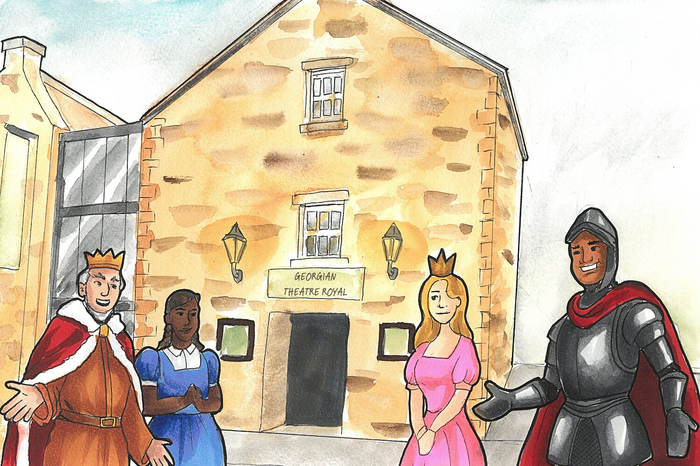
“It’s like a doll’s house in here!” These were the first words Tom Davis spoke upon gracing the stage of the Georgian Theatre Royal in Richmond, North Yorkshire. Granted, the man does stand at 6’7”, but the fact remains: the place is tiny. The Georgian (as my hometown lovingly abbreviates it to) seats just over 200 across three levels, meaning you can see every face that stares back at you, even under the harshest of spotlights. From Ian McKellen’s 80th birthday tour to my A-Level Drama devised piece, the oldest working theatre in Britain, tucked away in a small market town infamous for its equally small MP, has seen its fair share of performances. But what shapes these is not the shows themselves, but the special bond forged between audience and performer in such a unique and intimate space.
“Theatre and space are inherently interlinked”
Cambridge is not without its own fair share of intimate venues. I have stood level with audiences in Pembroke Cellars and walked and sat amongst them mid-show in Corpus Playroom. In the former, you can shape your audience however you’d like. Staples of student life that unite audiences, such as college chapels, gardens and even the Union, have been transformed into performance spaces like these, forcing their audiences to re-examine how they view them. Theatre and space are inherently interlinked, one and the same, each enhancing the other; it’s just that we only realise the true extent of this when we are familiar with them. The mystical forests of Shakespeare are easy to place in the idyllic gardens of colleges, while the incongruity of tragedy in the sanctity of a chapel allows for the drama to be heightened. These stages (including those which are not immediately seen as such) are begging for a director to take them and use them as a way for productions to challenge the role of the audience as a passive observer. My heart always soars with joy when I see an outlandish CamDram credit like ‘Olfactory Artist’ or ‘Blood Technician’.
This is where the Georgian stands out. In honour of their historically passionate audiences, the venue’s backstage doubles as a museum of theatrical artefacts. It’s not just the actors who are reminded of the space’s past, either, as the walls of seating boxes are lined with caricatures of 18th-century theatregoers: some jeer, some applaud, one is half-asleep, some connecting with each other just as much as they’re connecting with the play itself. Standing onstage today, you can meet their eyes just as you can meet the audience’s. Though I’m not calling for modern audiences to be invited to pelt performers with rotten tomatoes, there is space – especially in the relaxed environment student theatre provides – for performers to encourage their audiences to shrug off, the conventions of theatre etiquette we commonly abide by and see how it changes their relationship to what they watch. To do so is not even breaking convention, but rather returning to the conventions of old and thus living history itself. As a Classics student, I would be remiss not to mention that in ancient Athens, the birthplace of theatre itself, audiences could be similarly rowdy.
“It’s a truly heart-warming labour of love”
Perhaps this is best attested to with the well-loved tradition of pantomime. While countless pantos are performed up and down the country, if there’s one thing theatre at home and theatre in Cam have in common, it’s that they both know how to do it properly. That is, with community at its core. While the beating heart of a pantomime is its audience, becoming an entity in the show in their own right in a place with its own unique conventions, the Georgian takes it to another level, calling for its audiences to have a hand in the creation of props. Every year, crafters descend upon the theatre to knit and crochet small plushies to be pelted from even the galleries at the play’s villain in the climax of the show from (this year, it’s stars!), upholding a history of involved audiences in a perhaps more uplifting manner. It’s a truly heart-warming labour of love, with a sense of camaraderie otherwise only found in the ADC bar after a get-out. In both Cambridge and at home, it takes a village to raise the magic of panto, and it shows in a performance where the audience simply get to have fun.

In this way, intimacy in performance extends past the proxemics of a performer to their audience. It is equally found in the sense of community that is built between a theatre and its patrons. I carry a piece of the Georgian on every stage I stand on, and every show I do. I encourage you to do the same, too.
 Interviews / ‘You have to take it as it comes’: discussing content creation with Auden Barnes17 May 2026
 News / Science Park to ‘triple’ in size with £3bn investment21 May 2026
 News / Sons of imprisoned Saudi scholars urge Cambridge to call off deal with Saudi defence ministry22 May 2026
 Science / Forked over: dish-parity between college cafeterias17 May 2026
 Theatre / Crossing Points devastates the Corpus Playroom20 May 2026
 Sport / Fitzwilliam narrowly regain Cuppers trophy in tight affair with Selwyn22 May 2026
 Comment / The personal cost of reporting sexual violence at Cambridge22 May 2026
- News / Sons of imprisoned Saudi scholars urge Cambridge to call off deal with Saudi defence ministry22 May 2026
 Science / CamGraPhIC’s crusade to curb the AI energy crisis22 May 2026
 Film & TV / Hokum and the horror of guilt21 May 2026