
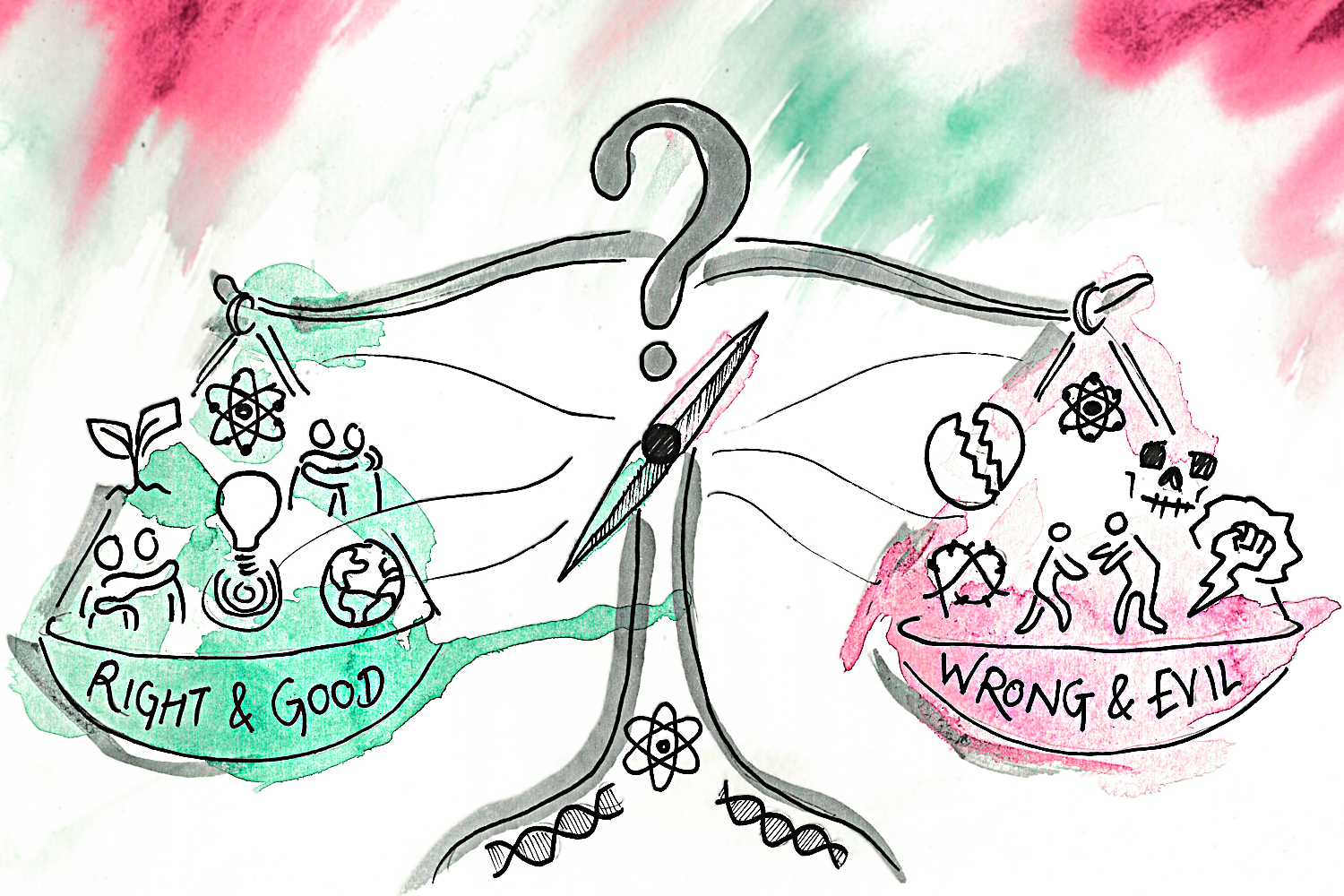
The idea that science can only tell us what is, but not what should be, is a familiar refrain both within and beyond the scientific community. Questions of right and wrong – of ‘good’ and ‘evil’ – are often treated as matters best left to personal preference, religion, culture, or philosophy. But the claim that scientific inquiry can provide no useful guidance in our pursuit of moral progress is absurd.
Here, ‘science’ does not simply mean a person in a lab coat handling test tubes and processing data. Rather, it refers more broadly to a rational, honest, and evidence-based approach to answering questions about the world. If morality concerns the experiences of conscious beings, then science has far more to say about moral questions than we often allow.
All possible goals in the moral sphere seem, ultimately, to depend on wellbeing. If Kant’s Categorical Imperative led only to needless suffering, few would consider it a moral framework worth defending. Similarly, the religious concepts of Heaven and Hell rely on the prior assumption that some states of conscious experience are better than others. Whether in this world or another, we are already making judgements about wellbeing.
“If morality concerns the experiences of conscious beings, then science has far more to say about moral questions than we often allow”
The existence of conscious subjectivity means that different individuals can experience positive and negative states of wellbeing. Any value we hold must, in some way, enter conscious experience. If having a moral compass means anything, it must involve some guide for acting in ways that improve, rather than diminish, the wellbeing of conscious creatures. Consider anything you value – justice, love, freedom, truth, beauty – and ask whether it could matter in a universe containing no conscious beings at all.
This argument rests on the assumption that conscious states are closely intertwined with the physical states of our brains. There is little evidence that the mind exists independently of the brain, and a great deal suggesting that our thoughts, emotions, perceptions, and suffering are rooted in physical processes. Of course, this assumption could be wrong. If convincing evidence emerged suggesting that the mind and brain are, in fact, radically distinct, a scientific worldview would have to adapt. But that would not prove that morality lies beyond rational inquiry.
If minds depend on physical states, then by studying the brain and human behaviour we can uncover truths about wellbeing. These truths can help us understand which actions, policies, and social structures are likely to improve or worsen people’s lives. We may not yet have the tools to answer every moral question with precision, but that does not mean moral values are permanently divorced from scientific investigation. The absence of a sufficiently powerful telescope does not mean that distant galaxies are beyond the domain of science in principle.
“A moral compass is not a mysterious faculty handed down from above, but a set of beliefs about how our actions affect conscious life”
It is often claimed that objective morality cannot exist without religion. Yet the existence of conscious minds, the possibility of greater or lesser wellbeing, and the use of evidence to understand how these states arise provide a framework for morality without relying on religious dogma or faith. When we say that the Nazis were wrong, we are not merely expressing a personal preference. We are saying that their vision of a ‘better’ society – built on the mass extermination of Jews, political opponents, disabled people, and others – was catastrophically mistaken by any measure of human wellbeing. The question, then, is: better by what metric? If the metric has no relation to the experiences of conscious beings, it is difficult to see why it should matter morally at all. A society that produces terror, pain, humiliation, and death is not simply ‘different’ from one that protects human flourishing. It is worse in a way that can be studied, described, and understood.
In his book, The Moral Landscape, neuroscientist and philosopher Sam Harris describes morality as a ‘navigation problem’: a way of guiding ourselves towards actions that improve the experiences of conscious individuals. In this view, a moral compass is not a mysterious faculty handed down from above, but a set of beliefs about how our actions affect conscious life. If certain actions reliably enhance wellbeing, and others reliably destroy it, then those facts matter.
This does not mean moral questions are easy. Nor does it mean that brain scans alone can answer them. Wellbeing is complex, shaped by biology, psychology, social conditions, culture, economics, and politics. But complexity does not place a subject outside the reach of evidence. Climate science, medicine, and economics all deal with complex systems, yet we do not conclude that there are no better or worse answers within them.
“If a society adopts customs that reliably produce suffering, fear, or deprivation, we should be willing to say that those customs are morally mistaken”
Were plantation owners mistaken in thinking that slavery was conducive to a better society? Are the Taliban mistaken in believing that preventing girls from attending school under threat of violence improves society? If our answer is yes, then we are already appealing to some standard beyond mere tradition or cultural preference. We are recognising that certain practices predictably damage the wellbeing of conscious individuals.
The divide between morality and scientific inquiry should not be as wide as it is often made out to be. A deeper understanding of the mind, behaviour, and society can help calibrate our moral compasses as we seek to improve the quality of conscious experience. Religion may continue to shape people’s moral language and motivations, but it is not the only possible foundation for moral reasoning – not when scientific inquiry exists. Nor should appeals to culture shield practices that cause demonstrable harm.

If a society adopts customs that reliably produce suffering, fear, or deprivation, we should be willing to say that those customs are morally mistaken. Moral relativism may encourage tolerance, but taken too far it leaves us unable to criticise cruelty when it appears under the banner of tradition. Future scientific advances will not hand us a perfect moral rulebook, but they can help us better understand what conscious beings need to flourish – and that knowledge may prove essential to moral progress.
