‘Mental illness doesn’t exist in a vacuum’ says Obsessive, Compulsive, Divine
Ahead of its run at the Edinburgh Fringe, Nika Akberlin speaks with Rachel Byrne about her new play currently showing at the Corpus Playroom

In her new play, Obsessive, Compulsive, Divine, writer and director Rachel Byrne shines a light on the lived reality of OCD (obsessive-compulsive disorder). I sat down with her to talk about the challenges of staging a war that takes place entirely inside the mind, the art of finding humour in heavy moments and what inspired her to take this story to the Edinburgh Fringe.
I open the interview asking Rachel what drew her to writing this particular play. She tells me: “When I was 11, I first had an intrusive thought that I was going to kill my mum, and it was one of the most terrifying experiences that I ever had.” After this, she shares the comforting and deeply resonating process of discovering OCD: “I’ve never heard of it before and thought people need to know about this in case they are also having intrusive thoughts like mine.” With a particular interest in examining shame and self-worth on stage, Rachel explains her thought process of wanting the play to be set “literally in the mind of somebody”, where each of their thoughts can become actual characters.
“Compulsions can be anything – they can be mental, they can be physical”
On misconceptions about OCD, Rachel shares that her best friend for a while thought OCD meant “obsessive cleaning disorder”. This is indicative of the media’s inadequate and poor portrayal of the condition, usually reducing its complexity to a simple cleaning habit. Rachel continues: “I believe some of the stigma is very ingrained about what OCD looks like and a lot of the understanding around it is about the compulsions; but there’s less understanding about the thoughts that drive those compulsions as well as how excruciating those thoughts are.” Furthermore, strikingly, the compulsions the protagonist Eileen has are not those typically portrayed: “because compulsions can be anything – they can be mental, they can be physical.” Rather than focusing on what Eileen is actively doing, the script seeks to put emphasis on the psychology behind the actions.
Rachel’s play not only explores Eileen’s experiences but also looks at the people around her, which has interesting implications on shaping the play’s inter-familial relationships. Eileen herself has a very low self-worth, which puts a strain on her relationship with her sisters. Rachel explores the impact Eileen’s emotional absence has on her sisters, which “makes them confront how they need her” and causes them to “feel guilty or angry about their own issues”. In families, everyone is going through their own individual experiences and struggles; this multifaceted portrait is a kind of an undercurrent through the play. Eileen is the protagonist but Mary and Toni, who are her sisters, are left feeling like: “What about me? You still have responsibility towards me, you still have a relationship. You can’t just leave me in the lurch.”
“I think humour is a useful form of coping and of getting through it – eventually it allows some distance”
When I ask what drew her to a comedic approach, rather than situating Eileen’s world in the tragic genre, Rachel explains: “I think humour is a useful form of coping and of getting through it – eventually it allows some distance.” The play balances the light and shade in an engaging way. Moreover, Rachel notes: “this is not a tragedy; this is somebody’s life that they are experiencing and it is sad, but it also doesn’t make them devoid of personality.” While the script spends a lot of time in Eileen’s internal consciousness, the production endeavours to show that her mind is not only characterised by OCD but is so much more than that.
The play is split between day and night, which is a structure intended to effectively visually contrast between how Eileen presents herself and what is actually happening in her mind: “[At night], in her head, we have her intrusive thoughts. In the day, we have her interactions with her sisters. The contrast allows us to see the development of her relationships alongside the deterioration of her mind.” As the interview draws to a close, I ask about staging this play at Edinburgh Fringe. Rachel responds: “The great thing about the Edinburgh Fringe is that there is a wide variety of people and I think because it’s a story about people, it’s very applicable to anybody – it’s not only about OCD.” Her play deconstructs how we hide things and how much we show that conflict between inner and outer world. She adds: “I think we can all relate to that. We can all sort of examine how much we let people in, how much we let people help us and to what extent selfhood is our own and relational.”
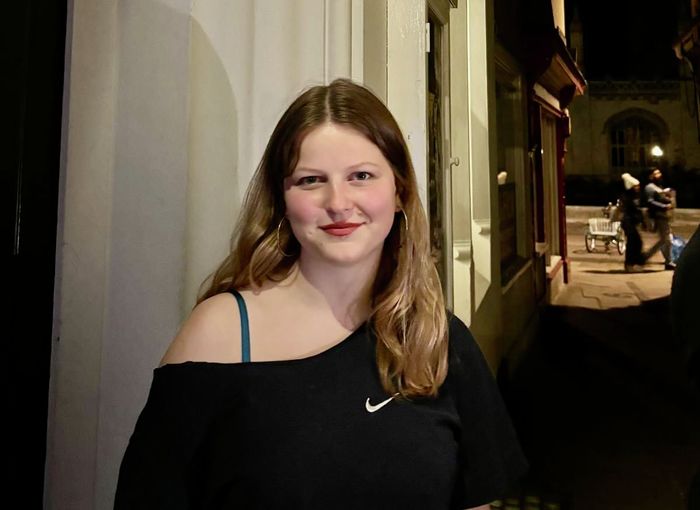
My final question brings the conversation to a close: “If audiences leave the theatre remembering just one thing about Eileen, what would you want it to be?” Rachel’s response is resolute: “Literally that mental illness doesn’t exist in a vacuum.”
Obsessive, Compulsive, Divine will be playing at the Corpus Playroom until the 20th June. It will also be playing this summer at The Drayton Arms (SW London) and Edinburgh Fringe (Greenside @ George Street).
 News / Simon Goldhill resigns following sexual misconduct investigation16 June 2026
 Comment / Exercise, academia, and the Cambridge addiction to both17 June 2026
 Theatre / A celebration of Queer Love in sacred spaces: Romeo and Juliet in Peterhouse Chapel16 June 2026
 Lifestyle / Breaking no contact…hours15 June 2026
 Comment / My favourite dance floor is the one with my friends on it15 June 2026
 Lifestyle / You can’t always get what you want 18 June 2026
 Theatre / ‘Mental illness doesn’t exist in a vacuum’ says Obsessive, Compulsive, Divine 18 June 2026
 News / Caius to begin antisemitism inquiry after Nazi symbol carved into bench18 June 2026
 Film & TV / Gen Z, FilmTok and the A24 problem17 June 2026
 Features / Are the Footlights getting dimmer?17 June 2026