The (not-so) silent killer
Pooja Gada explores how Cambridge’s everyday noise is quietly wreaking havoc on our health
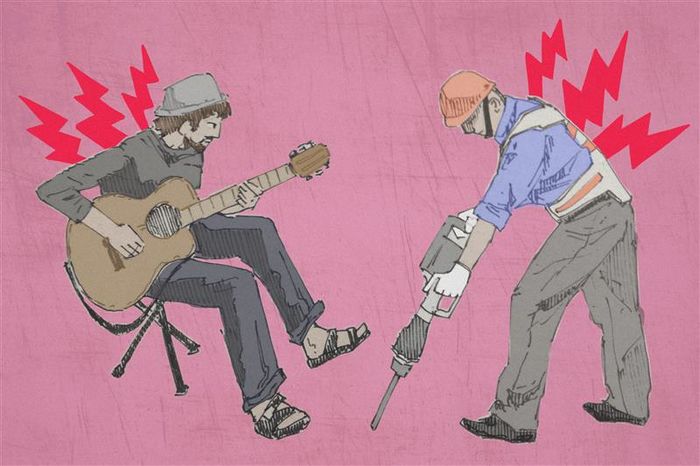
Ba-bam-bam-Ba-bam-bam. That’s the sound of the sweet ‘music’ I fall asleep every night to: the pounding bass of Rose Crescent’s infamous La Raza. And I am hardly the only casualty. Most Cambridge students endure a similar acoustic assault, from street buskers to house parties to construction work. Yet while we adjust, acclimatise, and adapt to our noisy everyday, our bodies are not so unaffected. In more ways than one, our bodies keep the score.
Our bodies are being exposed to sound levels they were never meant to withstand. According to the World Health Organisation, sustained noise above 55 decibels (dB) – about the loudness of a refrigerator or a quiet residential street – increases the risk of stroke, type 2 diabetes, and even dementia. (As I write this, La Raza is currently hitting 77 dB). Long-term exposure to noise has already been linked to 12,000 premature deaths and more than 48,000 cases of new ischaemic heart disease across Europe. In England alone, road traffic noise accounted for 100,000 Disability Adjusted Life Years (DALYs) lost in 2018, with one DALY representing the loss of one year of good health. Noise, in other words, is far more than a nuisance. It’s deadly.
“Sustained noise above 55 decibels (dB), about the loudness of a refrigerator, increases the risk of stroke, type 2 diabetes, and even dementia”
The damage extends beyond the physical to the cognitive. In children, a 2018 study found that aircraft noise was associated with poorer reading ability, weaker oral comprehension, and reduced long-term memory. Adolescents show similar vulnerabilities: a 2019 study reported that every 10 dB increase in traffic noise raised the odds of hyperactivity, inattention, and peer relationship difficulties. Noise may even affect reproductive health. A 2024 cohort study found that long-term exposure to noise in women aged 35-45 was associated with an increased risk of infertility, while other research has linked high noise exposure to adverse birth outcomes.
But how does noise actually harm us? Research suggests that when sound enters the auditory system, it can activate the brain’s stress circuits – particularly pathways involving the amygdala and the sympathetic nervous system. This activation triggers the release of stress hormones such as cortisol and adrenaline, initiating the body’s fight-or-flight response. While this system is designed to protect us in moments of real danger, repeated activation over months and years places sustained pressure on the cardiovascular, metabolic, and immune systems. Sleep offers little escape: even at night, the brain continues to register noise, and studies show that nighttime noise can fragment sleep and disrupt the body’s normal ‘repair’ processes from taking place. In essence, chronic noise exposure keeps the body in a low-grade state of alert, quietly wearing it down over time.
“A 120 dB rock concert is not twice as loud as a 60 dB conversation; it’s one million times more powerful”
Despite these harms being well-documented, noise is still not treated as a serious health issue. While air pollution and diet routinely appear on lists of major public health risks, noise rarely does – even though it affects far more people. Part of the problem is habituation: we think we’ve ‘got used’ to noise, but perception adapts faster than physiology. Our stress response stays switched on even when our awareness fades. To the body, there is no difference between a motorcycle revving outside our window and a lion growling in the dark; both activate the same fight-or-flight cascade.

Compounding this, the very system we use to measure noise obscures the true scale of harm. The decibel scale is logarithmic: every 10 dB increase represents a tenfold jump in sound intensity, and therefore in biological impact. A 120 dB rock concert is not twice as loud as a 60 dB conversation; it’s one million times more powerful. Yet legal reporting thresholds set by the WHO and other regulators sit far above the levels where health damage truly begins. The result is a world in which technically ‘safe’ noise saturates daily life while silently eroding our health.
Noise may be invisible, but its effects are anything but. We need to start treating it as the health crisis it has quietly become. Until then, I’ll be wearing earplugs.
 Interviews / ‘You have to take it as it comes’: discussing content creation with Auden Barnes17 May 2026
 News / Science Park to ‘triple’ in size with £3bn investment21 May 2026
 News / Sons of imprisoned Saudi scholars urge Cambridge to call off deal with Saudi defence ministry22 May 2026
 Science / Forked over: dish-parity between college cafeterias17 May 2026
 Theatre / Crossing Points devastates the Corpus Playroom20 May 2026
 News / King’s fellow excluded over sexual harassment allegations23 May 2026
 Arts / The modern, Cambridge ‘Paragone’23 May 2026
 Sport / Fitzwilliam narrowly regain Cuppers trophy in tight affair with Selwyn22 May 2026
 Comment / The personal cost of reporting sexual violence at Cambridge22 May 2026
- News / Sons of imprisoned Saudi scholars urge Cambridge to call off deal with Saudi defence ministry22 May 2026