‘Friendly’ foxes – are urban foxes becoming self-domesticated?
Laura Verdina explains the evolutionary reason these furry scavengers have become so common in Cambridge
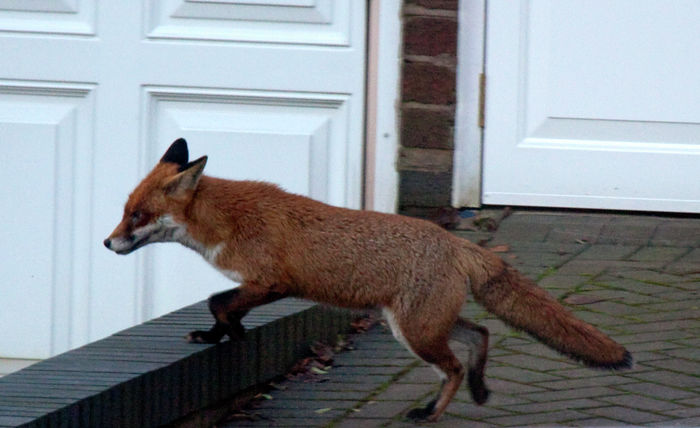
One evening in Michaelmas, on the way home from a supervision, I spotted a red fox leaping bravely out of the bushes onto the pavement five metres in front of me. Foxes are mostly nocturnal, so this encounter was made even more odd by the fact that the sky had only just started turning dark.
Whether you’re on your way to Sidgwick Site for a 9am lecture or walking home from a late-evening supervision, crossing paths with a fox in urban areas such as central Cambridge seems to be becoming more common. Could this phenomenon be explained by evolutionary change?
The increasing presence of the red fox, Vulpes vulpes, in urban areas may be a result of foxes undergoing ‘self-domestication’. Domestication is a term used to describe the evolutionary change which happens when one population (such as humans) is controlling another population, by selecting for favourable features or managing the growth of the population.
“Prominent theories suggest both humans and cats evolved partly through self-domestication”
One example of a domesticated species is chickens, which were domesticated from red junglefowl. This leads to heritable changes in both the behaviour and physical characteristics of the members in the population being managed. On the other hand, self-domestication occurs when this selection is self-imposed.
Reduced aggression is one of the main traits selected for during the process of animal domestication. Along with this selection, it is common to find that other morphological changes occur too (such as reduced brain size and loss of pigmentation). This range of features which can occur during domestication is called the ‘domestication syndrome’.
Foxes are not the only animals suspected to have undergone self-domestication. Prominent theories exist which suggest both humans and cats evolved partly through self-domestication. In the case of cats, some sources claim that they chose to begin living near prehistoric human settlements (which happened to attract a lot of rodents, providing an easy food source for the cats). A similar situation could be happening in the UK with urban fox populations.
So, what evidence exists for the self-domestication of foxes? Both morphological and behavioural changes between rural and urban red foxes have been documented. One 2020 study found changes in skull structure, which show that urban foxes have shorter snouts and smaller brain cases than their rural counterparts.
“The next time you spot one of these furry red creatures roaming around your college, remember it is still a wild animal – no matter how friendly it may appear!”
These trait changes correlate with the domestication syndrome previously discussed. For an urban fox, this shorter snout may in fact be an advantage. Shorter snouts may lead to a slower jaw closing speed. However, as these city foxes are more likely to be scavenging on stationary piles of food, as opposed to live prey, there is less of a need to maintain a fast speed of jaw closure. Additionally, it is energetically less expensive for these city foxes to have a short snout instead of a longer one.
Another 2020 study found urban foxes exhibit bolder behaviour in response to novel food objects when compared to rural foxes. This supports the idea that foxes may be self-domesticating and becoming less afraid of unfamiliar urban environments in order to find easy sources of food. Their increasingly friendly behaviour towards humans may be proof of their self-imposed selection of traits which help them adapt to their busy urban environments.
Despite these pieces of evidence, the consensus remains that the UK’s urban foxes have not yet abandoned their wild roots. Although they are beginning to display signs of domestication, Dr Blake Morton, who authored the study on behavioural changes in urban foxes, believes that foxes will not be domesticated for many years to come: “definitely not within our lifetimes, and it wouldn’t be for many, many generations.” The next time you spot one of these furry red creatures roaming around your college, remember it is still a wild animal – no matter how friendly it may appear!
 Comment / The Cambridge drift1 June 2026
 News / Cambridge psychologist warns against blanket social media ban for under-16s1 June 2026
 News / University support staff strikes end after month of action2 June 2026
 News / News in Brief: Corpus climbing, climate cash, and commendable contributions1 June 2026
 Music / We need to talk about Kendrick2 June 2026
 Comment / Top of the slops: the competitiveness of college dining4 June 2026
 Interviews / Bible Scholar Mattie Mae Motl: “God is a woman”4 June 2026
 Features / One big happy (college) family?4 June 2026
 Theatre / Bold beginnings in the Corpus Playroom 3 June 2026
- Music / We need to talk about Kendrick2 June 2026