Let it grow: mistletoe comes to town
Laura Verdina explains why populations of this evergreen parasite are exploding in Cambridge
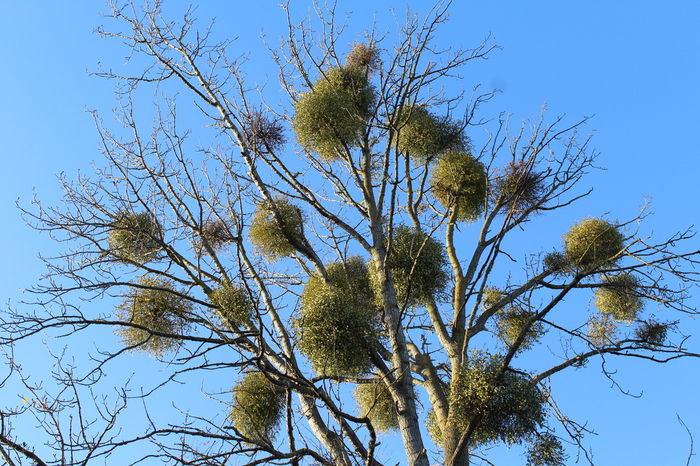
The evergreen mistletoe plant is now a common sight around Cambridge, characterised by green spherical clusters among the branches of another tree. This festive plant is linked to ancient Nordic mythology, with the tradition of ‘kissing under the mistletoe’ becoming popular in the UK around the 1800s.
The fact that it stays green over winter amidst the barren branches of its host tree links it with symbolism of fertility and life – this is potentially why it is considered good luck to kiss beneath it. However, some evidence suggests that these leafy growths weren’t always so common in this area of England.
“Mistletoe is hemiparasitic, meaning it is able to photosynthesise independently, but relies on a host tree for other nutrients, including water and minerals”
Traditionally, mistletoe was located in open green spaces with lots of light, such as orchards and parks in south-west England. Mistletoe is hemiparasitic, meaning it is able to photosynthesise independently (hence the need for ample light), but relies on a host tree for other nutrients, including water and minerals. Trees which are parasitised by many dense mistletoe clusters are at risk of dying: the more nutrients the tree loses to mistletoe, the weaker it becomes.
Over the past 20 years, studies have reported that mistletoe populations are “increasing explosively in Cambridge”, based on surveys which analysed both the number of trees parasitised by mistletoe, as well as the total number of clumps found across all trees counted. In 2009, over 1,500 clumps were found around the city, and a more recent initiative in 2017 was launched aiming to find out whether the species has continued to spread across the city. This initiative, part of the larger NatHistCam project, found “unexpected amounts” of mistletoe.
To support this data, a 2022 article used computer modelling to predict how distributions of mistletoe could change across Europe with differing temperatures. It found that the potential range of mistletoe will shift in a north-eastern direction; this modelling approach complements the earlier surveys conducted which found increases in the amounts of mistletoe in Cambridge, a region which has historically not seen high numbers of the plant. Combining the results of the computer modelling with the real-world data collected explains the shift in distribution of mistletoe from South-West England and Wales towards regions of eastern England, such as Cambridge.
“Next time you receive a kiss under a bush of mistletoe in Cambridge, thank a Blackcap for planting it there”
What could be causing this unusual increase of mistletoe? It is possible that climate change is to blame. Blackcaps are a species of migratory bird particularly effective in ‘planting’ mistletoe onto trees – once a Blackcap eats the mistletoe berries, it can wipe the seeds off of its beak and leave them on the branch of a tree. This has the impact of either increasing the number of clusters present on an already infected tree, or even transplanting mistletoe to another tree altogether.
Since Blackcaps are migratory birds, their usual behaviour is to migrate to the UK around summer then return south to continental Europe in autumn. However, one study showed that between 1981 and 2011, the number of Blackcaps remaining in the UK over winter has increased by 57%. It’s most likely that milder winters caused by climate change have led to this change in bird behaviour.
As the UK climate continues to get warmer in the coming years, we can expect further spread of mistletoe into the North-East of England. Factoring in to this the Blackcap’s ability to spread mistletoe and its increasingly frequent tendency to overwinter in England allows us to paint a clear picture of how, and why, mistletoe distributions are changing across the UK. The next time you receive a kiss under a bush of mistletoe in Cambridge, thank a Blackcap for planting it there!
 Comment / The Cambridge drift1 June 2026
 News / Cambridge psychologist warns against blanket social media ban for under-16s1 June 2026
 News / University support staff strikes end after month of action2 June 2026
 News / News in Brief: Corpus climbing, climate cash, and commendable contributions1 June 2026
 Music / We need to talk about Kendrick2 June 2026
 Comment / Top of the slops: the competitiveness of college dining4 June 2026
 Interviews / Bible Scholar Mattie Mae Motl: “God is a woman”4 June 2026
 Features / One big happy (college) family?4 June 2026
 Theatre / Bold beginnings in the Corpus Playroom 3 June 2026
- Music / We need to talk about Kendrick2 June 2026