Medea at the Cambridge ArtsTheatre
According to the programme notes for Medea, theatrical “directness and vitality” were the proposed governing principles of the fledgling Cambridge Greek Play at its inception in 1882, and Annie Castledine’s production of Euripides’ tragedy, performed in the original language of a 2,500 year-old text, possessed those qualities in abundance. By choosing to incorporate additional onstage seating, while also making use of a thrust stage which intruded into the comfortable sanctity of the audience, Castledine’s production achieved an immediacy of staging which provided an appropriate platform for the representation of the raw, uncompromising emotions which we associate with Greek tragedy.
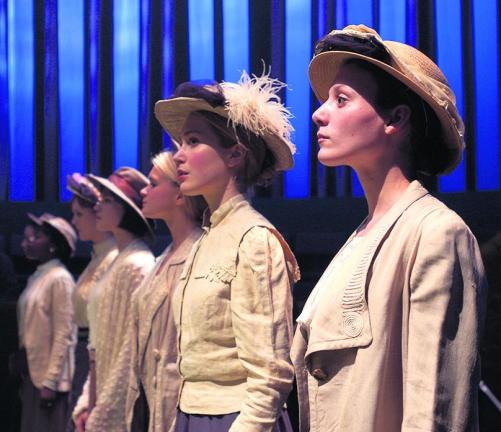 By setting her production in 1912 England and by casting the chorus as a group of suffragettes, Castledine had clearly opted to highlight the play’s concern with ideas of female liberation. Regularly hitching up her dress and continuing to enjoy a lingering frisson with Jason, Marta Zlatic’s Medea was a sexual force of nature and a purveyor of a rebellious sexuality, which the prudish suffragettes could only marvel at and occasionally avert their collective gaze from. In contrast to the “civilization” of the Greeks, Medea is a “barbarian” and, as an outsider in a foreign land, her situation was a metaphor for the alienation of women in a patriarchal society. In Castledine’s hands, she became a kind of feminist Prometheus, desperate to be unbound, and achieving liberation only through the most savage of means, by killing her children to revenge her husband’s infidelity. Misha Verkerk as Jason single-handedly captured the arrogant masculinity of Greek society (quick to dismiss women as mere sex-fiends) while it is the unfaithfulness of men, rather than women, which is asserted by Medea. In this sense, Castledine’s production was fascinated with the exploration of feminine liberation, whilst also testing its parameters.
Stylistic representation was always going to be of particular importance, and the cast, under the guidance of Castledine and collaborator Clive Mendus, achieved an impressively bold stylized physicality. The chorus, always exhibiting great physical poise, moved in a shoal-like group whilst speaking many of their lines in an exaggeratedly singsong tone, and throughout the production achieved an impressive solemnity of rhythm. This, in turn, was complemented by the actual music provided by an onstage trio of musicians. The language barrier was easily hurdled by the talented cast. Robert Lloyd-Parry’s Aegeus even achieved a comic warmth of characterisation, appearing as an old English duffer, in spite of the Greek. Virginia Corless, as the Messenger, gave the story of the princess’ death by poisoning an exhilarating breathless vitality. Most importantly perhaps, Marta Zlatic and Misha Verkerk as Medea and Jason showed an effortless command of the language, and their final showdown after Medea had killed her children was as powerful and heart-wrenching as anything I have seen performed in English.
This was an innovative, assured and poetic production, not to mention an impressive feat, for which all involved deserve enormous credit. It could perhaps have had more of an impact if the protagonists’ operatic emotions had been turned up a notch or two but, all things considered, it was a rare treat for a Cambridge audience.
Ed Rice
FOUR STARS
 News / Missing Sidgwick sculpture spotted in Oxford 1 April 2026
 Features / Hyper-productive or healthy? The rise of wellness culture at Cambridge1 April 2026
 News / Record-breaking £190 million donation will fund new Cambridge School of Government2 April 2026
 News / Homerton plans to convert former Labour Club into student accom1 April 2026
 News / Downing law society banned from holding formals in College for a year31 March 2026
 Fashion / A taste of the glamorous life4 April 2026
 Lifestyle / Take a punt, and try canoeing!3 April 2026
 News / Cambridge alumnus Matt Brittin appointed BBC director-general3 April 2026
 Arts / In defence of decorative poetry3 April 2026
- News / Record-breaking £190 million donation will fund new Cambridge School of Government2 April 2026